3/3/12

Dendron Considers Coal-Fired Plant (again): Short Term Benefits versus Long Term Effects


Photograph of Beth Roach, guest writer for this post.  My friend from Surry  County, Virginia, she is fighting the proposed  coal-fired electric plant in the town there of  Dendron.   She says she was privileged to be born and raised in this special place called Surry, that the ability to explore the wilderness, play outdoor athletics, and swim in the James River strongly influenced her life.  It was such inspiration from her surroundings that led to her career encompassing historic interpretation, environmental education, and natural resource conservation. She descends from the Nottoway Indian Tribe, which she is an enrolled member.

*

Monday, March 5, citizens in Surry County will again be asking Dendron Town Council to block Old Dominion Energy Coop (ODEC)'s proposed  coal-fired electric plant that will overshadow the tiny town (population 200) at a  time when other states are deciding that new coal-fired plants are NOT a good idea.  As scientist Mark Jacobson  has written:
The best ways to improve energy security, mitigate global warming and reduce the number of deaths caused by air pollution are blowing in the wind and rippling in the water, not growing on prairies or glowing inside nuclear power plants.
And "clean coal," which involves capturing carbon emissions and sequestering them in the earth, is not clean at all....
This follows on a hearing before the Surry County Planning Commission on February 27, which my friend in Surry, Betsy Shephard critiques:

One of the things that came out of last week's Planning & Zoning hearing (besides the fact that out of 350 attendees, only 7 residents spoke in favor of the coal plant....more on that another day), was that finally there would be an official recommendation that the Town of Dendron commission a 3rd party study.
I asked another friend, Beth Roach, who attended the the hearing to write a guest post on what happened.  She says the views expressed here are her own, yet she hopes that many others will consider both sides of the argument and listen to their consciences...and their hearts.

So, I now turn this page over to Surry native Beth Roach..

~:~

 All I ask is for them to consider both sides. The powers that be in Surry have made it no secret that they are through hearing arguments and ready to vote, pass, and cash those checks. Numerous testimonies by local residents, environmental non profit groups, and regional neighbors have fallen upon deaf ears. While a lot of locals have been a part of the fight for several years, there are others who are joining the opposition everyday. They are dismayed at the harmful effects that this process - from mountain top removal to coal combustion to fly ash storage - creates. They have difficulty understanding why the decision makers don't take this information seriously. The short term benefits are risks, speculations, projections, and assumptions. The term "state of the art technology" has been ODEC's flagship phrase to assure people that no harmful effects will exceed the government's regulations. This isn't good enough. There are many case studies that disprove this logic. I bet this approach has been used every time a plant has been built. Yet, each plant eventually has its problems. Safety records are well kept secrets; ask anybody who has worked at a power plant. They can tell you that "hiccups" very rarely make the paper. Unless ODEC has some super powered crystal ball with a %100 success rate, they can't forecast the future. Nor does this approach address the known problems associated with the amount of pollution that IS allowed under current regulations. What does it boil down to? We can show empirical evidence about why and how these emissions are so harmful. We can demonstrate how the air, water, and land will suffer throughout time. We can plead by reminding them that we are a part of the same community. That to serve the earth IS to serve man. Yet, we are forced to sit back and watch this coal plant move forward as if this stuff doesn't matter. Is it that more environmental education at a young age is needed? I believe so. An enormous amount of evidence has been presented, yet if people don't have the foundational knowledge of how this relates to the community at large then the evidence won't matter to them. Perhaps they do understand the science and chose to ignore it? I don't have a cure or a lesson plan for that problem. My closing thought comes from my mother, a reading teacher, and my aunt, a media specialist (modern term for school librarian) for Surry County Schools. Both want to share this piece of wisdom from the Lorax to the planning and zoning commission, to ODEC, to the board of supervisors, and to the Dendron Town Council: Unless someone like you cares a whole awful lot, nothing is going to get better. It's not.

2/25/12

Zen and the !@#Oof!* of Journalism Impact


Illustration from Rio Carnival Services.  Over a year ago DigiDave David Cohn) decided to revive the idea of a group of journalists getting together once a month to write in depth about the same topic, directed by a different host each time. Steve Outing, February carnival host publishes a roundup  with links to  posts by my fellow carnies. 

*

For the February Carnival of Journalism, our host Steve Outing asks,
What emerging technology or digital trend do you think will have a significant impact on journalism in the year or two ahead? And how do you see it playing out in terms of application by journalists, and impact?

The first definition of  "impact" in the dictionary is "collision" not "effect." 

When Steve raised his question,  I had visions of the Hadron Collider, of accelerating particles banging into each other at great speed "in hopes of grabbing a piece of the primordial fire, forces and particles that may have existed a trillionth of a second after the Big Bang," as physicist Dennis Overbye put it in the New York Times.

For particles substitute tweets and facebook posts and cell phone text messages and pictures and videos, all coming at journalists faster and faster. 

Rather than trying to predict the next killer app, let me give an example of how twitter has democratized the news, not during the Arab Spring or the Occupy movement, but earlier in time and closer to home.

Twitter and the Appalachian Winter of December 2008.

We've always had trouble in this region getting the news out except in the case of mining disasters where lots of folks die.  Right now, we're coming up on the fortieth anniversary of the Buffalo Creek flood.  125 died after the coal company turned down the sheriff's offer to warn people to get to higher ground when the rubble used to dam Buffalo Creek  started to fail to hold back 132 million gallons of  coal slurry.

Then in  Martin County Kentucky we had another sludge spill on October 11, 2000,  which dumped 300 million gallons. Somehow no one died.  As in 1972, the sheriff was taking orders from the coal company, this time deputies turned away media on the road leading  in to the flooded area.   Although there were reports in the Lexington and Martin County papers and on their websites (and in the New River Free Press, which I authored)  the New York Times waited to write about the spill  until Christmas Day that year.

You might not  recall reading about it.  After all, by then it wasn't really news.  Compare that to the coverage of 11 million tons of oil spilled in 1989 by the Exxon Valdez and the images that it still brings to mind.

How twitter changed things

December 22, 2008,  525.2 million gallons of coal ash sludge  at TVA's Kingston coal-fired power plant ruptured the dike of a 40-acre holding pond and covered 400 acres up to six feet deep, damaging 12 homes and wrecking a train.

This time new media and citizens in the area were able to amplify their reports by tweeting.  I remember, at first, the moderator on a coal list serve chastised me for posting the links.  Then, a story appeared in the New York Times by December 24.  The list moderator apologized.

There's the old saying about a tree falling in the forest and, of course, a lot of trees are still falling without the larger world hearing.  There are still plenty of stories that are important to tell, but which haven't accumulated enough quantum mass to reach a broad public.

SAMPLER:  A case of digital journalistic optimism

Like Steve, I'm a "digital optimist."  There are many emerging apps that journalists are embracing, as evidenced by those written about by my fellows in the Carnival and discussed this past week at the Knight Foundation's Media Learning Seminar. That's why I've started work on a new media alliance for our region:  SAMPLER--Southern Appalachian Media Project for Literacy on Environmental Renewal.

We plan to strengthen regional coverage by creating an alliance of  journalists and citizens to provide in-depth reporting on regional topics including sustainable development and transition from dependence on the mono-economy of coal mining, especially the destructive practice of mountaintop removal, as well as a mechanism to crowd source such efforts and critique coverage that is biased or stenographic. You can read more on SAMPLER here. You can make a tax deductible donation designated for SAMPLER to the Ohio Valley Environmental Coaltion at RAZOO..

With  SAMPLER, we're not waiting for the next killer app, although, should it arise, we'll figure out how to take advantage of it.  Rather, we're looking to
find new ways to convey information and news by using existing platforms and human networks.  You know, friends, neighbors, libraries, local citizens groups, email lists.  I'd say mobile phones, but we have lousy reception many places in Appalachia.

What the Big Bang theory means for digital journalism

Steve urges how it's important not be "caught blind-sided, again."   An older friend tells me she always remembers what Dear Abby, or perhaps Ann Landers,  advised when someone was afraid it was too late to pursue a new path:  time will pass whether you make changes or not.

The Big Bang Theory posits a universe starting  small, hot and dense, which has since expanded into something vast.  We're finite individuals and it's tempting to get overwhelmed   trying to figure out what's coming next.  In such vastness, though, there is also space to choose, room to chill.

2/7/12

Good Night, Irene


Dear Irene,

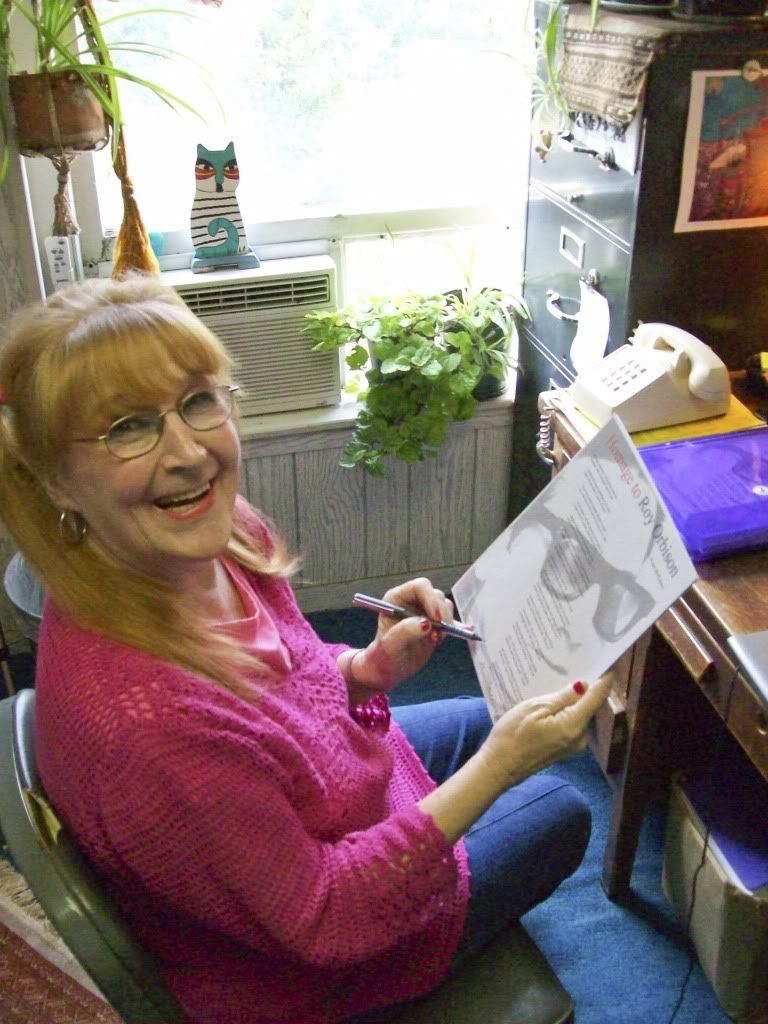
Was this picture taken in your office?  Maybe at home, but I'm guessing from the style of phone  it's at West Virginia Wesleyan. Frostburg used the photo for your reading in  September. Did you help them pick it out? It looks to me like a black and white version is used in part by the Intermountain in Elkins, so I'm guessing your family likes. So do I.

I did a little research and found out that you're holding a broadside of your poem, "Homage to Roy Orbison" which came out in 2009, after you published it Appalachian Heritage and in your fifth collection, Vivid Companion, in 2004.

Like Roy's, your
sense of form
shapes up this shard-filled life.
*

February 4 I wrote up a little piece telling folks the  news that you were gone.  Talbott Funeral says it will be receiving friends from four til nine tonight and it's already 3  p.m.  I could drive the four plus hours to Belington and still make it if I leave within an hour, but I haven't gotten any work done today, since I've spent the last four hours thinking on you.

I haven't got any work done and they're still blowing up our mountains, (Doh, of course nothing has miraculously changed since Saturday). I'm still looking for a community fund to apply for a Knight grant to  train more voices in our region  to tell their stories.  And  to interest the national press in better explaining what's going on.  Knight's  "live chat" for the grant is tomorrow at noon, just about when folks will be in the midst of the celebration of your life.  I could slip out, even though I don't own a laptop.  Google tells me the library over on Elliot is open all day and has net access computers.  I just liked  the library's page on facebook. 

I could drive the nine hours round trip, meet your family and friends.  Even walk around town and imagine your childhood.  Ask directions to the farm. But besides the grant, Dendron needs help stopping a new coal plant and in Giles they're still dumping ash on the banks of the New. And I've got pitches to write for The Guardian, which hasn't published me since December.

But you're a higher priority.

*
That song Leadbelly made famous  echoes in my mind.  Not the verses, mind you--the context is off--but the chorus:
Good night Irene
Good night Irene
Good night Irene
I'll see you in my dreams.
Makes me wonder what you thought of that song?  It's been recorded since by so many folks from The Weavers and Johnny Cash to  Michelle Shocked and Tom Waits.  Heck I was just now reading that even Raffi has a version.

I can't  ask you anymore in person--or in letters or facebook--unless I imagine your reply.  And that  isn't usually my nature.  Although it  would make an interesting writing prompt. The Gazette says they're burying you tomorrow.

*

And, even if I don't make the four-plus hour drive, I plan to sit shiva for at least the next week.  It's not as if  you were Jewish, nor am I close enough kin as it's usually defined.  But, that phrase comes to mind as an explanation: kindred spirits.

I thought about how I'd say we're connected, when I was searching images on Google to find a photograph to use at the top of this post. That word "connected" came to me when I found the photo at  a review of Jayne Anne Phillips Fast Lanes on Critical Mob.  It was tucked away on the tab labelled "connections," not the one marked "influences."

I can't claim that you influenced my writing. I hadn't read enough of you, even though West Virginia named you poet laureate years before we met in Charleston. I was off reading Bill Stafford, who doesn't write anything like me, except in the sense that all three of us were (and I am) writing from a set of common concerns, if not backgrounds.

*

Thanks to Vic, I'm listening to you reading three of  your poems from that October when I last saw you:
  • "Homage to Hazel Dickens"
  • "At 24"
  • "Sunday Morning, 1950"
I'll research later and try to add links to written versions or if I can't find any, I can check with your sister, Eileen Martin and see how to get permission to transcribe them here. But until then,  folks can listen here:

(I hadn't noticed when Vic posted it to his blog last April, but the West Virginia Book festival posted it in a remembrance. )

*

I'm also listening Llewellyn McKernan interview you at the West Virginia Writers Summer Conference:
  • your approach to how to start writing writing memoir, how she adapted her draft to write essays to be recorded on NPR and the feedback loop to the memoir
  • your  take on the status and history of the development of Appalachian literature from the times of Louise McNeill  and James Still, and
  •  your thoughts on writing process and teaching creative writing.


Just wish I had known about it before the Book Festival.  I might have asked you to continue the discussion, either when we were sitting on that bench together or during your reading when you asked for questions from the audience.


*

So, Irene, think of this as a wordy poem for you without line breaks.  Or NaNoWriMo by a poet and ten months early (Jeanne Larsen asked me Thursday night at Hollins, was I ever going to write a novel.)

Don't reckon I'll have more time to write you today.  I've been sitting here now, pushing aside other things.  And now it's been a good five hours and I've never even taken a break to get something to eat. The emergency Lemon Luna Bar from my purse is long gone. The last bit of  Lightlife organic Tempeh smells like it's  several days past turned.

So I don't reckon I'll have more time to write you today. But, if not, goodnight, Irene.  I'll hear you in my dreams.

2/4/12

Irene McKinney, ¡Presente!

Photo of of Irene (right), Denise Giardina and Jayne Anne Phillips at the 2010 West Virginia Book Festival accompanied Greg Moore's Charleston Gazette post:  "Live blog: Sunday at the West Virginia Book Festival."


This will be brief and I'll write more later.  I just wanted to let folks who loved Irene know, if they hadn't heard the sad news. The Poetry Foundation, publisher of Poetry magazine hasn't even posted the news yet at her bio, as I write this. The service is 11 a.m. Wednesday at Talbott Funeral Home in Belington,, WV (Barbour County), where Irene was born and grew up on her family's farm. That's about 2 1/2 hours from Charleston, 4 hours from here.


Phillips, who comes from Buckhannon, WV--where McKinney taught--told the Charleston Gazette,
She is a great loss to the state of West Virginia...She made West Virginia real, sensory and important in all its timeless variety, the land, farms, the people and animals, the rituals. She knew the meaning of home place.

I last saw Irene McKinney that Sunday in October 2010. Before her reading, she sat next to me on one of the benches in the cavernous Charleston Civic Center, talking about how excited she was to start a new low residency MFA Creative Writing Program at West Virginia Wesleyan and asked if I had any suggestions for faculty. I told her about Katie Fallon, whom I knew from her time at Virginia Tech. Irene's announcement followed the first week in November.

The program offers interested writers the opportunity to explore the connection between place and identity, focusing on their home area, one of the field study destinations, such as Ireland, or the Appalachian region itself. The program will officially launch in July, 2011 with a three-day literary festival, and the deadline for applications is March 1, 2011.

Irene was so approachable, so enthusiastic, treating folks as her equal. Outspoken and ironic, she often repeated the words which can be found penned in the introduction to the 2003 anthology "Listen Here: Women Writing in Appalachia."

I'm a hillbilly, a woman, and a poet, and I understood early on that nobody was going to listen to anything I had to say anyway, so I might as well just say what I want to.
Or in the poem "At 24",

"I don't know who I am, but you can't have me."

I had only met Irene once before, when I got to participate with her and Denise Giardiana as part of Ohio Valley Environmental Coalition's West Virginia Writers MTR project. I already knew Denise from Hindman and Jeff Mann from VirginiaTech, as well as Chris Green and Edwina Pendarvis, who had edited an anthology that included one of my poems, as will as Diane Gillam Fisher, whom I had just met that March at the Appalachian Studies Association conference. The project was where I met Katie, Bob Henry Baber and Rob Merritt.

UPDATE 2/7/2012  Good Night, Irene

1/18/12

"Dark Wednesday" : Proposed internet laws antipiracy or anti--freespeech?


Illustration is a screenshot from Mozilla.

January 18, websites are joining the Electric Frontier Foundation in calling for an end to current internet blacklisting legislation S. 968 PROTECT IP Act (PIPA) in the Senate and  H.R. 3261 Stop Online Piracy Act (SOPA) in the House. Under the current drafts, courts could order credit card firms, online payment companies like PayPal and advertising networks to stop doing business with those websites. They could also order search engines to stop linking to them and internet service providers (ISPs) to block their customers from accessing them.

Sounds like China?  No, we're talking about the USA.


Currently sites must remove specific copyrighted content if presented with a properly filled out DMCA takedown request. The notices require that the complainants must identify exactly what pages the content is on, and  prove that they are indeed the owners of the content. Even then, this process is often abused according to the Electric Frontier Foundation.

SOPA and PROTECT IP contain no provisions to actually remove copyrighted content.  Instead they focus on the censorship of links to entire domains.

Thus, if the AG served a site, it would be required to scrub every post and comment on the site containing the domain and censor the links out, even if the specific link contained no infringing content. Does this sound like free speech?

Think not?  Then join us and write and  call your Senators and Congressperson  to tell them to stop this legislation.

And to read about how to particpate in other ways, see this excellent rundown by Ars Technicha (h/t to Dan Radmacher)


1/7/12

Floyd Radio Show


January 7, 20 12, while  I was down at the LaPrelle's in Rural Retreat for the Big House Crafty Week, I was invited to participate in Season 1, Episode 5 of the Floyd Radio Show.  Beside helping with the final re-write and participating in some of the group skits, I  read my poem "Green Beans"

UPDATE:  The Floyd Country Store now has archived podcasts on its website.  You can hear me read "Green Beans  at 22:21.  In the above picture, Anna is wearing the dress she made during Crafty Week (from an original pattern.)  It's emerald green French eyelet lined in a gold-yellow.

1/6/12

Tanner Cultural Center: A Legacy to Preserve and Celebrate


In April 2010, a tornado ripped through Newport, Tennessee, damaging the roof of the Tanner Cultural Center. Although money to conduct repairs was distributed to the City through the Federal Emergency Management Agency, according to William Isom II and Friends of the Tanner Cultural Center, the City is now talking about demolishing the center.  This despite a the National Trust’s Rosenwald Schools Initiative to save the remaining Rosenwald Schools, of which Tanner Center is one.  Not to mention the National Rosenwald Schools Conference: 100 Years of Pride, Progress, and Preservation to be held at Tuskegee University in Alabama June 14-16, 2012.

 We need to ask that the City of Newport act as responsible stewards for this beloved community space of such great cultural significance. Won't you join me before January 10 by writing Scott Collins newportadm@newporttn.org or calling 423-623-7323 ext 18 and asking that the City of Newport instead proceed without further delay on the needed repairs and clean up of the center. (Please send a cc of your email to Issom william@800northfourth.com.)

Constructed in 1924, as a Rosenwald School with local funds and a donation from Sears-Roebuck magnate Julius Rosenwald, to serve the educational needs of the Black students in Cocke County, the Tanner Building is special because of its status as a surviving East Tennessee Rosenwald School and its utilization as a community space for the Black and rural populations of Cocke County.

There are many surviving alumni of the Tanner School living and working in the neighborhood in which the building is based. Groups that have been displaced from this structure include; AA, Families First, East Tennessee Human Resource Agency, Clean Water Expected in East Tennessee, Community House Cooperative, Head Start, The Farmers' Market, and Veteran's Affairs to name a few. The building also provided meeting space for other groups, community events and computer lab access to the neighborhood.

As noted in the the Cocke County Heritage Development Report from 2008 conducted under the direction of Dr. Carroll Van West, the school is a "legacy to be preserved and celebrated."

12/21/11

Let's Remember Mary C. Snow: An Open Letter to The Charleston Gazette


 Photo is from a screenshot of  WCHS television's video.

*

Thomas Carlyle is reputed to have written, "Histories are a kind of distilled newspapers."

As a lover of your newspaper, that's why I was disappointed today when I checked your archives and couldn't read more about Mary C. Snow, an educator in Kanawha County, West Virginia Schools for more than fifty years and the first African-American principal in the area. By contrast, WCHS television still has a January  video online. Perhaps that's because Wes Armstead, now Managing Editor at the station remembers Snow as one of his teachers.

Mary Snow passed away in January at the age of 97.  Now, as you report, many in the community have asked that West Side Elementary School be renamed in her honor as a remembrance of her dedication to the community's children. And yet, reading the virulent comments on the articles, I'm wondering how many folks know in any depth about the accomplishments of Ms. Snow and her importance in the history of Charleston and of West Virginia.

As the December 19 editorial in The Daily Mail noted of the School Board's 3-2 not to rename the school,
It's a crying shame, and a missed opportunity to teach history.

Snow, who died in January at age 97, was a shining example of the power of public education.

The school should have been named for her - not so much because it would properly have honored her, but because it would have extended her teaching career.

Nothing would have pleased her more.

Born in 1913, the oldest of seven children in a poor family, Snow lost her father to violence when she was 13. Her mother took in laundry to support her children.

But Mary C. Snow overcame poverty and racism to graduate from West Virginia State College and earn a master's degree from the University of Cincinnati.

She went on to serve as a teacher, principal and inspiration on the West Side for more than five decades.

Like West Side educator Isom Cabell before her, she changed history.Snow's story resonates as strongly today as it did when her generation was in elementary school.
As my friend filmmaker Jordan Freeman noted on facebook, "It's very representative of WV government's disrespect of its own citizens that the school board won't name the school after a well-respected community teacher, a small thing in the scheme of things, but a very clear example of unresponsive state government."

Community leaders including Reverend Watts are circulating a petition that already had 500 signatures as of December 15, according to your paper.

Jordan is planning a petition on Change.org (the same site that Molly Katchpole used to used to persuade Bank of America to cancel its $5 debit card fees. Jason explains, "They've been doing great on-the-ground organizing to get this name change, as the tip of the iceberg about basic community respect. An online petition will hopefully help further that effort." (I'll include a link when the petition is online.)

The Gazette has special reports which open its archives on scoundrels such as bank robber Roy Plummer and disgraced politician Jerry Mezzatesta. Also on some of the scourges that let outsides stereotype WV and Appalachia, in general, as benighted: drug overdoses, mining disasters, mountaintop removal. How about a special report on one of its outstanding assets, Mary C. Snow?  A good place to start might be the articles on the current controversy, as well as your obituary and the February 16, 1996 interview and the March 24, 1996 story on Ms. Snow's role in the origins of unity day.

Johann Wolfgang von Goethe is reputed to have said, "Sin writes histories, goodness is silent." Please don't prove him right.

12/12/11

SB 1751: If coal ash is so safe, the utility and coal company executives should eat it!


If you were to believe the above coal ash "facts" circulated by the American Coal Ash Association 's Educational Foundation, coal ash is safe.

Or, "Coal ash offers our society extraordinary environmental and economic benefits without harm to public health and safety when properly managed." One wonders who is going to make sure things are "properly managed?" Not the Environmental Protection, if that group and the coal companies have their way, right now they're pushing hard for passage of S. 1751 to stop the EPA's plans to regulate coal ash, especially the Democratic senators from the states of North Carolina, Virginia, Florida, Colorado, Montana and Alaska, all of whom are undecided on S. 1751. This despite the legitimate arguments that:

  •     S.1751 endangers the health and safety of thousands of communities: it will prevent the EPA from ever revisiting a federal coal ash rule even if it is found that coal ash dumps pose an even greater threat.
  •     S.1751 is a dangerous bill: it would allow the construction of coal ash dumps that don’t meet drinking water standards for arsenic, lead and other pollutants.
  •     S.1751 will cost American jobs: An October 2011 study by a Tufts University senior economist Frank Ackerman (email, bio)  found that strong coal ash regulations, such as the one proposed by the EPA in 2010, would generate 28,000 jobs annually.
  •     S.1751 will hurt recycling: once coal ash is dumped into water, which this bill would allow by permitting the construction of new coal ash ponds, it cannot be recycled.
  •     S.1751 fails to address the current threat: this bill will not phase out dangerous ash ponds or prevent another tragedy like the coal ash spill in Tennessee in 2008.
  •     Coal ash is hazardous to our health: the cancer risk from drinking water contaminated by arsenic near some coal ash ponds is 1 in 50, which is 2,000 times greater than the EPA’s acceptable risk level
  •     Coal ash is a national problem: it is the second largest industrial waste stream in the U.S.

Emily Enderly, also at Earth Justice, sent me a chart that compares the presence  or absence of regulatory requirements for coal ash under four different regulatory schemes:

(1) EPA’s proposed subtitle C (special waste) rule;
(2) EPA proposed subtitle D (nonhazardous waste) rule;
(3) the municipal solid waste (household trash) regulations found in 40 C.F.R Part 258.
(4) Coal Ash Bill (H.R. 2273 (passed 267 - 144 on October 14) which is identical to S. 1751

I've set up a link on google docs where you can view, print and/or download it:

Comparison of Coal Ash Regulation under Four RCRA Regulatory Schemes

If you don't want to register for google and would like a copy of the chart, email me.

Background information:

Please remember that if you live near an existing or proposed coal ash dump, you can sign on to the letter below being organized by Environmental Integrity  by sending your name and address-- including city, state and zip code-- in an email  to Sam Flenner <samf.environmentalintegrity@gmail.com > and cc LaToya Archibald < latoya.s.archibald@gmail.com> by noon, December 12 Eastern Time. If someone doesn't have email, you can send  their name, address, city state and zip code (Phone and email optional) along w. the copy below.  And if you're lucky enough not to have this problem pass this on to others who might.

No matter where you live, you can  email, fax or phone your Senator to tell them that coal ash is dangerous and SHOULD be regulated, vote AGAINST Senate bill 1751.

Okay, here's that form and  letter...

*

DON’T FORGET US LETTER PERMISSION

The following give their permission to (name local sponsor org) to include their names name and addresses on the letter entitled Don’t Forget Us addressed to members of the US Senate.  They and their family are My are directly impacted by lax state disposal safeguards of coal combustion waste.  They urge their federal Legislators to support the EPA’s rulemaking process under the Resource Conservation and Recovery Act (RCRA) and oppose any actions or legislation that would impede the EPA rulemaking process to set common-sense safeguards for the disposal of this waste.
Name: ____________________________________

Address: __________________________________ 

City: _____________ State: ___ Zip Code _______ 

Phone: ____________________ (optional)     
        
Email: ____________________ (optional)             

*


October 20, 2011
US Senate
Washington, DC 20510
Dear Senator ____:

We understand that you may soon vote on a bill that would leave oversight of coal ash dumps to the states, and prevent EPA from taking action against polluters who threaten our air and groundwater. We are referring to S. 1751, which is identical to the industry-backed bill that cleared the House of Representatives on October 14. We know Congress has already heard from industry lobbyists, big contributors, and state bureaucrats. We live near these dumps, and put up with their pollution year after year. Please hear our voices.

We know what it is like to suffer through the daily onslaught of blowing ash, drink water from faucets contaminated with ash leachate, and see our wetlands and creeks poisoned with toxic metals like arsenic. We have complained again and again about the endless noise, dust and pollution from trucks dumping coal ash near us while we become more stressed out or sick and the value of our property plummets, with no real response from our states.

Some of us are also joining this letter because a new ash dump has been proposed nearby or because we are concerned about the growing threat of coal ash in our area and its impact on our health and the quality of life in our community. More than two years ago, we were promised that the US Environmental Protection Agency would finally set national standards to clean up these sites, and close the most dangerous ones.

Now we face legislation that would stop EPA in its tracks, and replace real standards with imaginary state “plans” that polluters could ignore without fear of enforcement by EPA. After what is already known about the danger from storing millions of tons of coal ash in unlined ponds, why would you tie the government’s hands from ever stopping this practice?

Do our lives matter to you?

Is protecting coal ash “recycling” from a “stigma” more important than our health or the quality of our water? Even those who believe “stigma” is real cannot seriously argue that shielding leaking dumps from EPA enforcement somehow makes recycling easier. And ash mixed with other wastes in leaking ponds – now a common practice – cannot be recycled at all.

What will you accomplish by requiring federal and state bureaucrats to review, and then approve, disapprove, and reapprove state plans that can never actually be enforced by EPA against polluters? If your own family’s drinking water was being contaminated, would you think haggling over “plans” the right response?
States have had decades to improve their management of these dumpsites, and have done nothing – or next to nothing – as contamination has spread, even after the Kingston dam collapse manifested the problem. We know good, hard-working people in our state agencies, but budget cuts, political pressure, the power of local polluters, and the lack of any serious oversight or enforcement from EPA make their job impossible.

Put yourself in our place. What if you lived near a power plant’s landfill or ash pond like we or our neighbors do, and found out that the water you and your children drink may be unsafe to drink? How long would you want to wait for your state agency to do something about the problem? Three years? Five years? Ten? We have waited that long, and are waiting still.

As the Americans who live next to our nation’s ash dumps, our opinions should matter. These dumps should have permits that we can comment on. We should be able to object to any permit or plan that threatens our lives and property, and the government should be given a deadline to respond to our concerns. Dumps that contaminate groundwater should be closed, and the groundwater cleaned up. And EPA should be able to crack down on polluters – without having to wade through endless “planning” —or the bill will mean nothing.

As you consider this legislation, please don’t forget about us. We are not against the coal industry. We simply want laws that protect people and that they be enforceable. We appreciate your time and consideration.
Sincerely,

12/7/11

U.S. District Attorney Goodwin: Alpha "not a life, it's not a being, it can't go to jail."


Editor's note: This was my draft of an article commissioned by The Guardian which appeared later the same day as, Who will pay for the Upper Big Branch mine disaster?: "Massey Energy's owner makes a $209m settlement, but safety violations that killed 29 miners in West Virginia go unpunished"


Montcoal, WV.  3:27 PM on Monday, April 5, 2010.  It was the worst U.S. coal-mining disaster in nearly 40 years.  Twenty months ago, just across the river from Coal River Mountain  on Cherry Pond Mountain near its mountaintop removal mine, Massey Energy's underground mine at Upper Big Branch exploded.

We learned right away that at least twenty-five men had been killed, two more injured, one gravely. Four days dragged on, while we hoped for a miracle, but four missing men were dead. Over the course of time we learned from an independent report and another by the United Mine Workers that Massey had failed to maintain its ventilation systems properly causing methane levels to increase to dangerous levels.

According to Ian Urbina and Michael Cooper, writing April 6 in the New York Times,
In the past two months, miners had been evacuated three times from the Upper Big Branch because of dangerously high methane levels, according to two miners who asked for anonymity for fear of losing their jobs.
Finding blame

Flash forward to 3:00 p.m. on December 6, 2011, thirty miles away in the state capital of Charleston. The U.S. Mining Safety and Health Administration released its investigation report concluding that the disaster was "entirely preventable," caused in part by a pattern of major safety problems and Massey's efforts to conceal hazards from government inspectors. A summary video is here.

Earlier, at 11 a.m., U.S. District Attorney. Booth Goodwin announced that his office, along with the Federal Bureau of Investigation and the Department of Labor had entered into a non-prosecution agreement which will cost Alpha Energy Resources, Inc., which had acquired Massey, $209 million.

Massey’s reputation was probably beyond repair.  Writer Jeff Goodell had profiled its CEO, Don Blankenship, as the "Dark Lord of Coal Country, the industry's dirtiest CEO. In southern Appalachia we knew Blankenship only too well.As Goodell described him, accurately,
he grew up in the coal fields of West Virginia, received an accounting degree from a local college, and, through a combination of luck, hard work and coldblooded ruthlessness, transformed himself into the embodiment of everything that's wrong with the business and politics of energy in America today — a man who pursues naked self-interest and calls it patriotism, who buys judges like cheap hookers, treats workers like dogs, blasts mountains to get at a few inches of coal and uses his money and influence to ensure that America remains enslaved to the 19th-century idea that burning coal equals progress. And for this, he earns $18 million a year — making him the highest-paid CEO in the coal industry — and flies off to vacations on the French Riviera.
Blankenship left Massey in December 2010.  December 6, ABC News tells us Don Blankenship accepted a $12 million golden parachute. Other parting gifts included an additional $5,000-per-month to serve as a Massey consultant for two years, paid health insurance, a secretary, residential property rights and accrued pay from his employment, including performance bonuses. In return, Blankenship agreed not to compete with Massey for two years and to cooperate with the company to resolve any litigation that arose during his tenure.

And yet, Kentucky records, alluded to by ABC, show that on January 26, 2011, Blankenship signed as president in a corporate filing for McCoy Coal Group. The corporation had previously registered its incorporation on January 11, under a slightly different name.


When Alpha announced January 29, 2011 that the company would spend $7.1 billion to acquire Massey, Alpha CEO Kevin Crutchfield said that "At the end of the day, we were actually able to get comfortable with the exposed risk" and Massey's estimated $150 million in losses related to the disaster was "appropriate." Massey had already taken a charge of $128.9 million during 2010 to cover costs from the explosion, including workers' compensation, restitution for the families of the miners and expected litigation costs.

But not prosecution

Under the December 6 agreement, Alpha will make payments and safety  investments totaling $209 million:
  • $46.5 million in restitution (at least $1.5 million for each worker)
  • $80 million for safety improvements
  • $48 million for safety research over the next two years
  • $10.8 million for fines for the accident and
  • $24.2 million to resolve pending civil penalties at all of its other former Massey operations
As Cecil Roberts, of the United Mine Workers pointed out in a newsrelease I received,
We have repeatedly heard from the current congressional leadership that they were not prepared to act until they knew what happened at UBB. Now they know.
He called for strengthened whistleblower protections for workers who want to report safety issues and official standing for the families of the victims in the investigative process.

With regard to the non-prosecution agreement, Alpha Natural Resources says that it acquired Massey
more than a year after the tragic explosion at their Upper Big Branch mine. Alpha believes the settlements announced today provide the best path forward for everyone. The bulk of the settlement will fund safety training, research and advanced technologies that the company believes ultimately will create a safer work environment for coal miners throughout the industry.
Ry Rivard, capitol reporter for the Charleston Daily Mail quoted District Attorney Goodwin as saying the non-prosecution agreement represented a "balance" and that Alpha was "not a life, it's not a being, it can't go to jail."

So who pays?

Twenty-nine men dead. Two more injured. Two hundred and nine million gets Alpha off the hook for prosecution? So much for the personhood of corporations. Stay tuned to see if any individuals get prosecuted other than Massey's security director. At least this time, the government didn't sign away its rights to do so.

Goodwin made his announcement at the Robert C. Byrd federal courthouse in Charleston, WV, named after that state's late beloved U.S. Senator, who has since been replaced by its former governor Joe Manchin. Although Byrd was generous in his support of the coal industry, towards the end of his life he was losing patience with Massey and its record of reckless disregard of its workers safety.
The old chestnut that “coal is West Virginia’s greatest natural resource” deserves revision. I believe that our people are West Virginia’s most valuable resource. We must demand to be treated as such.
As Vernon Haltom, of Coal River Mountain Watch told me in an email interview,
Spending on 'major safety initiatives' after 29 miners were killed is closing the barn door after the horse is out. The executives who routinely place profits above the lives of miners and community members must be held accountable for all their crimes. Until then, there will be no sense of justice where the coal industry leaves a legacy of death and destruction.
Goodwin assures us that the criminal investigation continues. He says that Alpha, and by extension, its predecessor Massey is not a person and can't go to jail. But what about Don Blankenship?

12/4/11

If there's a Heaven, Bob Thomas is playing bass there....


So sad to learn from Wes Chappell and Randy Marchany that Bob Thomas, the bass player for No Strings Attached (NSA) since 1984, died unexpectedly on Saturday, December 3 from  complications following a heart attack. That's a screenshot of  him on the right playing "Lady Be Good" with Randy. Wes, too, but he's off-frame. Bob took being a bassist seriously, playing not only acoustic bass, but bass clarinet, and bass saxophone, saying he had the goal of "owning a bass instrument from every instrument family."

Here's a photo of him playing that bass clarinet with NSA in 2000 taken by the late Don Shorock:

Bob was a sweet guy and a terrific musician (and showman) and his death leaves a gaping hole in our hearts and the New River Valley music community. There are many photos on this  NSA fb page.  UPDATE:  According to the December 11 Roanoke Times Bob was 66 and
The date of a planned memorial celebration will be announced at a later time. Those who wish to make a contribution in his memory could donate to the New Orleans Musician's Relief Fund, the Humane Society of Montgomery County, or the charity of your choice.
Also,
Bob was the son of the late Barkley and Margaret Ford Thomas. He graduated from Shelby (North Carolina) High School and attended the University of North Carolina-Chapel Hill.

Among Bob's survivors are his longtime companion, Patricia Polentz; his daughter, Maggie England and husband, Huiet; and grandsons, Mac and Jake England, of Cramerton, N.C.; sister, Susan Thomas, of Underhill, Vt.; niece, Johanna Hulick and family, of Seattle, Wash.; nephew, Jeremy Hulick, of Bethesda, Md.; aunt, Eleanor DeLashmutt, of Atlanta, Ga.; and several cousins.
John Jones II  posted a telling anecdote December 13 in the guestbook for Bob there.  Since I'm not sure it will remain up, I'll reprint it here:
 
I didn't know Bob personally, more like an aquaintance. I did borrow a contra-bass clarinet from him for a while. He had little information about me as we had never interacted but he loaned me the instrument with no questions asked and the simple request to take care of it.

 The New Orleans Musicians Relief Fund, Inc. is a grass roots certified 501c(3) founded by and for displaced musicians, which is still sending grants to displaced New Orleans musicians thanks to donations from around the world.You can also donate your time, your talent and/or your gear.  One way is to help publicize the organization.  More on that at the bottom of this post.  First, back to some pictures and music by Bob.

*

Rusty May, who himself play bass with NSA from 1980-4, described Bob in a note to the New River Old Time listserve, as 

the very talented and hardest working bassist in the New River Valley.... adept at bluegrass, bebop, old-time, swing and everything in between.  
 The picture is a screen shot from a video of the band playing with guests Guy George, Karen Mueller, and Butch Ross at the 2008 Winterfest in Irving, TX.


Here's Bob, Wes and Randy with Pete Hastings playing Carl Perkins (I think) All God's Children Want to Rock at the Dulcimer Festival Showcase concert in Shepherdstown, West Virginia on Sept. 13, 2008


In a more Celtic vein (although typically NSA eclectic) at the same concert:
http://www.youtube.com/watch?v=q6R-SCT2Q_Y
http://www.youtube.com/watch?v=FuEkVXANkjc (the sound seems to start at about 0:33)
http://www.youtube.com/watch?v=8NrxhuA4YHI

And as the soundtrack for a flick on the 2008 Albuquerque Balloon Fiesta:
http://www.youtube.com/watch?v=vxlkwG1N778
http://www.youtube.com/watch?v=bCCSwSb6ZFo

There are plenty of audio clips at No String Attached's website.  Probably the funniest Bob got was on "I'm a Hog for you, Baby."  (H/T to Jeff W. for reminding me.  Wish there were a video, or a complete version to share with you...but I'm guessing this addition photo by Shorock may be capturing one of the performances of that number:


BTW, with Pete exiting NSA in 2009, Jim Crawford joined the band.


In  addition to NSA, Bob played with a number of other groups including serving as the  upright bassists and bass saxophonist  for Front Porch Swing with Scott Perry  (r. reso-phonic guitar, ukulele & vocals), backed and Tom Ohmsen (l. on mandolin.)
 
 That group describes itself as a
hillbilly act Homer and Jethero jamming with be-bopper Charles Mingus, while Blind Lemon Jefferson and Ukulele Ike take turns sitting in

Bob also was part of the smooth jazz group, Mood Swing, which also included  Harry Doss on guitar, Karl Sanzenbach on guitar and wind instruments and Kathy Stell on vocals.

He also played in the Triple B Trio with Bill Adams and Brian Mueller. (Thanks, Rusty, for pointing that out...)


Back in 1989, he played Dixieland jazz with Doss, as well as Ed Schwartz, , John Gregg, Carter Edmondson, Bill Bondurant, Sally Walker, Norman Olmstead, and Kathy Duncan in the the Riverboat Ramblers.  I think that's the bass saxophone, right?


 And his friend, Nancy Grover Mason, a bass player who lives in NC, tells me that when she was in Blacksburg (Bob taught her how to play) she was in a trio with Bob from about 1991-5 named 2 Hot Sodas:  Sandy on alto sax, Edwin Lacy on clawhammer banjo, Bob Thomas on tuba.

At the end we had a euphonium player Kevin Wilkes join us, and Bob took over either clarinet or rhythm section. He had a big "bag of tricks" he'd carry, with sticks and percussion instruments, toys, etc.
 Here's a picture from the original lineup from a gig at a Blacksburg church.  (She's not sure which one, but says that it hosted folk concerts during the 90s.)


*


New Orleans Musicians Relief Fund

12/1/11

Milbank the Bully


Dana Milbank, a Washington Post's opinion writer, filed a story on the announced retirement of Barney Frank,"Barney the bully: Congressman Frank’s other legacy."
The morning after his retirement announcement, Rep. Barney Frank scored an interview on NBC’s “Today” show, gaining the opportunity to act as an elder statesman in front of a TV audience of millions. Instead, the Massachusetts Democrat chose to quarrel with the interviewer.
My friend from NewsTrust, Barry Grossheim recommended the story, rating it "good" for informaiton, insight, style and credibility,  commenting,
The other side of Barney Frank. I like his politics but on a personal level, not so much!
Sorry, Barry, but I can't agree with your assessment.  Milbank seems to write this just to be contrarian from those praising Frank upon his retirement. The reporter he quotes seems to have been playing gotcha and Frank wasn't cooperating.

 Milbank has been one of my least favorite writers ever since he penned his gem, "President Obama Continues Hectic Victory Tour on July 30, 2008," with the "clever" lede,
Barack Obama has long been his party's presumptive nominee. Now he's becoming its presumptuous nominee. For an analysis of that piece, see http://newstrust.net/stories/23965/
Jason Linkins (email), now a Huffington Post political reporter analyzed Milbank's piece that same day for HuffPo in "Washington Post Fuels Outrage After Misquoting Obama."  Not sure how much outrage there was, but Milbank, trying to be clever definitely took Obama out of context. Milbank quotes Obama as saying, 
 This is the moment . . . that the world is waiting for...I have become a symbol of the possibility of America returning to our best traditions.
Linkins writes that according to a Democratic leadership aide in attendance, the full quote was:
It has become increasingly clear in my travel, the campaign, that the crowds, the enthusiasm, 200,000 people in Berlin, is not about me at all. It's about America. I have become a symbol of the possibility of America returning to our best traditions.
BTW, thanks Bob Her

11/17/11

Nikki Finney's Remarkable Head Off and Split Takes National Book Award


Affrilachian Poets  member and UK English Department prof  Nikky Finney wins National Book Award for Head Off and Split. I was wowed when I got to hear her read at the  Symposium on Affrilachia  @ UK in March.

In a November 11 interview with WUKY, Finney explains the title of her collection:

When I was a girl, my mom would send me to the fish monger. I would go in, choose the fish, hand it over to him. He would inevitably say, "Head off and split" question mark.

I went back five years ago. The same phrase was said to me. I'd heard it a thousand times. I thought, wow, that's a great metaphor for what we dismiss or cut away or don't want to see. The cold grey eyes, the scales, the fins, and then we're handed over the succulent fish without all those nasty details.

I wanted to bring that in to talk about how, as a culture and a community and a country, that I think we have to stay involved in all the details. We can't hand the fish over and just get it back with the succulent fish. I think we're in a time where we really we have to sort of get our hands in there and do the dirty work and not hand it off to somebody else.


Here's Finney reading some of her poems:

"Left" (pdf of poem)


"Condoleeza Suite"


"My Time Up with You"


"Red Velvet" [about Rosa Parks]


"Dancing with Strom"

And a long reading at the New School (starting @ 12:20) starting with her recounting the story of when Nikki Giovanni came to Tallladega College.


There's  an interview available at Oxford American and one at Poets & Writers for the February-March 2011 issue which you will have to read at the library, if you don't have a copy of the magazine..  The Virginia Festival of the book doesn't have its schedule up yet for March 2012, but announced via facebook that Finney is one of its readers.

Here's her acceptance speech (@16:50)
http://www.ustream.tv/recorded/18565428  (I couldn't embed because evidently only YouTube works with Blogger.

9/29/11

Maria Gunnoe: We're Sick of Dying for Your Bottom Line

September 26, House Republicans stages its Subcommittee on Energy and Mineral Resources Oversight Field Hearing on "Jobs at Risk: Community Impacts of the Obama Administration’s Effort to Rewrite the Stream Buffer Zone Rule" 

Say what?  It was the Bush administration which tried to eliminate the Stream Buffer rule.  You can listen to the whole hearing and read the testimony here, with Bo Webb and Maria Gunnoe start their testimony at 99:22. and 106:27 respectively.

As Bo Webb wrote in the comments he submitted:
  
The very title of this hearing indicates a bias against those of us who are living (and dying) in mountaintop removal mining communities. The title suggests that jobs are at risk if the SBZ rule is corrected. The SBZ rule must be corrected in order to protect The People’s health. It’s been broken and it needs fixed.
Let us not forget, President Ronald Reagan, your president, my president, in 1983 created the Stream Buffer Zone Rule because he realized the responsibility he had to protect America’s water supply in the face of an industry that was moving more rapidly toward a method of mining that would turn entire mountains into ruin and destroy head water source streams that carry drinking water to millions of American citizens. This committee now shares that responsibility because President George W. Bush, with the stroke of a pen, trashed the Reagan SBZ rule just before leaving office as a present to a coal industry that wills itself to increase profit at all cost, even at the cost of human health. 
Or as Maria Gunnoe told Gene Kitts of Alpha as he was leaving the hearing, "We're sick of dying for your bottom line.

9/2/11

Do we need the EPA?


Table adapted from Beyond Red vs. Blue Political Typology, Pew Research Center for the People & the Press, May 4, 2011.  See question  on pp 136-7 on public support for environmental regulation.  This is a first draft of a piece commissioned by The Guardian,"Why the GOP is going after the EPA: Republican lawmakers aim to cut back or even abolish the Environmental Protection Agency, even though it pays for itself, published September 12, 2011.


*

Who is following the U.S. public in its strong support for protecting the environment?

If you can rely Pew's 2011 survey (see above chart), 71% of those questioned--across the political spectrum--agree with the statement, "This country should do whatever it takes to protect the environment." Yet, on September 2, President Obama joined Environmental Protection Agency (EPA) critics in Congress and  GOP  presidential candidates  in  arguing that the agency unnecessarily burdens U.S. industry.

As the clever Erica Grieder (writing as E.G., Austin, in The Economist) says in "The Hole in the Ozone Standards,":

When the White House makes an announcement on the Friday before a holiday weekend, you can bet that it won't be anything in which they take special pride.

Obama stated that while his commitment to public health and the environment is "unwavering,"  he has ordered the EPA to withdraw its draft Ozone National Ambient Air Quality Standards in order to
underscore the importance of reducing regulatory burdens and regulatory uncertainty, particularly as our economy continues to recover.
Ground level ozone is the primary constituent of smog. In June, EPA Administrator Lisa Jackson testified before the Senate Environment and Public Works Committee (EPW) hearing on the Clean Air Act and Public Health.  In July she responded to EPW member Tom Carper (D, DE) that she had opted to review the 2008 ozone standards, rather than keep them in place until the next mandated review in 2013.  Bush's standards--which he  weakened at the last-minute in  2008 and are under court challenge were
not legally defensible given the scientific evidence in the record for the rulemakeing, the requirements of the Clean Air Act and the recommendations of the CASAC [the Congressionally-established, independent  Clean Air Science Advisory Committee.]
Further, were Bush's standards to be
overturned in court, it would have resulted in more financial and planning uncertainty for Cities and States, when they could affort it the least.
The most recent suit may be the one filed June 23 against the EPA for failing to enforce industrial emissions.  Ironically, Republicans on the Senate Committee on Environment and Public Works reacted with glee, posting this and this, only days after complaining about litigation costs, which had led them to order this study.

Will critics of EPA regulation see the irony, if the cancellation of ozone standards lead to more litigation costs?  Probably not.  Rather they will continue to complain that environmental groups are profiting from the taxpayers by suing the federal government.  What ever happened to concern for the public's health and safety?

Juliet Eilperin--who reports on on science, policy and politics in areas including climate change, oceans, and air quality for the Washington Post--called Obama's statement "a win for the business community."

Of course, Obama's position is nowhere near as extreme as that of Congressman Mike Rogers (R-AL), who told an anonymous radio host (listen to the full interview at about 16:45 for context):

You know the fact is, if in fact I think the American people do next November what they started last November, that is, cleaning house, and we do get a Republican-controlled Senate and a Republican president, I think you going to see some dramatic structural changes in this country... Who says the federal government has to have an EPA. Every state has their own environmental protection agency. Why does the federal government need to be doing that? ... I think we’ll have to look at a lot of things that we’re doing at the federal level and ask ourselves, ‘is this really what the federal role?’ And if not, discontinue it.

As far as abolishing the EPA, investigation reporter Mark Schapiro--Senior Correspondent for the
Center for Investigative Reporting(CIR)--tells me,

It's an economic catastrophe to remove incentives and oversight.

Nor, is Obama's position as extreme as that of Sen. Richard Burr (R-NC), who has filed a bill to merge the EPA w. the Department of Energy.  Other Republicans and some Democrats would weaken the agency through budget riders or reduce its authority in specific areas, arguing against needless "job killing"  regulations.  This despite the fact that reports show the EPA’s regulations to be cost effective.

The CIR's Schapiro--author of  Exposed: The Toxic Chemistry of Everyday Products and What's at Stake for American Power--also tells me,
The dialogue between ‘jobs’ and ‘regulation’ is endless and repetitive, and in almost every instance the claims by industry that new, more protective regulations would result in job losses and harm competitiveness have turned out to be dramatically overstated.
 In the past,  the EPA's  Jackson  countered critics of federal regulation, saying that "[s]mart environmental protection can actually drive innovation."  Are some U.S. industries resisting innovation?  Are there ways--other than through their  lobbying against regulation--that they are putting themselves at a disadvantage in the world market?

The answer to both questions--according to Shapiro--is yes.

*

More information coming soon:

The Guardian had asked for the following, but I ran out of space because of the breaking news from the Obama admnistration:
  • who funds the critics
  • what things were like before the EPA existed
  • the EPA's budget


To give a more complete picture I'll also add:
  • Cass Sunstein's explanation to Jackson for Obama's September 2 statement
  • reactions to Obama's statement
  • the acceleration of funders' power because of the Supreme Court
  • the more moderate Republican critics with conservative cred  that say the EPA's methods are outdated but the severe critics are misguided:
  • the Democrat-sponsored legislation to weaken the EPA
  • the Republican-sponsored legislation for the same
  • the EPA's cost-benefit ratio, despite its critic's contentions
  • the  current weaknesses in EPA's power (standards of proof before regulation, etc, v.s. European standards)
  • Schapiro's  explanation of  how lobbying for weak regulation undermines U.S. status in the global economy

      9/1/11

      Are Republicans Doing Oppo Research on Don Langrehr


      Photo of Don this July at the Ruritan fish fry by his neighbor Carol Brandt used with permission.

      *

      Don Langrehr received the Democratic nomination for 12th District to the VA House of Delegates July 29. August 31, my friend and retired organizer Mark Barbour forwarded me something from Don's campaign.  Don says  that this week, the Town of Blacksburg received a Freedom of Information Act Request (FOIA) for Town Council meeting minutes over the last 6 years from National Republican Congressional Committee.

      I'll update this as soon as I have time.  I need to interview some folks before I can write a decent piece, not just stenography, but given midnight September 1 deadline for donation reporting, I thought I'd pass on Don's rationale for why he needs your help.  I donated a bit at this link yesterday and some of my readers may want to do the same.  I think Langrehr, a Blacksburg Town Council member and Radford University education professor is someone who genuinely stands for equality and shared prosperity. 

      Don writes,

      I have a feeling that someone, perhaps a local Congressman, is not very fond of my candidacy for the General Assembly. I also get the feeling that our campaign will surely heat up over the next couple months with some blatantly negative advertising targeted at me.


      I must be prepared for any negative attacks on our campaign. Tomorrow at midnight is the filing deadline for the current financial reporting period and I need your financial help! A strong showing of financial support will demonstrate our resolve towards anything our opponents have planned....Please help send the message that any future dirty tricks are not going to derail our House of Delegates campaign.

      BTW, if you prefer to send a check:

      Don Langrehr for Delegate
      PO Box 10612
      Blacksburg, VA 24062