Showing posts with label arts and activism. Show all posts

7/12/12

Being the Change


Today, I took a break from writing about coal ash in Giles County to attend Being the Change, the inaugural TED talk at the Lyric Theatre in Blacksburg.

I'll write more about it later, but you can view the video of arts activist Jason Roberts of Better Block courtesy of YouTube:

 Mike Hudson of Progress and Main was taking a video, so I'll post it as soon as it's available.

2/7/12

Good Night, Irene


Dear Irene,

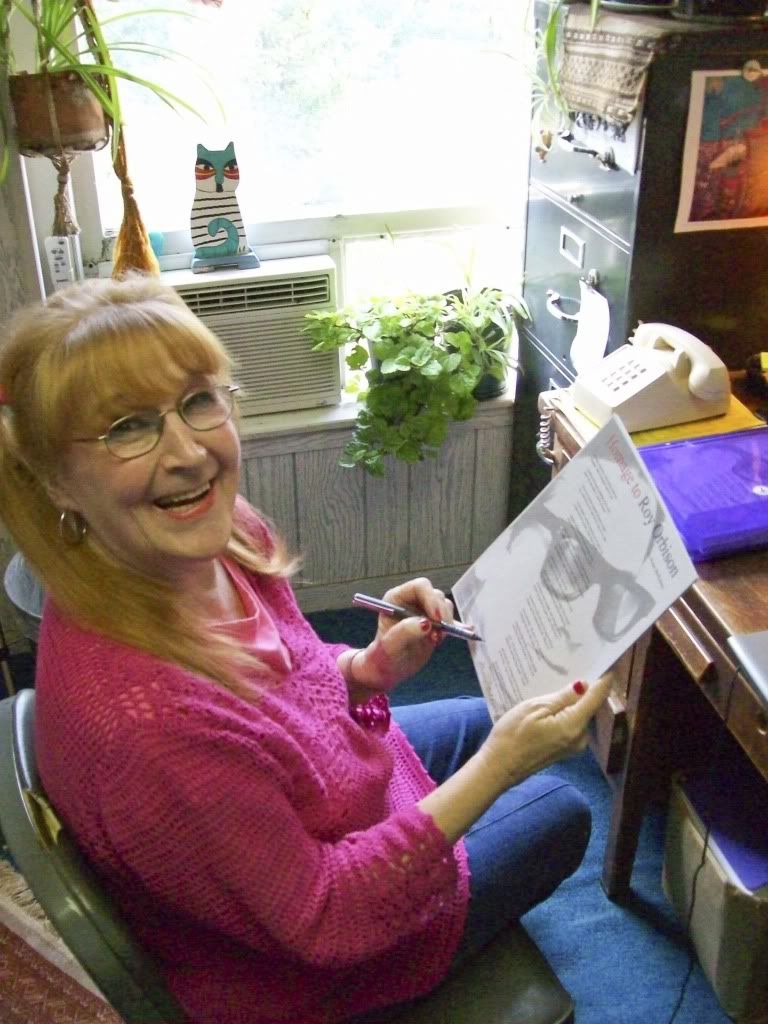
Was this picture taken in your office?  Maybe at home, but I'm guessing from the style of phone  it's at West Virginia Wesleyan. Frostburg used the photo for your reading in  September. Did you help them pick it out? It looks to me like a black and white version is used in part by the Intermountain in Elkins, so I'm guessing your family likes. So do I.

I did a little research and found out that you're holding a broadside of your poem, "Homage to Roy Orbison" which came out in 2009, after you published it Appalachian Heritage and in your fifth collection, Vivid Companion, in 2004.

Like Roy's, your
sense of form
shapes up this shard-filled life.
*

February 4 I wrote up a little piece telling folks the  news that you were gone.  Talbott Funeral says it will be receiving friends from four til nine tonight and it's already 3  p.m.  I could drive the four plus hours to Belington and still make it if I leave within an hour, but I haven't gotten any work done today, since I've spent the last four hours thinking on you.

I haven't got any work done and they're still blowing up our mountains, (Doh, of course nothing has miraculously changed since Saturday). I'm still looking for a community fund to apply for a Knight grant to  train more voices in our region  to tell their stories.  And  to interest the national press in better explaining what's going on.  Knight's  "live chat" for the grant is tomorrow at noon, just about when folks will be in the midst of the celebration of your life.  I could slip out, even though I don't own a laptop.  Google tells me the library over on Elliot is open all day and has net access computers.  I just liked  the library's page on facebook. 

I could drive the nine hours round trip, meet your family and friends.  Even walk around town and imagine your childhood.  Ask directions to the farm. But besides the grant, Dendron needs help stopping a new coal plant and in Giles they're still dumping ash on the banks of the New. And I've got pitches to write for The Guardian, which hasn't published me since December.

But you're a higher priority.

*
That song Leadbelly made famous  echoes in my mind.  Not the verses, mind you--the context is off--but the chorus:
Good night Irene
Good night Irene
Good night Irene
I'll see you in my dreams.
Makes me wonder what you thought of that song?  It's been recorded since by so many folks from The Weavers and Johnny Cash to  Michelle Shocked and Tom Waits.  Heck I was just now reading that even Raffi has a version.

I can't  ask you anymore in person--or in letters or facebook--unless I imagine your reply.  And that  isn't usually my nature.  Although it  would make an interesting writing prompt. The Gazette says they're burying you tomorrow.

*

And, even if I don't make the four-plus hour drive, I plan to sit shiva for at least the next week.  It's not as if  you were Jewish, nor am I close enough kin as it's usually defined.  But, that phrase comes to mind as an explanation: kindred spirits.

I thought about how I'd say we're connected, when I was searching images on Google to find a photograph to use at the top of this post. That word "connected" came to me when I found the photo at  a review of Jayne Anne Phillips Fast Lanes on Critical Mob.  It was tucked away on the tab labelled "connections," not the one marked "influences."

I can't claim that you influenced my writing. I hadn't read enough of you, even though West Virginia named you poet laureate years before we met in Charleston. I was off reading Bill Stafford, who doesn't write anything like me, except in the sense that all three of us were (and I am) writing from a set of common concerns, if not backgrounds.

*

Thanks to Vic, I'm listening to you reading three of  your poems from that October when I last saw you:
  • "Homage to Hazel Dickens"
  • "At 24"
  • "Sunday Morning, 1950"
I'll research later and try to add links to written versions or if I can't find any, I can check with your sister, Eileen Martin and see how to get permission to transcribe them here. But until then,  folks can listen here:

(I hadn't noticed when Vic posted it to his blog last April, but the West Virginia Book festival posted it in a remembrance. )

*

I'm also listening Llewellyn McKernan interview you at the West Virginia Writers Summer Conference:
  • your approach to how to start writing writing memoir, how she adapted her draft to write essays to be recorded on NPR and the feedback loop to the memoir
  • your  take on the status and history of the development of Appalachian literature from the times of Louise McNeill  and James Still, and
  •  your thoughts on writing process and teaching creative writing.


Just wish I had known about it before the Book Festival.  I might have asked you to continue the discussion, either when we were sitting on that bench together or during your reading when you asked for questions from the audience.


*

So, Irene, think of this as a wordy poem for you without line breaks.  Or NaNoWriMo by a poet and ten months early (Jeanne Larsen asked me Thursday night at Hollins, was I ever going to write a novel.)

Don't reckon I'll have more time to write you today.  I've been sitting here now, pushing aside other things.  And now it's been a good five hours and I've never even taken a break to get something to eat. The emergency Lemon Luna Bar from my purse is long gone. The last bit of  Lightlife organic Tempeh smells like it's  several days past turned.

So I don't reckon I'll have more time to write you today. But, if not, goodnight, Irene.  I'll hear you in my dreams.

2/4/12

Irene McKinney, ¡Presente!

Photo of of Irene (right), Denise Giardina and Jayne Anne Phillips at the 2010 West Virginia Book Festival accompanied Greg Moore's Charleston Gazette post:  "Live blog: Sunday at the West Virginia Book Festival."


This will be brief and I'll write more later.  I just wanted to let folks who loved Irene know, if they hadn't heard the sad news. The Poetry Foundation, publisher of Poetry magazine hasn't even posted the news yet at her bio, as I write this. The service is 11 a.m. Wednesday at Talbott Funeral Home in Belington,, WV (Barbour County), where Irene was born and grew up on her family's farm. That's about 2 1/2 hours from Charleston, 4 hours from here.


Phillips, who comes from Buckhannon, WV--where McKinney taught--told the Charleston Gazette,
She is a great loss to the state of West Virginia...She made West Virginia real, sensory and important in all its timeless variety, the land, farms, the people and animals, the rituals. She knew the meaning of home place.

I last saw Irene McKinney that Sunday in October 2010. Before her reading, she sat next to me on one of the benches in the cavernous Charleston Civic Center, talking about how excited she was to start a new low residency MFA Creative Writing Program at West Virginia Wesleyan and asked if I had any suggestions for faculty. I told her about Katie Fallon, whom I knew from her time at Virginia Tech. Irene's announcement followed the first week in November.

The program offers interested writers the opportunity to explore the connection between place and identity, focusing on their home area, one of the field study destinations, such as Ireland, or the Appalachian region itself. The program will officially launch in July, 2011 with a three-day literary festival, and the deadline for applications is March 1, 2011.

Irene was so approachable, so enthusiastic, treating folks as her equal. Outspoken and ironic, she often repeated the words which can be found penned in the introduction to the 2003 anthology "Listen Here: Women Writing in Appalachia."

I'm a hillbilly, a woman, and a poet, and I understood early on that nobody was going to listen to anything I had to say anyway, so I might as well just say what I want to.
Or in the poem "At 24",

"I don't know who I am, but you can't have me."

I had only met Irene once before, when I got to participate with her and Denise Giardiana as part of Ohio Valley Environmental Coalition's West Virginia Writers MTR project. I already knew Denise from Hindman and Jeff Mann from VirginiaTech, as well as Chris Green and Edwina Pendarvis, who had edited an anthology that included one of my poems, as will as Diane Gillam Fisher, whom I had just met that March at the Appalachian Studies Association conference. The project was where I met Katie, Bob Henry Baber and Rob Merritt.

UPDATE 2/7/2012  Good Night, Irene

10/7/10

Appalachia Should Abide


Painterly photo by my friend Wendy Johnston of Athens, WV,  shows Larry Gibson of Kayford, WV (the only time I have seen him without his cap, other than in this photo by Antrim Caskey) as he gazes out the window of the Metro bus police used to transport arrestees to  Anacostia for booking.  To the immediate left, ahead of the window frame,  is Dustin White,  of Charleston, WV, who grew up in the  endangered community of James Creek on Cook Mountain.

*

I've always loved the song Peter and Gordon recorded in the 60s, "Land of Oden", about a mountain 10,000 miles high and square:
Once every million years
A little bird comes winging,
Sharpens his beak
And quickly disappears.

And when that mountain,
it wears away
Then, to eternity
will be one single day.
On  September 25  in Washington, DC, I read to folks preparing to rally, march and sit in during the Appalachia Rising protest the following Monday. My poem "Looking Out Over An Abyss in Boone County" includes the line "mountains should abide."

Big Coal has decided against almost-eternity for Central Appalachia. Ours is a war zone. To get at thin seams of coal, Massey and others detonate fertilizer and diesel fuel – the same materials used to build truck bombs. They destroy up to 1,000 vertical feet, dump the resulting rubble into valleys: hauling it away would cut into profits. And while solid mountains are practically inert, pulverised, their rock poisons air; poisons headwater streams flowing through valleys, down to the Mississippi, into the Gulf of Mexico.Top soil and hardwoods? Companies often shun these gifts from nature, bury them as "overburden", standing in the way of getting at coal.

Companies that destroy the world for privatized profits and socialized harm are amoral or immoral. A government that won't protect us from such rogues is complicit. How are we supposed to live without air, without water?

After years, I'm still surprised by the lies. Take Massey spokesman Jeff Gllenwater, who told Peter Slavin, "There's no credible evidence of coal causing cancer." That depends on whom you find credible. I asked Michael Hendryx, at West Virginia University, about Gillenwater's claim. He wrote back:

No credible evidence of coal causing cancer"?  Nonsense.  There is abundant evidence.
Coal contains trace elements of a number of known carcinogens including arsenic, cadmium, chromium, nickel, beryllium, and others.  When coal is processed at local facilities after extraction, these elements enter the local environments in the air and in the water.  Furthermore, particulate matter from air pollution such as that caused by coal mining and processing is a well known cancer risk.  Water and air pollution from coal mining and processing are well established. This is to say nothing of coal combustion, which kills over 20,000 Americans every year from a variety of causes including cancer.

There is also solid epidemiological evidence that cancer death rates are higher in Appalachian mining environments compared to non-mining environments in ways that are NOT explained by smoking, diet, age, or other factors.

In short, there is credible evidence.

Big Coal, though, has money to spread lies, influence policy. Citizens sued to protect our mountains and won under the Clean Water Act, only to have the Bush EPA and Army Corps of Engineers reclassify mining waste as "fill", in 2002 – as if rubble were gravel being used to build bridges across streams.

Since then, we have sued some more, signed petitions, made phone calls, testified at hearings, written letters, travelled hours to meet with officials, appointed and elected – all to stop this stripmining on steroids. Still, the coal industry goes virtually unchecked.

So, yes, thousands went to Washington and marched on 27 September to tell the EPA to do its job. Yes, we continued on to PNC Bank to say stop funding this obliteration. Then, 115 folks sat down in front of the White House, in an act of civil disobedience, accepting arrest, to tell President Obama that, yes, he can do something, if he only will.

Appalachia and its people predate Big Coal. There's still a remnant of "almost heaven" and we're willing to share it. Come visit, educate yourself, join your voice with ours. Otherwise, these mountains will be squandered – not at the end of time, but in less than 20 years.

Note:  thanks to Bo Webb, who encouraged Matt Seaton of the Guardian to solicit a piece from me.  This originally appeared (with British spellings and dating conventions) on October 7 as "Appalachia rises as mining razes mountains."  I've restored Michael Hendrxy's quote in full, as I have no word limit here and I find the ellipses distracting.

9/29/10

Green Beans

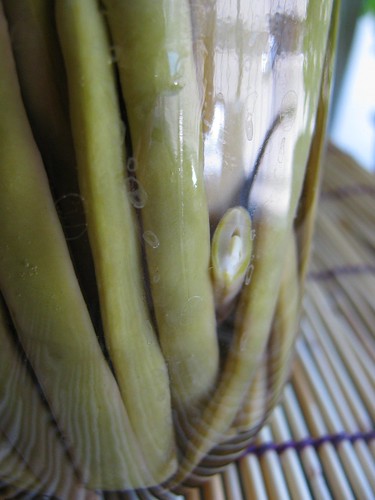
Photo from Flickr--no photographer identified--used by a cooking blog.


The original story in the Roanoke Times included a picture of white-haired Elizabeth holding a can of beans with a title something like, "Women Hasn't Opened Can of Beans for 57 years."  I wrote this to imagine why....

*

GREEN BEANS

"And as the years passed
the beans became a reminder
of her long-departed youth."

--Roanoke Times and World News, 10/26/78

*

Last week Elizabeth turned eighty.
She touches her hand to jar
blue against the velvet green of her beans
canned 1921, last year they had the farm.
The beans curve, green fingers
tip to tip
long, slender
as hers were that July
everyone said she'd the prettiest hands.

She feels cool weight of quart
thinks of pots steaming
so hot that July
Jonathan drug the woodstove out in the yard.
She is telling her daughter
a teaspoon of sugar
a teaspoon of salt
now wipe that rim.

Beans were scarce that year.
She paid her little ones
to pick beetles off
not before the vines all wilted.
Only one row in the new ground thrived
an odd row planted when she ran out of corn.
She sowed and picked beans by the moon
not enough to can
she canned them anyway
stacking beans upright
in concentric circles.

Nights she lay at Jonathan's side
stared at beans in the moon patterned ceiling.
At midnight
she finally slipped from the bed
counted stripe on stripe
tomatoes, peaches, corn
a hundred quarts

and that can of beans

cool fingers
soothing her to sleep.

*

Wish I  had a copy of the article in the Roanoke Times with me, so I could scan the picture of  Elizabeth.

This poem was originally published by Artemis, as I recall.  Although I started it in 1978, when I first joined a writers' workshop, I didn't finish it until several years later at the Hindman Settlement School's Writers' Workshop.  It turned out to be the first of a series about Elizabeth, called Weatherings, which take place over the course of a year in which the weather evokes earlier memories.  Fred Chappell used to sign notes to me Old Fred and tease me that I was writing about myself.  (He didn't know that my birth name is Beth, not Elizabeth, but maybe he was on to something.)


I read it for an audience most recently on September 25 at Voices from the Mountains (the lead-up to the march and sit-in on September 27) and got compliments from our emcee Reverend Billy, novelist Silas House, poet Bob Henry Baber, activists Roland Micklem and Sue Rosenberg and musician Carry Kline, among others, which was heartening.

 To tell the truth, following barn burners like Larry Gibson and Micky McCoy, I was glad that there was a musical interlude before I read  : ).  After this I finished out with Looking Out Over An Abyss in Boone County, one of my own barn burners.  The latter is about Larry Gibson's 50 acres at the edge of an mtr site and I don't think I had ever read to an audience when he was present.

UPDATE:  I also read the poem on the Floyd Radio Show January 7, 2012, where it was recorded and you can now listen on an archived podcast, which I've included at the link.

7/23/10

Judy Bonds: "Fight harder and finish them off."

Portrait of Judy Bonds by Robert Shetterly for his project, Americans Who Tell the Truth, used by permission of the artist. (UPDATE 7/29: Ordering info--more details see the bottom of this entry.)

Vernon Haltom, Judy Bond's co-director of Coal River Mountain Watch, just sent me the bad news that Judy has found out that she is battling stage three cancer. Vernon writes that "She said that some people have asked her before, "What do you want us to do if anything ever happens to you?" Her answer is "Fight harder." She repeated that today, to fight harder. " Her words:
We've got them on the ropes and smell blood. Don't let up, fight harder and finish them off.
I'm sharing this by permission. When I asked to what extent I should share the news, Vernon answer, "I asked how much of that she wanted me to let folks know, and she said there's no point in keeping it from people."

Treatment will take at least 3 months, and she doesn't expect to be back at work for several months. Judy had been sick for several weeks when her doctor sent her to the hospital in Charleston, after antibiotics didn't work on what had been diagnosed as pneumonia. Vernon wrote,
Judy has always been a fighter, never giving up. This is her big fight now; the only one she's able to do right now. ...Please, keep her in your prayers.
Judy won the prestigious Goldman Prize in 2003, for her work in fighting mountaintop removal. I also love the quotation on the page I've linked to.
The right to mine coal here ends where it endangers our health and safety. You may have your job tomorrow, but what do you tell your kids? That you wasted the future of these mountains?

*


Did you know you can support this post?

I'm putting this on a separate page, so as not to mix my discussion of how to crowd-source my journalism with news of Judy. But if you're interested, see my July 29 update: "Why I decided to try and fund this blog." (And, I might mention, if the experiment goes well, to also provide a way for me to fund support for activism in the coal fields and others' media coverage thereof. Too bad I didn't have the idea before I launched this page--for a while it was getting over 300 out of the last 500 hits, according to statcounter. If this works, I might also pitch in for something other than a free account and have better data.

3/23/08

Split this Rock Sunday

After a meeting at Busboys and Poets to hear about DC Poets Against the War from Sarah Browning, Esther Iverem, Joseph Ross, and Melissa Tuckey and discussing how to continue the work of the festival, we reconvened at George Washington University at noon for a reading by Naomi Ayala subbing for Sharon Olds who was sick, followed by Galway Kinnell, who before getting to his own poems, read one by Walt Whitman and another by his friend Richard Bly, substituting Iraq for Vietnam.

Steve had gone to Easter service, so he joined us late and we walked in silence for the five blocks to Lafayette Park, across from the White House, where we compiled a Cento consisting of 12 words read by each poet.

Afterwards, Len, Steve and I got together for coffee and an impromtu reading, after we were joined by two others from the festival who I beckoned in as they walked by. Since the Starbucks was closing, we actually read part of our poems at a table outside.

I drove out to Springfield and visited Mom and spent the night. Carol was also visiting.

Split this Rock Coverage in WaPo ​


Photo by Susan Biddle shows Martín Espada (left) and Ethelbert Miller (center.)  Not sure of the woman on the right.


I'm exhausted, I'm exhilarated. Yesterday's Washington Post feature by David Montgomery, "Poets Adverse to War," in the Style section is worth checking out, for the photos alone, not to mention some of the quotations form the poets. I just wish the story had led off with that. But poets here are not accorded the same place in public life as they are in Europe and Latin America.

For instance, Martín Espada:  "People in this society are starved for meaning...In a time of war, the government divorces language from meaning. . . . They drain the blood from words. Poets can put the blood back into words...No change for the good ever happens without being imagined first. . . . That's where poets come in...What I do is an act of faith. I put words out into the atmosphere. They become part of what we breathe. Hopefully that has some impact. But we shouldn't try to quantify the impact of a poem like it's a package of beans....You don't fight the good fight just because you think you're going to win....You fight the good fight because it's the right thing to do, regardless of the outcome, which you can't predict anyhow. That's how I feel about the work that I do."

For more photos see Split This Rock's photo archives at Flickr.  For instance, here's Jill Brazel's photo of the silent march to the White House on the 5th Anniversary of the start of the war in Iraq:


3/20/08

Split This Rock Poetry Festival


Sonia Sanchez at Bus Boys and Poets, and Martin Espada, Ethelbert Miller, Naomi Shihab Nye (pictured above) and Alix Olson at Bell Multicultural High School. Quite the lineup. I walked over to the latter w. Steve, who lives in the city. Interestingly he was talking about a poet who's work impressed him and it turned out to be Diane Gilliam. Adrianne Rich could not attend but sent a letter and a poem. Sam Hammill had had a series of minor heart attacks, so likewise.

This one by Naomi Shihab Nye earned a standing ovation:

Wandering Around an Albuquerque Airport

After learning my flight was detained 4 hours, I heard the announcement: If
anyone in the vicinity of gate 4-A understands any Arabic, Please come to the
gate immediately.

Well — one pauses these days. Gate 4-A was my own gate. I went there.

An older woman in full traditional Palestinian dress,
just like my grandma wore, was crumpled to the floor, wailing loudly. "Help,"
said the flight service person. "Talk to her. What is her problem? We told her
the flight was going to be four hours late and she did this."

I put my arm around her and spoke to her haltingly. "Shu dow-a, shu- biduck
habibti, stani stani schway, min fadlick, Sho bit se-wee?"

The minute she heard any words she knew — however poorly used – She
stopped crying.

She thought our flight had been cancelled entirely. She needed to be in El Paso
for some major medical treatment the Following day. I said "No, no, we’re fine,
you’ll get there, just late, Who is picking you up? Let’s call him and tell him."

We called her son and I spoke with him in English.
I told him I would stay with his mother till we got on the plane and would ride next to her — SouthWest.

She talked to him. Then we called her other sons just for the fun of it.

Then we called my dad and he and she spoke for a while in Arabic and found
out of course they had ten shared friends!

Then I thought just for the heck of it why not call some Palestinian Poets I
know and let them chat with her. This all took up about 2 hours.

She was laughing a lot by then. Telling about her life. Answering questions.

Soon after, she pulled a sack of homemade mamool cookies — little powdered
sugar crumbly mounds stuffed with dates and nuts — out of her bag and was
offering them to all the women at the gate.

To my amazement, not a single woman declined one. It was like a Sacrament.
The traveler from Argentina, the traveler from California, the lovely woman from
Laredo — we were all covered with the same
powdered sugar. And smiling. There are no better cookies.

And then the airline broke out the free (non-alcoholic beverages from huge
coolers and the two little girls for our flight--one African
American, one Mexican American — ran around serving us all Apple Juice and
Llemonade and they were covered with powdered sugar too.

And I noticed my new best friend — by now we were holding hands – had a
potted plant poking out of her bag, some medicinal thing, with green furry
leaves. Ah, an old country traveling tradition: always carry a plant. Always
stay rooted to somewhere.

And I looked around that gate of late and weary ones and thought, "This is the
world I want to live in. The shared world."

Not a single person in this gate — once the crying of confusion stopped – was
apprehensive about any other person.

They took to the cookies. I wanted to hug all those other women too.
This can still happen anywhere.

Not everything is lost.

~


And this one by Martín Espada is the title poem from a collection of the same name:


Imagine the Angels of Bread

This is the year that squatters evict landlords,
gazing like admirals from the rail
of the roofdeck
or levitating hands in praise
of steam in the shower;
this is the year
that shawled refugees deport judges
who stare at the floor
and their swollen feet
as files are stamped
with their destination;
this is the year that police revolvers,
stove-hot, blister the fingers
of raging cops,
and nightsticks splinter
in their palms;
this is the year
that darkskinned men
lynched a century ago
return to sip coffee quietly
with the apologizing descendants
of their executioners.

This is the year that those
who swim the border's undertow
and shiver in boxcars
are greeted with trumpets and drums
at the first railroad crossing
on the other side;
this is the year that the hands
pulling tomatoes from the vine
uproot the deed to the earth that sprouts the vine,
the hands canning tomatoes
are named in the will
that owns the bedlam of the cannery;
this is the year that the eyes
stinging from the poison that purifies toilets
awaken at last to the sight
of a rooster-loud hillside,
pilgrimage of immigrant birth;
this is the year that cockroaches
become extinct, that no doctor
finds a roach embedded
in the ear of an infant;
this is the year that the food stamps
of adolescent mothers
are auctioned like gold doubloons,
and no coin is given to buy machetes
for the next bouquet of severed heads
in coffee plantation country.

If the abolition of slave-manacles
began as a vision of hands without manacles,
then this is the year;
if the shutdown of extermination camps
began as imagination of a land
without barbed wire or the crematorium,
then this is the year;
if every rebellion begins with the idea
that conquerors on horseback
are not many-legged gods, that they too drown
if plunged in the river,
then this is the year.

So may every humiliated mouth,
teeth like desecrated headstones,
fill with the angels of bread.