Showing posts with label social media. Show all posts

2/17/18

Guest Post by Elizabeth Englander: Ten Ways Schools, Parents and Communities Can Prevent School Shootings Now


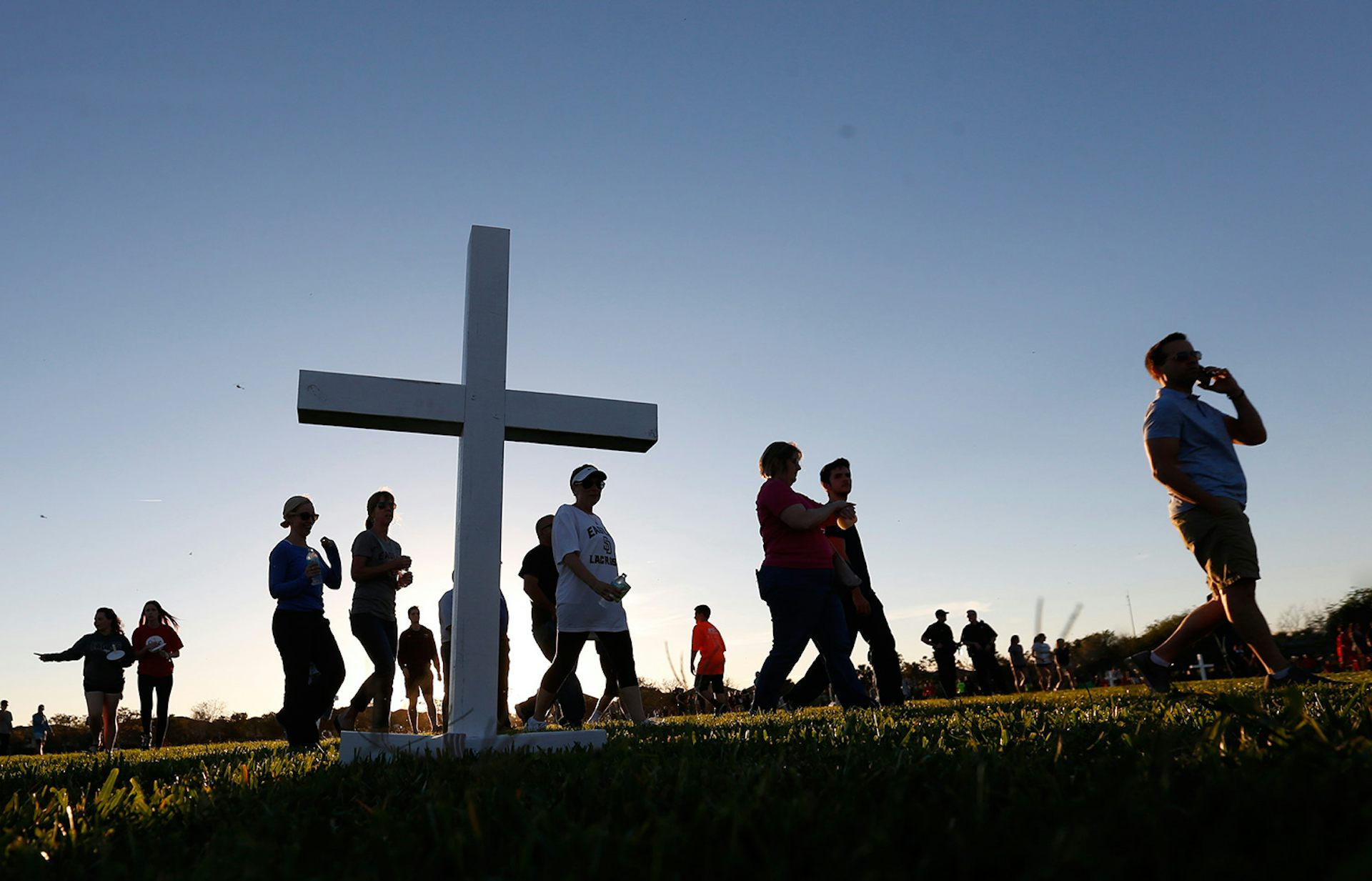
Photo by Miami photojournalist Wilfredo Lee for AP accompanied this piece of the same title published by The Conversation published 2/16/18 by Elizabeth Englander (profile, email) Professor of Psychology, and the Director of the Massachusetts Aggression Reduction Center  at Bridgewater State University.


The Conversation is a collaboration between editors and academics to provide news analysis and commentary that is free to read and republish using a Creative Commons, no derivatives licence.

*

After a shooter killed 17 people at a Florida high school, many have expressed frustration at the political hand-wringing over gun control and calls for prayer.

As a parent, I understand the desire for practical responses to school shootings. I also absolutely believe the government should do more to prevent such incidents. But the gun control debate has proven so divisive and ineffective that I am weary of waiting for politicians to act.

I study the kind of aggressive childhood behavior that often predates school shootings. That research suggests what communities and families can start doing today to better protect children. Here are 10 actions we can all take while the federal government drags its heels.

What schools can do


Because educators observe students’ emotional and behavioral development daily, they are best positioned to detect troubled behaviors and intervene. In Los Angeles, for example, schools have successfully used outreach and training to identify potentially violent students before problems occur.

1. Teach social and emotional skills 

Children learn social skills from everyday interactions with each other. Playtime teaches young people how to control their emotions, recognize others’ feelings and to negotiate. Neighborhood “kick the can” games, for example, require cooperation to have fun – all without adult supervision.

Today, frequent social media use and a decrease in free play time has reduced children’s opportunities to learn these basic social skills.

But social and emotional skills can – and should – be taught in school as a way to prevent student violence. Students with more fluent social skills connect better with others and may be more able to recognize troubled peers who need help.

2. Hire more counselors and school resource officers


Due to budget cuts, many schools have few or no trained school psychologists, social workers or adjustment counselors on staff. These mental health professionals are society’s first line of defense against troubled students – especially with the current increase in adolescent depression and anxiety.

In my opinion, school resource officers – trained police officers who work with children – are also helpful for students. While untrained officers may pose a threat to students, well-trained school resource officers can connect with kids who have few other relationships, acting as a support system. They are also on hand to respond quickly if crime or violence erupts.

Putting trained school resource officers and counselors in every school will cost money, but I believe it will save lives.
3. Use technology to identify troubled students

Technology may challenge kids’ social development, but it can also be harnessed for good. Anonymous reporting systems – perhaps text-message based – can make it easier for parents and students to alert law enforcement and school counselors to kids who seem disconnected or disturbed. That enables early intervention.

In Steamboat Springs, Colorado, one such tip appeared to prevent extreme violence in May 2017. Police took a young man who’d threatened to harm his peers into protective custody before he could act on his words.

What communities can do


Communities also help raise children. With many eyes and ears, they can detect often smaller problems before young people grow into violence.

4. Doctors should conduct standard mental health screenings


Extreme violence is almost always preceded by certain behavioral problems. These typically include a propensity toward aggression, a marked lack of social connectedness, indications of serious mental illness and a fascination with violence and guns.

Doctors could detect these problems early on with a standardized screening at health checkups. If concerns arise, referrals to counseling or other mental health professionals might follow.
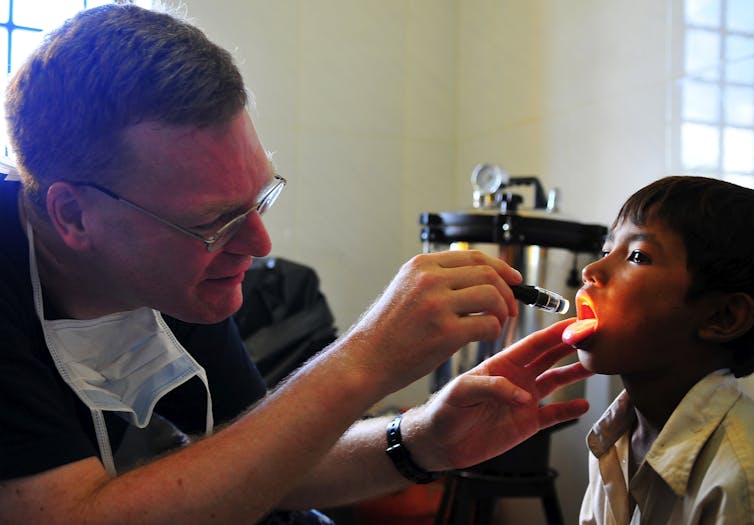


Doctors are an underutilized community resource. Regular check-ups could help prevent violence. Myfuture.com, CC BY-ND


5. Enlist social media companies in the effort to detect threats


Most young people today use social media to express their feelings and aspirations. In the case of school shooters, these posts are often violent. A single violent post is hardly a guarantee of homicidal acts, of course. But evidence strongly indicates that repeated expressions of this nature can be a sign of trouble.

I would like to see companies like Instagram, Twitter and Snapchat create algorithms that identify repeated online threats and automatically alert local law enforcement. 

What parents can do

Parents and guardians are often the first to detect their child’s emotional struggles. Here are some tips for monitoring and promoting healthy emotional development at home.

6. Think critically about your child’s social media use

From virtual war games to cruel trolls, the internet is full of violence. The relationship between violent content and aggression hasn’t been consistent in research: Some studies see no relationship at all, while others find some correlation between violent video games and violent behavior.

This mixed evidence suggests that online content affects children differently, so parents must assess how well their child handles it. If your daughter likes “Assassin’s Creed” but is gentle, socially successful and happy, the onscreen violence may not be strongly impacting her.

But if your child is drawn to violent games and tends to be aggressive or troubled, discuss the situation with your pediatrician or school counselor.

7. Consider what your child is missing out on

Is your child sleeping properly? Do your kids socialize with other young people? These two behaviors are linked to mental health in children, and excessive screen time can reduce or diminish the quality of both.

Make sure digital devices aren’t disrupting your kids’ sleep, and schedule play dates if your kids don’t make plans on their own.

8. Assess your child’s relationships

Like adults, children need confidants to feel invested in and connected with their community. The trusted person can be parent, a family member or a friend – just make sure someone’s playing that role.

For children who struggle to make friends and build relationships, there are programs that can help them learn how.
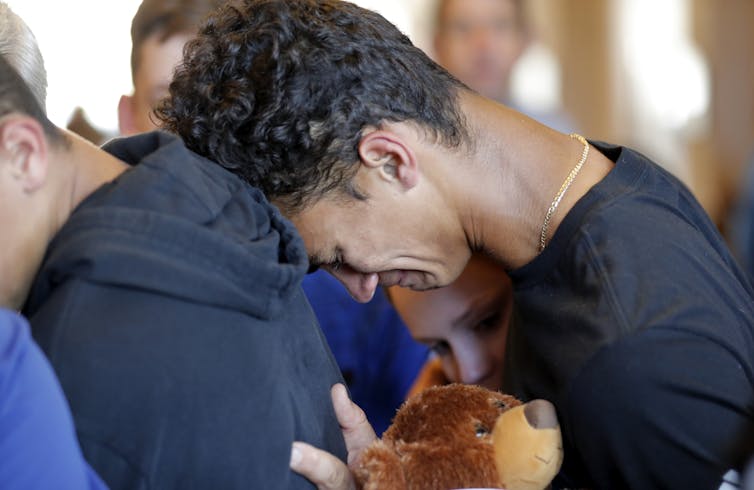


Children need confidants to feel connected to their communities. AP Photo/ by Louisiana-based Gerald Herbert


9. Fret productively about screen time

Research shows that excessive screen time can damage kids’ brains. That’s alarming in part because parents can’t realistically keep kids entirely off devices.

So rather than just fret over screen time, focus instead on how children can benefit from a variety of activities. Evidence shows that children who experience different pursuits over the course of their day – from sports and music to an after-school job – are happier and healthier for it.

10. Talk with your child


This is both the easiest and hardest way to make sure your kids are doing OK. Children, especially teenagers, don’t always want to talk about how life is going. Ask anyway.

My research shows that simply asking children about their friends, their technology use and their day is an important way to show you care. Even if they don’t respond, your interest demonstrates that you’re there for them.

Try this one now. Ask your children what they’re thinking about the shooting in Florida and how they like their friends and school. Then listen.

7/2/12

Firsthand Accounts: Parts of WV, Ohio "Apocalypse" due to the Derecho


I first posted this on 7/2/12 at 11:05 a.m. This photo is used by permission from Tina Thomas (@Grannytt). This is preliminary blog post to get the word out. Check back often as it's being updated. The most recent update was on July 8 at 9:41 a.m.

Please help us spread the word of the storm's effects. If you're on twitter, here's a tweet:


Please RT, spread word 1st hand reports #WV #OH #Derecho #Appalachia Apocalyptic bit.ly/N4ceBa
Here's a public version of photo and link to this post which is up behind the "facebook garden" gate, which you can share:

http://on.fb.me/NXZd9R
Please share via all your social networks and news aggregators, such as Stumbled Upon. Remember that Aaron Bady got all those hits on the post about Maria because someone shared it to Redditt. So many,even locally,have no communication on conditions other than through social media.

*
Unexpected wind gusting above 80 miles per hours through parts of Appalachia affected us here in Blacksburg and the Roanoke Valley of Virginia, but things were inconvenient, rather than dire (excluding the fatalities.)Our electric coverage was a patchwork, which meant you could drive further down the road and find gasoline, restrooms, water. Such was not the case in most of West Virginia and Eastern Ohio.

Tina Thomas lives on the Kanawha River in Arbuckle, WV

She has open skies all around her. She told me via twitter that she took the above picture in Leon, WV looking west towards Ripley Friday evening as the storm was moving in. I have another one she took looking east towards Point Pleasant. She's a priority electricity customer, because she shares the grid with Urgent Care of Leon County in Buffalo, a small facility for rural folks in WV. She explains,
Without this some out on the back roads would have to drive one hour or more for help.
She and the urgent care and "only" went without power for 26 hours...
Believe it or not, that is what it looked like to the West.
Bob Kincaid lives in Fayette County, WV

Kincaid, has been Board president of Coal River Mountain Watch. He runs the internet radio network, H.O.R.N. On July 1 at 1:18 p.m., he wrote me
Here's what I know at this point:

This is my third trip to Summersville since the storm hit. I'm trying furiously to get my generator going to afford us a little relief.

Gasoline is available at the Sheetz and a few other places in Summersville.

Ice is a distant memory. Haven't seen a single place where it's available. This is where the Nat'l Guard should be providing relief: ice, water and MREs.

WalMart is sold out of camp stoves, propane, lantern fuel, ice chests and gas cans and batteries. So is every other store.

Sheetz is to be commended. I've seen a tanker truck there every time I've been here. They seem to be treating the situation with the gravity it deserves.

I have not seen a single Nat'l Guard vehicle in the times I've been out. No state troopers, either.

And yes: I reiterate: Earl Ray Tomblin's [campaign] website entry page is some silly stuff about writing a letter to the EPA over the so-called "War on Coal." Nothing about the emergency, nothing about safety, nothing about relief efforts. He should be roundly excoriated for his inaction.
At 2:30 p.m., he added,
I saw my first Nat'l Guard Vehicle today: a Hummer pulling into the Taco Bell in Summersville.
Lorelei Scarbro lives in Raleigh County, WV

Scarbro, the widow of a coal miner volunteers full-time at the Boone-Raleigh Community Center, which she helped found and of which she is the Board Chairwoman. She emailed me on July 3, 2012 at 7:26 p.m.
I was in Whitesville this morning. No power and I did see the national guard unloading a truck of water at the fire station. That water was going to clear fork because they have no power or water. I saw only one truck and one Hummer..no food just water. No tornado the streets were clean axnd empty.

We need so much more. I stopped and asked the fire chief what I could do. He asked if the community center was open. I said no because we have no power. If we had power we could be cooking for people.  I am looking forward to the day when we can fill the roof with solar panels.  Me and mine are ok.
I first became aware of how bad things were elsewhere when I received an email

Documentary filmmaker Mari-lynn Evans lives in Akon, Ohio, but has family in Braxton, WV. She sent word through via a friend at 11:45 p.m. on June 30, calling the situation "Apocalyptic."

Things haven't improved much.  As another friend pointed out, we don't have the military and National Guard defending us from the police. No one is trying to shoot us. Almost all the houses are still standing. There are no people being left behind, forgotten about in hospital and jails.But here, folks are still in a bad situation and the government response appears lacking.  And we're dealing with high temperatures and lack of water.  As Mari-Lyn explained,
Driving in the darkness with nothing open for hours felt so eerie.
Another passenger in the car said
it was like being in a Steven King novel. It is a horrible situation for so many living in this state of disaster.
As if it weren't enough that folks weren't already dealing with poisoned water from chemical and coal industries. I wondered when the national media would start covering events. Marilyn posited:
I think no one knows this is happening because so few of us are able to get this info out due to no phones or computers.
How would folks in the national media find out what was happening?

I would have not known how bad things were, if  I not received had first-hand accounts.  Mari-Lyn was emailing and posting to her facebook page.The email lists we are on are closed to most media so that folks can talk freely. The facebook page requires that you be her "friend."  The accounts in the paper and the releases from the governor's office were so bland and minimized the damage.  The tweets from WV media weren't using the hashtags #WV #Derecho.

Here are some samples of what I was learning

Below, you'll find emai posts from Mari-Lyn and from Elisa Young, a paralegal in Ohio, used by permission.

In an update, I'll be posting from others as I receive permission. But before I update, I want to report, in a separate post, on FEMA in Fayette County, one of the areas hardest hit and complaints that feeding decisions are being skewed by the PGA tournament at the Greenbrier.  Then I'll be back to add more accounts.

Mari-Lyn Evans, Saturday, June 30, 2012,  11:45 p.m.

I'm In WV. It's desperate. No food water gas. Post email help!!!!!! If near WV bring food and water. Oxygen patients flooding hospitals. Many people with no phone service or gas to get help, water or supplies.

Post this to our Facebook. If you can come into wv with food water and check on people. I have not seen 1 emergency vehicle. People in hollers with no way to get help or leave. No one going house to house to check. 79 50 all clear no traffic. Come with aid

Where...is the national guard.  Cars and people are stranded at closed gas stations. No gas or lights from Parkersburg to Clarksburg. Then none in Braxton Upshur or Lewis Co.  Apocalyptic.

At the time, the Corps of engineers was not letting people use the facilities at Huntington and Burnsvillle.  By 7:02 p.m. the Corps of Engineers had unlocked the gates at Burnsville Lake, but the situation was still dire.  Her family in Buckhannon had reported lights have just come on there, but St Joes Hospital was not taking patients.  By this morning, things were still dire.

Mari-Lyn Evans,  Monday, July 2, 9:47 a.m.

Just off with Joe Manchin. They are calling Tomblin re Guard and State Police checking on people and setting up communication and help.

Now?

They did not know where any Guard was in WV. That is Tomblin's to do apparently.

I told them how desperate the situation was on the ground, that no one can get out word to get help.

I organized 4 trucks of food and water to go into Braxton County this morning. But, I have no idea how to help other than to help in the small area where I have family.
Mari-Lyn Evans, Monday, July 2, 9:47 1:22 p.m.
No one is in their offices. No one.
We are the few who are able to get calls out.
Posting everything I get to FB.
Elisa Young, Sunday, July 1, 12:01 a.m.
We are facing the same thing in Ohio, at least SE - Kasich is sending help to Cincinnati and central Ohio,has said the urban areas are the priority, but has said only when they are done there are they sending any help here.

I got stuck in Vinton County last night . It was like a typhoon. Just from the people there at the camp who were calling home, the electricity ...was completely out from Lancaster to Jackson, Marietta, and Meigs. At least a quarter of the state. I was low on gas, and when I got back to Nelsonville in the morning, the line for the only gas station open was farther than I could see the end of. I waited for two hours and then the police said another station had opened in Nelsonville and flagged us away. Waited another hour and a half at the next gas station and two people tried to fight me for the gas I'd paid for, but got enough to get home, where there was no water or electricity.

The electricity is on now, The [City of ] Athens County was made a priority, but they said it will be sporadic and they expect it to go out again. Still no water. More storms are coming through Monday and Tuesday.

It's been like a scene from a Steven King novel. The emergency help may be tied up somewhere, but it's not in this quarter of Ohio.
Elisa Young, Sunday, July 1, 8:18 a.m.
Aside from re-posting to friends, local lists and facebook. If we can't get down there, is there someone we can be calling to put pressure on for help?
Elisa Young, Sunday, July 1,  9:25 a.m.
Are toll roads open or does anyone know who to check with on that - state highway patrol?
Elisa Young, Sunday, July 1, 12:17 p.m.
Our electric is back on now, but neighbors keep knocking on the door. We have five families on the same well, happens to be in our house, and the water is still out....Landlord not responding.

A friend from Meigs just called me - I left her a message early Saturday to see how she was. She had been standing in line at the gas station that's open to charge her cell phone so she could have communication. Everything still out there.
Elisa Young, Sunday, July 1, 12:38 p.m.
...Mobile homes and 100 degree weather aren't a good mix with senior citizens without a hospital or ER in the county and gas supplies no guarantee if you can get there.
Elisa Young, Sunday, July 1, 12:44p.m.
[My friend in Miegs] has no cell coverage from her home - land line requires electricity to work with the type of phone she has. Had to drive to the gas station that was open to charge her phone and get cell coverage.

The county is sparsely populated - no cities, no hospital, university, or population density to make the county a priority.

I remember we always got the bulk of the pollution, dead last, bottom of the barrel service. I remember AEP telling me the reason they would not go to the expense of insulating the high tension power lines that ran across the community (they have the technology to reduce electromagnetic radiation), was that there weren't enough people to justify the expense.

Same old same old.
Elisa Young, Sunday, July 1, 12:48
I've been asking people here about injection well issues on the wells that require pressurization, when the power went out, and where they were actively injecting. MariLynn raised a good point about the impoundments. Would be a good idea for people to check on those near them - have never known industry to go out of it's way to report problems.
Elisa Young, Monday, July 2, 4:04 p.m.
On the way down to Meigs last night to check on some people and take food, I saw at least 30 repair trucks high-tailing it through Athens County headed toward Columbus. I was assuming to re-restore electricity.

It was strange going up to Columbus this morning for the press conference on the frack waste testing results. When I got to Columbus, it was business as usual.

The people I met there from Cleveland had no clue what was happening to the South.

NPR news also said that 20,000 additional people in SE Ohio were left without electricity after last nights' storm, bringing the total in the bottom two-thirds of SE Ohio to 243,000 homes without electricity.

They said power in Meigs/Gallia Counties won't be restored until Thursday at the soonest (7 days from when it went out) - we were dead last on the priority list and they listed Wellston specifically in their own category within the county list. Wellson is in Meigs County, where homes were blown off their foundations into the road by the winds - they are predicting electricity will be restored in Wellston, Meigs County, by next Tuesday. (12 days)

NPR also announced that the National Guard had been dispatched to central Ohio due to the power outages

2/25/12

Zen and the !@#Oof!* of Journalism Impact


Illustration from Rio Carnival Services.  Over a year ago DigiDave David Cohn) decided to revive the idea of a group of journalists getting together once a month to write in depth about the same topic, directed by a different host each time. Steve Outing, February carnival host publishes a roundup  with links to  posts by my fellow carnies. 

*

For the February Carnival of Journalism, our host Steve Outing asks,
What emerging technology or digital trend do you think will have a significant impact on journalism in the year or two ahead? And how do you see it playing out in terms of application by journalists, and impact?

The first definition of  "impact" in the dictionary is "collision" not "effect." 

When Steve raised his question,  I had visions of the Hadron Collider, of accelerating particles banging into each other at great speed "in hopes of grabbing a piece of the primordial fire, forces and particles that may have existed a trillionth of a second after the Big Bang," as physicist Dennis Overbye put it in the New York Times.

For particles substitute tweets and facebook posts and cell phone text messages and pictures and videos, all coming at journalists faster and faster. 

Rather than trying to predict the next killer app, let me give an example of how twitter has democratized the news, not during the Arab Spring or the Occupy movement, but earlier in time and closer to home.

Twitter and the Appalachian Winter of December 2008.

We've always had trouble in this region getting the news out except in the case of mining disasters where lots of folks die.  Right now, we're coming up on the fortieth anniversary of the Buffalo Creek flood.  125 died after the coal company turned down the sheriff's offer to warn people to get to higher ground when the rubble used to dam Buffalo Creek  started to fail to hold back 132 million gallons of  coal slurry.

Then in  Martin County Kentucky we had another sludge spill on October 11, 2000,  which dumped 300 million gallons. Somehow no one died.  As in 1972, the sheriff was taking orders from the coal company, this time deputies turned away media on the road leading  in to the flooded area.   Although there were reports in the Lexington and Martin County papers and on their websites (and in the New River Free Press, which I authored)  the New York Times waited to write about the spill  until Christmas Day that year.

You might not  recall reading about it.  After all, by then it wasn't really news.  Compare that to the coverage of 11 million tons of oil spilled in 1989 by the Exxon Valdez and the images that it still brings to mind.

How twitter changed things

December 22, 2008,  525.2 million gallons of coal ash sludge  at TVA's Kingston coal-fired power plant ruptured the dike of a 40-acre holding pond and covered 400 acres up to six feet deep, damaging 12 homes and wrecking a train.

This time new media and citizens in the area were able to amplify their reports by tweeting.  I remember, at first, the moderator on a coal list serve chastised me for posting the links.  Then, a story appeared in the New York Times by December 24.  The list moderator apologized.

There's the old saying about a tree falling in the forest and, of course, a lot of trees are still falling without the larger world hearing.  There are still plenty of stories that are important to tell, but which haven't accumulated enough quantum mass to reach a broad public.

SAMPLER:  A case of digital journalistic optimism

Like Steve, I'm a "digital optimist."  There are many emerging apps that journalists are embracing, as evidenced by those written about by my fellows in the Carnival and discussed this past week at the Knight Foundation's Media Learning Seminar. That's why I've started work on a new media alliance for our region:  SAMPLER--Southern Appalachian Media Project for Literacy on Environmental Renewal.

We plan to strengthen regional coverage by creating an alliance of  journalists and citizens to provide in-depth reporting on regional topics including sustainable development and transition from dependence on the mono-economy of coal mining, especially the destructive practice of mountaintop removal, as well as a mechanism to crowd source such efforts and critique coverage that is biased or stenographic. You can read more on SAMPLER here. You can make a tax deductible donation designated for SAMPLER to the Ohio Valley Environmental Coaltion at RAZOO..

With  SAMPLER, we're not waiting for the next killer app, although, should it arise, we'll figure out how to take advantage of it.  Rather, we're looking to
find new ways to convey information and news by using existing platforms and human networks.  You know, friends, neighbors, libraries, local citizens groups, email lists.  I'd say mobile phones, but we have lousy reception many places in Appalachia.

What the Big Bang theory means for digital journalism

Steve urges how it's important not be "caught blind-sided, again."   An older friend tells me she always remembers what Dear Abby, or perhaps Ann Landers,  advised when someone was afraid it was too late to pursue a new path:  time will pass whether you make changes or not.

The Big Bang Theory posits a universe starting  small, hot and dense, which has since expanded into something vast.  We're finite individuals and it's tempting to get overwhelmed   trying to figure out what's coming next.  In such vastness, though, there is also space to choose, room to chill.

6/15/11

Is Facebook founder Mark Zuckerberg Tone Deaf About Privacy?

5/23/10 Cartoon by Atlanta Journal Constitution's Pulitzer Prize winning Michael Luckovich, used by permission (blog including bio, email)

*

Remember the uproar when Facebook made your list of friends, pages you are a fan of, gender, geographic region and networks publicly available to everyone? Now, the social networking behemoth has silently enabled facial recognition software without your permission under the rather benign tag "Suggest photos of me to friends." Even if you choose to disable the option, Facebook still will have the technical ability to connect your name with your image.

Mark Zuckerberg might say his company is just evolving on privacy – witness his comments in this video interview that:
We view it as our role in the system to constantly be innovating and be updating what our system is to reflect what the current social norms are.
Contrast this with his former claims that privacy is "the vector around which Facebook operates".

Imagine if, in the name this vector, his company had labelled the new feature "facial recognition photo tags" and required users to opt in, rather than disable it after the fact. Methinks Zuckerberg would have had fewer takers.

But already, the deck is stacked against privacy. As media activist Cory Doctorow noted in a TED lecture, Facebook employs 
very powerful game-like mechanisms to reward to disclosure – it embodies BF's Skinner's famous thought experiment, the notion of the Skinner box … lavish[ing] you with attention from the people that you love … in service to a business model that cashes in the precious material of our social lives.

Is this new feature really designed to make the site more useful to users or to boost its commercial value as it nears an initial public stock offering?

As Joan Goodchild, senior editor of CSO (chief security officer) Online, noted to me:
Many privacy advocates feel Facebook needs to do a better job of educating folks about what the new feature is, what it does, and how to opt in or out. Many also feel a user should always be opted out of new features automatically, and should then have to opt in themselves. But it is often the other way around when Facebook rolls out these features.
My concerns go deeper: once data is available to third parties, however temporarily, the cat is out of the bag and beyond retrieval. And it's not just this constant meddling with our settings that's releasing our information – there are also security holes, not to mention scams and release of our data by third-party apps, which the Wall Street Journal found "were sending Facebook ID numbers to at least 25 advertising and data firms, several of which build profiles of internet users by tracking their online activities". More recently, Facebook was adding apps to our profiles that we hadn't requested and which we were unable to permanently disable.

And I'm also concerned about the front doors – also back doors--available for governments, including our own, which has been surveilling such security "risks" as the Quakers and calling Virginia opponents of mountaintop removal "terrorists" (pdf) (while excluding the Ku Klux Klan). There are already huge government-controlled facial databases: your photo on your driver's licence, government-issued identity card, travel visa and passport ends up in a government office. If the government wants to see a photo of your face, it often wouldn't need Facebook to get it. But Facebook's facial recognition feature certainly adds data points and a social graph. As Bruce Schneier, chief security technology officer of BT wrote me:
"Right now, Facebook has the largest collection of identified photos outside of governments. I don't think we know what the ramifications of that will be."
All this reminds me of Steven Spielberg's Minority Report: the 2002 film, based on a 1958 short story by Philip K Dick, featured law enforcement preventing "precrimes" and corporations bombarding passersby with holographic advertisements which crawled up the sides of walls, addressing them by name. 

Goodchild recently listed some of the hidden dangers of Facebook. And this is nothing new. As early as 2005 (the year after Facebook's rollout), MIT students were already detailing (pdf) what they saw as Facebook's threats to privacy:
"Users disclose too much, Facebook does not take adequate steps to protect user privacy, and third parties are actively seeking out end-user information using Facebook."
Facial recognition on Facebook arrived with no notice in the US, unless you kept up with the social network's blog last December. The feature came to general light last week, when Facebook extended the feature to other countries and European regulators started investigating.

In the US, Congressman Edward Markey (Democrat, Massachusetts), co-chairman of the bipartisan congressional privacy caucus, has complained:
"Requiring users to disable this feature after they've already been included by Facebook is no substitute for an opt-in process … If this new feature is as useful as Facebook claims, it should be able to stand on its own, without an automatic sign-up that changes users' privacy settings without their permission."
Marc Rotenberg, executive director of the Electronic Privacy Information Centre (Epic), spearheaded a complaint with the Federal Trade Commission on 10 June that Facebook's deployment of facial recognition software rises to the level of "unfair and deceptive trade practices". Joining Epic were the Centre for Digital Democracy, Consumer Watchdog and the Privacy Rights Clearinghouse, all of which asked (pdf) 

the commission to investigate Facebook, determine the extent of the harm to consumer privacy and safety, require Facebook to cease collection and use of users' biometric data without their affirmative opt-in consent, require Facebook to give users meaningful control over their personal information, establish appropriate security safeguards, limit the disclosure of user information to third parties, and seek appropriate injunctive and compensatory relief.

Facebook provides valuable ways to stay in touch with our friends and families, to network with our colleagues and customers and to coordinate activism. But is hypervisibility really in our best interest, and shouldn't we be the ones making the decisions about what to disclose? Markey submitted legislation in May outlawing the tracking of children online. He might need to add something for adults.
 *
UPDATE:  This piece was originally commissioned by the Guardian and appeared with minor changes as "What Facebook fails to recognise: Facebook has form for being cavalier with users' privacy, but its new facial recognition software has truly dangerous implications."  In response to its publication, FB issued this statement on the FTC complaint: 
We have heard the comments from some regulators about this product feature and we are providing them with additional information which we are confident will satisfy any concerns they will have."