5/11/12

May 10: Central Appalachian Women’s Climate Justice Tribunal


Charleston, WV hosted the Central Appalachian Women’s Climate Justice Tribunal--the first to take place in the US--Thursday, May 10 from 10 a.m. - 3 p.m. at the Charleston Woman’s Club (1600 Virginia St. East, Charleston, WVA).

Women  throughout Central Appalachia — from southern West Virginia, eastern Kentucky, southwest Virginia and eastern Tennessee — impacted by mountaintop removal and other mining abuses will raise their voices, exposing the impacts of mountaintop removal on their lives, their families and their communities. I posted live from my twitter feed. If you weren't able to attend there is a recording of the tribunal online thanks to the Loretto Community.

The tribunal will present its findings at the Rio+20 at the United Nations Conference on Sustainable Development in Brazil this June. Similar tribunals have taken place around the world, spearheaded by the Feminist Task Force. These tribunals have been used to create a public space for women to draw attention to critical issues at local, national and global levels.

The Jurists were:
  • Elizabeth Peredo, climate justice expert from Bolivia
  • Lois Gibbs, of Love Canal fame and Executive Director of chej.org, and
  • Grant Smith, Energy Policy Advisor at the Civil Society Institute.
Funders, co-sponsors and participants include: Appalachian Community Fund, Appalachian Voices, Coal River Mountain Watch, Jessie Smith Noyes Foundation, Keepers of the Mountain, Kentuckians for the Commonwealth, Southern Appalachian Mountain Stewards, Sierra Club, SouthWings, The Alliance for Appalachia, The CLEAN, West Virginia Free, West Virginia Highlands Conservancy.  The principal  organizers are OVEC (Huntington, WV).,  The Loretto Community at the United Nations and The Feminist Task Force of the Global Call to Action Against Poverty.

5/6/12

WTJU Folk Marathon: Lasko & Pun, Joe Overton, Joe Ayers and More!

Illustration is from WTJU Folk Marathon publicity of the Tshirt design by graphic artist Frank Riccio (portfolio, email).  Riccio helps host a program at the station and is affiliated with Virginia Book Arts and the McGuffey Arts Center in Charlottesville.  This entry was first published at 11:59 am on 5/6/12 and last updated 12:55 pm  on 6/12.

*

I'm a big fan of Morwenna Lasko and Jay Pun of Charlottesville ever since hearing them at a November 2011 house concert at Monkeyhouse in Blacksburg (thanks, Robyn and Jim!)  Here's a link to a video of the Berklee grads playing the Millenium Stage at the Kennedy Center in August 11, 2011.


So, of course, I was glad to tune in (podcasts online for two weeks) to hear them when they told me (the link is to their promo...I actually got an email) they would be special guest hosts playing a selection of the artists who help influence their own sound. for the 2012 Folk Marathon.

Peter Jones, folk director for the station explains this year's theme, “Too Hard To Label”
...we will be focusing on five of our favorite music labels: Smithsonian Folkways, Signature Sounds, Compass, Rounder and Rebel. And in honor of Woody Guthrie's 100th birthday, we will do a few shows in his honor...Not only have our regular announcers come up with the usual line up of special programs, but several musicians from the community are doing programs....
If possible, I was even happier to learn that my friend Joe Overton was one of those musicians, hosting the next segment after Morwenna and Pun's--local folk, old-time and bluegrass acts he had chosen, mostly younger acts, although he started with "Leaving Tennessee" by Mike Seeger and Tim O'Brien off of the Third Annual Farewell Reunion. The biggest treat was hearing him play live with Erin Johnson of Belle Star.

I met Joe when Willie Dodson and I stopped by to see him at his home in Tennessee on our way down to the Southern Climate Convergence near Asheville long before he moved to Charlottesville.  (All three of us oppose so-called mountaintop removal and Willie and Joe play together in the Here's to the Long Haul.). So, I decided to donate in memory of Irene McKinney, the late poet laureate of WV, who was also an opponent of MTR.

And then I learned as I continued to listen that there was a fretless banjo special with Joe Ayers. And on and on. I listened all the way until midnight.I'd encourage anyone who loves old time and folk music to join me in supporting the station.   How great that you can listen on demand for those two weeks. I KNOW what I'm going to listen to tomorrow.

Here's a picture of Morwenna and Jay when they played Blacksburg's Stepping Out in 2010.  (Copyrighted image used by permission with all rights reserved.)  They'll be back for 2012 at 5:00 on August 3, playing as the "MoJa Quartet" featuring Pete Spaar on upright bass and Devonne Harris on drums.


Here's a picture of Joe Ayers. 


And here's a picture of my friend Joe (far right) with another of his bands, The Clear Blue Sky.

5/1/12

ITT's Mike Elk Covering Labor Notes Conference Thanks to Crowdsource Funding

Picture of Mike Elk is adapted from a screen shot of his video at YouTube. 

*

For anyone who wants yet another example of the skewed economics of journalism, take a look at this video by Mike Elk, labor journalist for In These Times Magazine. He wanted $500 to fly from DC to cover the Labor Notes Conference (program) near Chicago in Rosemont, Illinois, where rank and file members, local union leaders and labor activists connect to strengthen the movement—from the bottom up.
Often in covering labor struggles, I find that union members often find themselves as equally frustrated with the bureaucracies of their unions as with the corporations they are fighting. Rarely though are the voices of these worker struggling to change their unions heard. Next weekend May 4 -6, Labor Notes is holding its bi-annual conference in Chicago. Over 2,000 activists and union members from dozens of different unions have already purchased registration to attend this meeting where they will discuss their struggles and the direction of the labor movement. However, I lack the funds to attend this important event and need your help to raise them. 
When it comes to labor writers, Mike is one of my favorite labor reporters.  Today, he filed a story,  "A Tale of Two Rules: Washington Bureaucracy and the Politics of Workplace Safety."  I DO wish he would write about how the UMWA leadership sells out mountains by supporting Big Coal.   They wouldn't even march to save Blair Mountain (ITT acknowledged this, but it was freelancer Melinda Tuhus.  Of course, UMWA Communications Department: Phil Smith Department Director, as is his wont, weighed in in the comment section, telling us all about how the union supports all its members and has nothing to do with making the laws or regulations  that allow one mining practice or another. We just mine the coal."

Yada, yada, yada.  Yeah sure.  And labor unions have nothing to do with making laws and regulations?  For instance, as I pointed out yesterday, the UMWA sided with Big Coal and the Chamber of Commerce et. al.  and against public health when it came to the EPA regulating coal ash.

Here's the rest of the Mike's approximate transcript from WePay.com. But listen to the video: his narrative has a lot more information about the state of labor and the disparity between the bosses and the rank and file.  Especially alarming are AFME's cutbacks in Wisconsin organizer positions in the light of governor Walker's attack on organized labor (and women's rights, as pointed out by John Nichols.)  Not good, especially with the recall coming up. 

 If you're not attending attending Labor Notes, you can follow Mike's live tweeting.  And I plan to post here some of his content, which he is sharing with other non-profit media.

4/30/12

HANDS OFF APPALACHIA!: Occupy MTR Investor UBS

Illustration via William Isom, II

*

The Historical Roots of May Day

May Day  originally commemorated Chicago's 1886 the Haymarket Massacre, when, during a general strike for the eight hour workday, an unknown person threw a dynamite bomb at police as they dispersed a public meeting, and police fired on workers, killing several demonstrators and resulting in the deaths of several police officers, largely from friendly fire.

 "Mayday," was also used as a distress signal for aviators because it approximates the French term "m'aider", meaning "come help me!"

 May Day 2012:  Occupy Movement Calls for a National Strike

This past winter, police aggression against even peaceful demonstrators, recalling Haymarket.  Occupy Oakland especially  brought this to light during  during the attack on Iraqi war veteran Scot Olsen.   Now Janet Weil, a San Francisco activist with Code Pink has written a manifesto. "Why I Strike"   in support of Occupy Wall Street's call for a general strike May 1.

Occupy Appalachia Joins Strike, Protests USB's Role in Destroying Our Mountains

Closer to home, Occupy Appalachia has called for May Day actions against Swiss-owned wealth management services company Swiss Banking giant UBS  which funds and provides investment support and advisory services for ALL companies engaged in mountaintop removal coal mining:  Arch Coal Inc, Alpha Natural Resources, Patriot Coal and James River Coal Company.

UBS  Fails to Live Up to Its Own Guidelines

  In UBS' 2011 Annual Report [p 62] it states:

"we decided to further strengthen our environmental and social risk management (including human rights) by identifying controversial activities where we will not do business, or only do business under stringent pre-established guidelines. Therefore we will not knowingly provide financial services to corporate clients, nor will we purchase goods or services from suppliers, where the use of proceeds, primary business activity, or acquisition target involves the following environmental and social risks: Extractive industries, heavy infrastructure, forestry and plantations operations that risk severe environmental damage."

"HANDS OFF APPALACHIA!" points out  that the company should bring its actions in line with its own annual report, and stop funding mountaintop removal coal mining.

Coal's Assault on Dissent

While Atlantic Magazine is asking if coal is doomed:  the companies have actually continued their assault on protest, "hoping to combine the results of several recent court cases to significantly narrow the ability of citizen groups to block new mountaintop-removal mining permits in federal court,"as Ken Ward, Jr. noted.

Lawyers for Alpha Natural Resources outlined their strategy last week during a hearing before U.S. District Judge Robert C. Chambers, who is considering citizen group challenges to at least two permits issued by the U.S. Army Corps of Engineers.

Targets for Occupy UBS:

Targets for Occupy UBS include East TM (Chattanooga, Cookeville, Johnson City, Kingsport, Knoxville, Oak Ridge); Southwest Virginia (10 South Jefferson Street, Suite 1050, Roanoke VA 24011; Western North Carolina (Ashville) and Kentucky (Lexington).
138 Charlotte Street, Asheville NC 28801

Invitation for Others to Suppport Hands Off Appalachia

If you cannot attend an action, Occupy Appalachia organizers are asking that you call or email the UBS branches and the headquarters and ask that they change their official policy on MTR:

Knoxville, TN
865-329-1239
Steven L. Meadows, Executive Director
steven.meadows@ubs.com


Johnson City and Kingsport, TN
423-928-7144 (Johnson City)
423-246 7111 (Kingsport)
David B. Arnold, Vice President - Investments, Johnson City & Kingsport Branches david.arnold@ubs.com


Oak Ridge, TN
865-522-5183
Bryan Mayo, Vice President - Investments, Oak Ridge Branch
bryan.mayo@ubs.com


Chattanooga, TN
423-267-1813
Jefferson B. Cronan CFP, Executive Director, Chattanooga Branch
jeff.cronan@ubs.com


Cookeville, TN
931-528-5426
John Stephen Boots, Account Vice President, Cookeville Branch
steve.boots@ubs.com


Roanoke, VA
540-344 5571
Paul Higgins, Branch Manager
paul.higgins@ubs.com
www.ubs.com/branch/roanokeah

Lexington, KY
859-269 6900
888-390-6900
859-335-8100 (fax)
Matthew Fresca, Branch Manager
matt.fresca@ubs.com
www.ubs.com/branch/lexingtonlc

Asheville, NC
828-258 9860
Jerome Hornowski, Branch Manager
erry.hornowski@ubs.com
http://financialservicesinc.ubs.com/branch/ashevillea8/

Right now haven't received the email contacts for the following. I'll add them, if I hear back from the organizers...

Washington, DC Branch
202-638-7090

Headquarters NYC
212-713-2000

Headquarters New Jersey
201-352-3000

Other Banks Are Complicit Both in Mining and Funding Coal-Fired Power Plants

The latest report on the reputational and financial risks of coal just released by RAN and Sierra Club omits USB, but ranks large banks as follows:


Mountaintop Removal Grade Coal Fired Power Plant Grade
Bank of America C- D
Citi C- D
GE Capital D D
Goldman Sachs F D (Cogentrix) / F (Other)
JP Morgan Chase D+ D
Morgan Stanley C- D
PNC C- F
Wells Fargo D D

EPA Has Failed to Protect Public

 April 4, more than three years after the TVA ash spill,   EJ, filed  against the EPA on behalf of 11 environmental and public health groups  (Appalachian Voices, Chesapeake Climate Action  Network, Environmental Integrity Project)  "to undertake long overdue action to address the serious and widespread risks that unsafe disposal of coal combustion waste or "coal ash" poses to human health and the environment."

Some in Congress Would Like to Prevent the EPA from Protecting Public Health

Meanwhile, David McKinley’s (R-WV)  successfully attached a clause to the House transportation bill which would bar the EPA from setting enforceable safeguards for toxic coal ash.  It's another case of  favoring  power plants and other big polluters.  Supporters for the amendment included US Chamber of Commerce, the American Coal Council, the United Mine Workers, utility companies like Duke Energy, and the American Road & Transportation Builders Association. Transportation Secretary Ray  LaHood--a Republican member of the House before he was appointed by Obama in 2009-- called the bill, H.R. 4348, a "big Christmas tree..."Look what they've loaded it up with... Keystone, coal ash — none of it has anything to do with transportation."


Currently industry dumps toxic waste into unlined and unmonitored ponds and landfills that can poison our waters and our health.   EJ states that "At least 185 coal ash dump sites have contaminated water supplies, and the U.S. Environmental Protection Agency admits that 54 dumps, a major spill will likely cause loss of human life."  [504  was a typo according to EJ's Lisa Evans].

In fact in nearby Giles County, the ash the unlined ash dump is on the banks of the scenic New River upstream from public drinking  and the Concerned Citizens of Giles County are in the process of suing the developer Giles Partnership for Excellence.

May Day is the Time for the Public to Take a Stand

In this this of increasing partisan divide and economic disparity, maybe it's time to return to both of the latter meanings. As Nancy L. Mancias, co-founder of Code Pink wrote on April 26, "Many people have suffered and died over the past decade of economic injustice and wars. Let's remember the words of labor organizer Mary 'Mother' Jones, who lived in Chicago in 1886: "Pray for the dead, and work like hell for the living!'"


4/29/12

May Day: Stop Sharecropping: Occupy Journalism!!!


For April, Andrew Lih, Associate professor of journalism at USC Annenberg School of Communication and Journalism asked his fellow journalists participating in the Carnival of Journalism to submit a video in which they talked about a "dangerous idea got pushing the boundaries of journalism."  So I thought, I'd combine his charge with my celebration of International Worker's Day.


May Day is not only young girls dancing around be-ribboned poles. The celebration started as a commemoration of Chicago's 1886 the Haymarket Massacre during a general strike for the eight hour workday.  Mayday, of course, also is "mayday" used as a distress signal for aviators because it approximates the French term "m'aider", meaning "come help me!"

And journalism needs help. Melissa Bell of the Washington Post writes about the Print Reaper--you know Grim's cousin, "only he wields a pen, which is, of course, sharper than a scythe." Well, my dangerous idea for journalism is stop sharecropping: if you're not getting paid, keep your work. Raise crowdsource funding and publish it on your own blog or at non-profit publication such as Facing South.

Hey, journalism professors and book authors, I'm talking to you. You who see Huffington Post as a way to drive traffic. Who are willing to write op-eds free-of charge for The Guardian or The New York Times.

Imagine if community theater replaced Broadway. That's what's happening. It takes time and money to write well and in depth. Yet, so-called citizen journalism is driving the value of our work down to zero, according to the Future of News-ers. And, frankly, pro-am "collaboration" takes advantage of the amateurs.

Kind of reminds me of the exploitation of student athletes by universities. Except the chances for a well-paid pro career are even more remote.

Someone's getting rich off our efforts, but it's not us. In early April, Facebook bought Instagram for one billion dollars. That means a two-years-old, 12-person photo sharing app had a valuation which exceeded the 161-year-old, 1,300-person, New York Times by $80 million.

So mic check:

Stop sharecropping!

We are the 99%!

Occupy Journalism!

*

For their final project, Lih's students compiled a podcast summary and video highlight reel.  Responses came in from a variety of other journalists, such as:
  • David Cohn (founder of Spot.us and founding news editor of the new project cir.ca)
  • Jack Lail (MultiMedia Editor for the Knoxville News Sentinel)
  • Marc Lavallee andMatt Ericson (Interactive News and Social Developer  and deputy graphics director, respectively at The New York Times)
  • Edith Yang (Online Marketing Director at Buzzsmith Marketing)
  • Cindy Royal author of Gendered Spaces and Digital Discourse: Framing Women's Relationship with the Internet)
  • Steve Outing (who wrote the “Stop The Presses!,”) column for Editor & Publisher Online and now directs Digital Media Test Kitchen at the the University of Colorado)
  • Dani Fankhauser (director of engagement for Flud social news reader app) and
  • Mike Roe (Web Producer at Southern California Public Radio)


4/26/12

Die Zeit (Germany) Covers MTR protests!

Illustration by Arnd Wiegmann from "So macht man Kohle: Was die Großbank UBS dafür kann, dass in Nordamerika ganze Berge verschwinden." Ralph Pöhner. Die Zeit, April 26, 2012. Or, "That’s the way to make 'Kohle': UBS's role in making whole mountains disappear in North America" (the German word “Kohle” has two meanings: Money and also Coal)

*

UPDATE: Translation posted by my friend artist, activist and farmer William Isom, II on April 30:

That’s the way to make 'Kohle': UBS's role in making whole mountains disappear in North America

It began with a mountain of letters and red hearts made out of paper: unknown people had placed them in front of the entrance of a UBS Branche in Knoxville, Tennessee.

“We love our mountains” was written on these letters, or “Your greed brought us here”. 3 Weeks later, on the 8thof March 2012 the next campaign took place in front of the UBS Building of Johnson City, Tennessee. It was a small campaign, a Reporter of Johnson City Press counted 40 People. Protesters knocked on the glas door holding signs saying “Better Invest in our Future” or “UBS finances Destruction” or “no coal”. An approaching Policeman send people away from private parking zones.

In Chattanooga and Oak Ridge, in Asheville or Lexington more campaigns against UBS are scheduled for the next days, rather small campaigns. It appears to be a regional conflict, it’s about protecting the environment, Mountains, Coal, something like that.

Looking at it from this side of the Atlantic Ocean, for instance from the UBS Headquarter at Zürcher Paradeplatz, only one fact seems to be gob smacking: There are UBS Branches in Places like Chattanooga, Johnson City, Asheville or Oak Ridge, who would have guessed? A universal bank , a global player. This corporate group a main financer of American mining, according to those letters and protest signs. And Swiss bankers seem to have become part of politics in Kentucky, West Virginia or Tennessee, somehow. In these mountains mining companies started to use brute mining methods. To get to the coal they simply blow off the mountain top, the cheapest method. Huge Komatsu-Trucks collect the boulder and cover the surrounding valleys with it. The rest of the mountain including the coal is ablated.

“UBS would never finance this kind of method in the Alps” says William Isom, Member of the NGO Mountain Justice in Kentucky. “Never, unthinkable something like that would be approved in Europe.

But the US are a big country, there are many remote places in these mountains, economically drained, with little job opportunities. But right here the major coal sources of the US are to be found. Since the eighties mining companies ablated 5500 square kilometers of hilly landscape in the Appalachian mountains, almost the size of Kanton Bern, and according to calculations by the US Government a 1000 kilometer of river disappeared. Groups trying to protect the environment came up with data stating that the explosive power used on one day equals the power of the Hiroshima bomb. Dozens of different species of animals and plants our threatened by extinction. The ground water around the mines shows too high levels of Arsenic, Lead, Barium and Manganese. The People in the neighborhood have to keep living in a place that quakes on the bottom, is covered by ash clouds and soon reminds of the landscape of the moon. Most people decide to leave their homes.

The business heavily relies on funds and here lies the weakness of mining companies:

They depend on banks that offer huge credit limits, like Citigroup, Morgan Stanley, the Bank of America and UBS. So young protesters in Tennessee, Kentucky or Wets Virginia rather gather in front of Banks than in front of the iron gates of mining companies. “ By putting pressure on the creditors we slow down the mining companies” says Ricki Draper, member of Mountain Justice in Knoxville. And as a matter of fact several banks have already pulled out. Credit Suisse announced in September 2010, to quit financing and counseling those companies which do business in mountain top mining. The spotlight is on UBS now, being one of the few remaining banks with branches overseas. “Foreign Banks have no ties with our community”, “But we have to watch whole communities being turned into solitude” says Ricki Draper in Tennessee. It sounds like the echo of manager wisdom: each business is local, despite globalization.

The corporate management in Zurich took note of these circumstances. For 2 years the notion “Mountain Top Removal” found its way into the annual report in which UBS keeps promising an improved process in regards to examining diligence and the grants. According to an official statement on the 9th November 2010 the Bank intends “to engage to more watchfulness, reviewing to what extend companies build their business on MTR-mining and if they tend to reduce this method of mining over time.” It sounded like a promise”. Just the day before, on the 8th November, UBS granted a 200 million dollar credit to Massey Coal in Virginia, the leading MTR-Company in the Appalachian mountains. In the 151 pages long credit contract the notion MTR appears not even once.

Soon after, in January 2011, UBS Investment Bankers from Stamford and New York flew to Virginia, to handle and advise the Merger between Massey and Alpha Natural Resources, giving birth to a Mining giant owning a quarter of the US MT-mines.

Seven weeks later, beginning of march, UBS together with Deutsche Bank helped the mining corporation James River Coal with an acquisition granting a 375 million dollars credit. The passed year James River increased the production of MT coal to 986 000 tons, 350 000 tons more than 2010, 50 per cent plus. These numbers were researched by Rainforest Action Network; James River doesn’t want to comment on it. The UBS statement seems rather misleading. The SEC and Bloomberg numbers state clearly that in the passed year UBS was business partner with 4 of the nine biggest MT-corporations. Only a few weeks ago UBS renewed a credit for a big player in MT-mining, Patriot Coal in Saint Louis.

“UBS destroys our mountains” protesters say, “UBS go home”, you can hear in front of UBS branches. By the way the banks dilemma is that its employees perceive hostility from private customers due to the banks business deals. They face different and partly odd interest groups, amongst them groups such as the green Christians or a priest who founded a church against consumption. These groups use Facebook and other websites, pointing out, that UBS is the third biggest financier for the environment sacrilege in the Appalachian mountains, UBS also made number one.

Amanda Starbuck, observing the Energy and Finance Business for Rainforest Action Network, says that UBS doesn’t stick out anymore, today it is the Bank of America, Citi, Morgan Stanley and PNC that stick out, when it comes to financing MTR.

But: Like UBS these banks have recently announced the same promises. The Bank of America announced to not prolong contracts with MTR-corporations. Citi, PNC and Morgan Stanley promised a stricter reviewing process. PNC and Morgan Stanley even announced to no longer finance corporations which do mainly business with MTR.

After all one can imagine that the citizenship and responsibility Reports of these banks in reality are rather meaningless. Where does responsibility begin in a global investment bank? When making deals with a corporation whose subsidiary company produces cluster bombs, deals with a resources corporation, whose copper mines release yellow acid into the Congolese river?

A Banker said: “ You always need to consider the regulatory circumstances in those matters”. In other words: It is about politics. It is no coincidence that the notion MTR appeared in the banks annual reports in the last 3 years. In Summer 2009 the Obama government started to tackle the problem MTmining. With the existing water protection laws they are trying to limit mining projects, new mountain blistering are examined more strictly. It is an ongoing struggle. The concerned states have no interest in putting a halt on the black of income. 3 Weeks ago the parliament of Tennessee put off a new law, forbidding the MTR technique.

National, regional or local: Which side should a global player take?

To come to a conclusion, the department of responsibility at UBS had several talks with environment organizations. From UBS point of view: No, we don’t destroy mountains. “UBS cooperates with mining companies world wide” says Christian Leitz, head of the department for responsibility.” But we have not financed any MTR project directly. In fact in Northern America you will find no mining company which exclusively does business with MTR. These companies have usually many divisions and locations, often on different continents. On the other side UBS has an investment bank , which acts globally; aiming to be under the top ten in regards to company transactions; the energy and mining business, from a global point of view, is one of the most important business sectors. And coal is a material with a future.

It is hard to believe, when listening to politicians or believing the media, rather talking about renewable energy; the facts show: Coal consumption will increase by a fifth within the next years, this is the estimation of the international Energy Agency. The number of Coal power plants in the USA increased since the year 2000 from 1000 to 1400.

Until 2020 Europe will have 80 more new built coal power plants, 3 times more then in the last decade.

The USA is, thanks to the big resources of coal, something like the Saudi Arabia of Coal. Who doesn’t want to take part?

4/22/12

It's Spring, Let's Drink Wine!


Pat and Dave from the Five O'Clock Meetup graciously opened their home for a blind tasting of Sauvignon Blanc. The twenty-five who attended brought at least 18 bottles of wine (some duplicates) and a selection of yummy appetizers. The picture above is from Amy. The montage below also includes photos from Peter and Sharon.

3/28/12

"OccuPeep D.C."


Photograph by Deborah Linsday of the Washington Post for Katherine Boyle's March 28 article, "Peeps Show VI: Power to the Peeps" which includes a gallery of other winners plus links to previous contests.

*

 I've always been fascinated by dioramas, dollhouses and minatures, so, of course, I look forward to the Washington Post's annual peep contest. Besides, the candy's are so-o-o sweet, I can't imagine what else they would be good for. This year things got political when first place went to "OccuPeep D.C." by Cori E. Wright, 38, of Falls Church, VA, who built the entire project to scale after figuring out that "a Peep is 3.5 percent the size of an average man.” She included signs based on those actually there and even a few rats, because after entering for three years, she noticed that "you have to pay attention to tiny details to become a finalist.”

3/25/12

Free Tix to Naomi Shihab Nye & more @ Split This Rock Sun 3/25


Split this Rock says it's offering a limited number of first-come first-served free tickets for the 11:30 am - 1 pm by reading by Naomi Shihab Nye, Sherwin Bitsui, and Kathy Engel in the auditorium at Carlos Rosario International School (1100 Harvard Street NW).

Come early and help plan the 2014 Split This Rock, starting at 9:30 am.

3/23/12

Occupy the Supreme Court with Poetry: Money is Not Speech!

I'll be at the Supreme Court between 4:30 and 5:30. Want to join us on the sidewalk at  1 1st Street NE (between East Capitol and A Street NE).  We'll be performing a group poem of protest at the Supreme Court.

From Split This Rock:

As poets, we believe that only speech is speech, not money. We will join together at the Supreme Court to create a poetic form called a Cento. Please bring a line of poetry, yours or another's, that speaks to any of the following:
◦an idea being drowned out by the noise of paid political advertisements
◦the importance of multiple voices in public life
◦the celebration of all the ways we exercise speech in the public realm: poetry and art, the letter to the editor, the vote, the protest, the prayer.


The line should not exceed 12 words. Write your line on a piece of paper and include the name of the poet, your name (if not using your own work) and your home town. Raise your poetic voice in a true act of free speech!

Feel free to bring a sign, but no poles larger 3/4" around ...

Tonight, from 7:30-9:30 pm the FEATURED READING: Homero Aridjis, Carlos Andrés Gómez, and Venus Thrash in the auditorium at Carlos Rosario International School (1100 Harvard Street NW).

3/22/12

Split this Rock 2012


Photo of poet and activist Sam Hamill from an interview at poet Rebecca Seiferle's (email) bieenial oline magazine, The Drunken Boat.

*

About to drive into DC to Thurgood Marshall Center for Service and Heritage (1816 12th Street NW) to register for the third biennial Split This Rock Poetry Festival (Poems of Provocation  and Witness) before heading over to a Tribute to Sam Hamill & Poets Against War at the True Reformer Building (1200 U Street NW) with Sarah Browning, Martín Espada, Sam Hamill, and Marilyn Nelson a 2:00 p.m.

Before there was Split This Rock, Sam Hamill brought us Poets Against War. Join us as we pay tribute to this visionary man and the life-changing movement he launched. An outspoken political pacifist, in 2003, declining an invitation to the White House, Hamill founded Poets Against War, compiling the largest single-theme poetry anthology in history, and galvanizing tens of thousands of poets to speak for peace. Sam Hamill also co-founded, and for 32 years was editor at, Copper Canyon Press, one our most influential poetry presses. The author of more than 40 books of poetry, essays, and translations, Sam Hamill is a model for the poet as public citizen. Poets who are activists in Split This Rock and the Poets Against War movement will read their own poems inspired by Hamill, followed by Hamill reading his own poems of provocation and witness.
UPDATE:  On June 19, Blog This Rock posted a transcript of the tribute to Hamill by one of my favorite poets, Martín Espada and another from June 25 with poet and translater William O'Daly.

And I hope to catch the last part of the 11:30 to !:00 p.m. presentation on "Poetry as Activism, Activism as Poetry: Poetic Interventions in the Public Sphere" by Ken Chen, Jennifer Karmin, Philip Metres, Mark Nowak, and Jonathan Skinner in the True Reformer Board Room:

How can poets mobilize poetry as a change agent? These poets demonstrate the ways that the arts can contribute to the defense of the environment, workers, and oppose war. Philip Metres will discuss the ways in which projects such as Peace Show (Cleveland) and the “Stories of War and Peace oral narratives project” have become counternarratives to war. Jonathan Skinner will present how engaged poets have responded to environmental catastrophe, in particular, poets' responses to the 2010 BP deepwater well blowout in the Gulf of Mexico. Jennifer Karmin will present images from her street performances Revolutionary Optimism and 4000 Words 4000 Dead. Ken Chen will talk about his activism and work around the Asian-American Writers workshop. Finally, Mark Nowak’s "Imaginative Militancy and Trade Union Poetics" will examine his collaborations with global trade unions in recalibrating the role of the poetry workshop.
I just wish I could clone myself as there are plenty of other offerings going on simultaneously. For instance, over at Hamiltonian Gallery (1353 U Street NW), a new venue this year, Minnie Bruce Pratt, Lisa C. Moore, and Dan Vera are talking about Political Publishing: Building Community, Solidarity, Liberation


All political liberation movements must struggle to bring forward suppressed ideas. This was true in 1847 when Frederick Douglass first published the abolitionist North Star, and is still true in 2012 as the NYPD arrests the operators of Occupy Wall Street’s livestream. Three publishing veterans will speak about their struggles, strategies, and successes, ranging from the 1970s through today, in bringing political art to public spaces. They’ll ask audience members to share their experiences and new developments in political publishing.
More events follow at various venues with featured evening readings in the auditorium at Carlos Rosario International School (1100 Harvard Street NW).  Tonight's is Douglas Kearney, Kim Roberts, and Sonia Sanchez, to be followed by an open MIC reading at Bus Boys and Poets (2021 14th Street NW at the corner with V Street).

Hope to see some of you there!

3/21/12

Virginia Festival of the Book

Photograph of  Homero Aridjis from City Lights Publishers.

*

For those of you lucky enough to be in Charlottesville today, may I recommend several events at the Virginia Festival of the Book?

At noon in City Council Chambers (605 East Main Street), Habitat for Humanity of Greater Charlottesville, UVA hosts Architecture prof John Quale  discussing his work on making affordable Prefab Housing. Quale is author of Sustainable, Affordable, Prefab: The ecoMOD Project, due out from the University of Virginia Press April 25, 2012,, ISBN 978-0813931524

Quale and his students at the University of Virginia, working with colleagues in the School of Engineering and Applied Science, and with affordable housing providers, have created four designs for environmentally sensitive affordable dwellings. The houses, built with modular units and/or panelized building components, include a two-unit condominium, a post-Katrina home on the Mississippi Gulf Coast, a historic renovation with accessible addition, and a townhouse configuration that can be replicated and mass-produced for Habitat for Humanity. Each house pays attention to its site and incorporates sustainable materials and systems such as solar hot water, rainwater retention, and strives for zero energy load.
At 2:00 p.m. at the Student Bookstore on campus (1515 University Avenue0 Lynn Coffey (Backroads: Plain Folk and Simple Living), Phil James (Secrets of the Blue Ridge: Stories from Western Albemarle), Paddy Bowman (Through the Schoolhouse Door: Forklore, Community, Curriculum) and Saundra Gerrell Kelley (Southern Appalachian Storytellers) share stories from Appalachia.

At 7:00 p.m. at the The Haven (112 W Market Street), my friend ballad singer Elizabeth LaPrelle, along with her fellow musicians Alexia Smith, James Leva, Danny Knicely and Aimee Curl celebrate the life and music of the late Mike Seeger, along with author  Bill C. Malone (Music from the True Vine).

And I can only see part of this because at 8 p.m.  Rita Dove translates, as Mexican poet and environmental activist Homero Aridjis reads from his work in Spanish at the Harrison Insittute on campus ( 160 McCormick Road.  City Lights Publishers of San Francisco will be publishing the second bilingual edition of Aridjis's poems in November: Time of Angels/Tiempo de ángeles,  (translated by George McWhirter).  In 2010, City Lights published Solar Poems/Los poemas solares by the same translatorHere's an 1998 article by Dick Russell (email), "Poetry in Motion:  Homero Aridjis, Mexico's environmental conscience, fuses literature and activism."

3/8/12

Donate to SAMPLER


Make a tax deductible donation designated for SAMPLER to the Ohio Valley Environmental Coaltion at RAZOO.com

3/5/12

SAMPLER (Southern Appalachian Media Project for Literacy on Environmental Renewal)


Photo of Joaquin Alvarado, senior vice president, digital innovation, American Public Media from the Knight Foundations blog.

February 20-21 I got to attend the 2012 Knight Media Learning Seminar, thanks to a travel grant from the Alliance for Appalachia and housing and wining and dining by friends who teach at Florida International University. I even got to meet DigiDave (David Cohn) after all these years of being friends online.

In preparation for the Seminar, I'd been working on putting together a project I've dubbed SAMPLER: Southern Appalachian Media Project for Literacy on Environmental Renewal.  You can make a tax deductible donation designated for SAMPLER to the Ohio Valley Environmental Coaltion at RAZOO.com  (which takes a smaller cut than paypal or even the non-profit, justgive.org.)

We're working to strengthen regional coverage by creating an alliance of  journalists and citizens to provide in-depth reporting on regional topics including sustainable development and transition from dependence on the mono-economy of coal mining, especially the destructive practice of mountaintop removal, as well as a mechanism to crowd source such efforts and critique coverage that is biased or stenographic.

The Challenge for Information in our Region

Many areas in Southern Appalachia are covered  only occasionally by the national dailies, often with no real feet-on-the-ground understanding of the complexity of local issues.  Regional papers providing balanced coverage tend to cover one state, although the problems are endemic.  Citizens often don’t understand the difference between pr, spin and good journalism.

We plan to do real journalism

We're taking our definition from the Society of Environmental Journalists and want citizens to be able to gain the knowledge they need for meaningful civic engagement and the skills to create and publish  stories, photos and videos of their communities.   Journalists will be able to cover topic they could not address as meaningfully alone. The project will use a website, twitter, facebook and other social media to provide content to national media.

Our Allies

The Alliance for Appalachia (and its twelve member groups) and the Institute for Southern Studies, publisher of Southern Exposure and Facing South have already expressed interest in being our first partners, as has the Institute for Rural Journalism and Community Issues at the University of KY.  In addition to journalists, we plan also to work with  other citizens groups, local libraries, schools and colleges and legacy media organizations.

We are also in the process of applying for associate membership (due to the small size of our budget) in The Media Consortium, whose active projects include funded collaborations on coal, campaign cash and the occupy movement.

Jeff Deal, IT specialist for Appalachian Voices has been helping us with mapping programs.


Existing Resources

Existing projects which can serve as resources/interface include Spot.Us and the  Public Insight Network. We're want to pursue membership in the Investigative News Network and the Society of Environmental Journalists.  We've approached folks at The American Independent and would like to work with the new non-profit taking over NewsTrust, once the transition announced sometime in March.

Tell us your ideas for SAMPLER

Do you have a story you'd like to read about or write?  Do you know of a resource or ally we should contact?  Add something in the comment section to this post or write to CommunityPoweredReporting (at) gmail (dot) com.

3/3/12

Dendron Considers Coal-Fired Plant (again): Short Term Benefits versus Long Term Effects


Photograph of Beth Roach, guest writer for this post.  My friend from Surry  County, Virginia, she is fighting the proposed  coal-fired electric plant in the town there of  Dendron.   She says she was privileged to be born and raised in this special place called Surry, that the ability to explore the wilderness, play outdoor athletics, and swim in the James River strongly influenced her life.  It was such inspiration from her surroundings that led to her career encompassing historic interpretation, environmental education, and natural resource conservation. She descends from the Nottoway Indian Tribe, which she is an enrolled member.

*

Monday, March 5, citizens in Surry County will again be asking Dendron Town Council to block Old Dominion Energy Coop (ODEC)'s proposed  coal-fired electric plant that will overshadow the tiny town (population 200) at a  time when other states are deciding that new coal-fired plants are NOT a good idea.  As scientist Mark Jacobson  has written:
The best ways to improve energy security, mitigate global warming and reduce the number of deaths caused by air pollution are blowing in the wind and rippling in the water, not growing on prairies or glowing inside nuclear power plants.
And "clean coal," which involves capturing carbon emissions and sequestering them in the earth, is not clean at all....
This follows on a hearing before the Surry County Planning Commission on February 27, which my friend in Surry, Betsy Shephard critiques:

One of the things that came out of last week's Planning & Zoning hearing (besides the fact that out of 350 attendees, only 7 residents spoke in favor of the coal plant....more on that another day), was that finally there would be an official recommendation that the Town of Dendron commission a 3rd party study.
I asked another friend, Beth Roach, who attended the the hearing to write a guest post on what happened.  She says the views expressed here are her own, yet she hopes that many others will consider both sides of the argument and listen to their consciences...and their hearts.

So, I now turn this page over to Surry native Beth Roach..

~:~

 All I ask is for them to consider both sides. The powers that be in Surry have made it no secret that they are through hearing arguments and ready to vote, pass, and cash those checks. Numerous testimonies by local residents, environmental non profit groups, and regional neighbors have fallen upon deaf ears. While a lot of locals have been a part of the fight for several years, there are others who are joining the opposition everyday. They are dismayed at the harmful effects that this process - from mountain top removal to coal combustion to fly ash storage - creates. They have difficulty understanding why the decision makers don't take this information seriously. The short term benefits are risks, speculations, projections, and assumptions. The term "state of the art technology" has been ODEC's flagship phrase to assure people that no harmful effects will exceed the government's regulations. This isn't good enough. There are many case studies that disprove this logic. I bet this approach has been used every time a plant has been built. Yet, each plant eventually has its problems. Safety records are well kept secrets; ask anybody who has worked at a power plant. They can tell you that "hiccups" very rarely make the paper. Unless ODEC has some super powered crystal ball with a %100 success rate, they can't forecast the future. Nor does this approach address the known problems associated with the amount of pollution that IS allowed under current regulations. What does it boil down to? We can show empirical evidence about why and how these emissions are so harmful. We can demonstrate how the air, water, and land will suffer throughout time. We can plead by reminding them that we are a part of the same community. That to serve the earth IS to serve man. Yet, we are forced to sit back and watch this coal plant move forward as if this stuff doesn't matter. Is it that more environmental education at a young age is needed? I believe so. An enormous amount of evidence has been presented, yet if people don't have the foundational knowledge of how this relates to the community at large then the evidence won't matter to them. Perhaps they do understand the science and chose to ignore it? I don't have a cure or a lesson plan for that problem. My closing thought comes from my mother, a reading teacher, and my aunt, a media specialist (modern term for school librarian) for Surry County Schools. Both want to share this piece of wisdom from the Lorax to the planning and zoning commission, to ODEC, to the board of supervisors, and to the Dendron Town Council: Unless someone like you cares a whole awful lot, nothing is going to get better. It's not.

2/25/12

Zen and the !@#Oof!* of Journalism Impact


Illustration from Rio Carnival Services.  Over a year ago DigiDave David Cohn) decided to revive the idea of a group of journalists getting together once a month to write in depth about the same topic, directed by a different host each time. Steve Outing, February carnival host publishes a roundup  with links to  posts by my fellow carnies. 

*

For the February Carnival of Journalism, our host Steve Outing asks,
What emerging technology or digital trend do you think will have a significant impact on journalism in the year or two ahead? And how do you see it playing out in terms of application by journalists, and impact?

The first definition of  "impact" in the dictionary is "collision" not "effect." 

When Steve raised his question,  I had visions of the Hadron Collider, of accelerating particles banging into each other at great speed "in hopes of grabbing a piece of the primordial fire, forces and particles that may have existed a trillionth of a second after the Big Bang," as physicist Dennis Overbye put it in the New York Times.

For particles substitute tweets and facebook posts and cell phone text messages and pictures and videos, all coming at journalists faster and faster. 

Rather than trying to predict the next killer app, let me give an example of how twitter has democratized the news, not during the Arab Spring or the Occupy movement, but earlier in time and closer to home.

Twitter and the Appalachian Winter of December 2008.

We've always had trouble in this region getting the news out except in the case of mining disasters where lots of folks die.  Right now, we're coming up on the fortieth anniversary of the Buffalo Creek flood.  125 died after the coal company turned down the sheriff's offer to warn people to get to higher ground when the rubble used to dam Buffalo Creek  started to fail to hold back 132 million gallons of  coal slurry.

Then in  Martin County Kentucky we had another sludge spill on October 11, 2000,  which dumped 300 million gallons. Somehow no one died.  As in 1972, the sheriff was taking orders from the coal company, this time deputies turned away media on the road leading  in to the flooded area.   Although there were reports in the Lexington and Martin County papers and on their websites (and in the New River Free Press, which I authored)  the New York Times waited to write about the spill  until Christmas Day that year.

You might not  recall reading about it.  After all, by then it wasn't really news.  Compare that to the coverage of 11 million tons of oil spilled in 1989 by the Exxon Valdez and the images that it still brings to mind.

How twitter changed things

December 22, 2008,  525.2 million gallons of coal ash sludge  at TVA's Kingston coal-fired power plant ruptured the dike of a 40-acre holding pond and covered 400 acres up to six feet deep, damaging 12 homes and wrecking a train.

This time new media and citizens in the area were able to amplify their reports by tweeting.  I remember, at first, the moderator on a coal list serve chastised me for posting the links.  Then, a story appeared in the New York Times by December 24.  The list moderator apologized.

There's the old saying about a tree falling in the forest and, of course, a lot of trees are still falling without the larger world hearing.  There are still plenty of stories that are important to tell, but which haven't accumulated enough quantum mass to reach a broad public.

SAMPLER:  A case of digital journalistic optimism

Like Steve, I'm a "digital optimist."  There are many emerging apps that journalists are embracing, as evidenced by those written about by my fellows in the Carnival and discussed this past week at the Knight Foundation's Media Learning Seminar. That's why I've started work on a new media alliance for our region:  SAMPLER--Southern Appalachian Media Project for Literacy on Environmental Renewal.

We plan to strengthen regional coverage by creating an alliance of  journalists and citizens to provide in-depth reporting on regional topics including sustainable development and transition from dependence on the mono-economy of coal mining, especially the destructive practice of mountaintop removal, as well as a mechanism to crowd source such efforts and critique coverage that is biased or stenographic. You can read more on SAMPLER here. You can make a tax deductible donation designated for SAMPLER to the Ohio Valley Environmental Coaltion at RAZOO..

With  SAMPLER, we're not waiting for the next killer app, although, should it arise, we'll figure out how to take advantage of it.  Rather, we're looking to
find new ways to convey information and news by using existing platforms and human networks.  You know, friends, neighbors, libraries, local citizens groups, email lists.  I'd say mobile phones, but we have lousy reception many places in Appalachia.

What the Big Bang theory means for digital journalism

Steve urges how it's important not be "caught blind-sided, again."   An older friend tells me she always remembers what Dear Abby, or perhaps Ann Landers,  advised when someone was afraid it was too late to pursue a new path:  time will pass whether you make changes or not.

The Big Bang Theory posits a universe starting  small, hot and dense, which has since expanded into something vast.  We're finite individuals and it's tempting to get overwhelmed   trying to figure out what's coming next.  In such vastness, though, there is also space to choose, room to chill.

2/7/12

Good Night, Irene


Dear Irene,

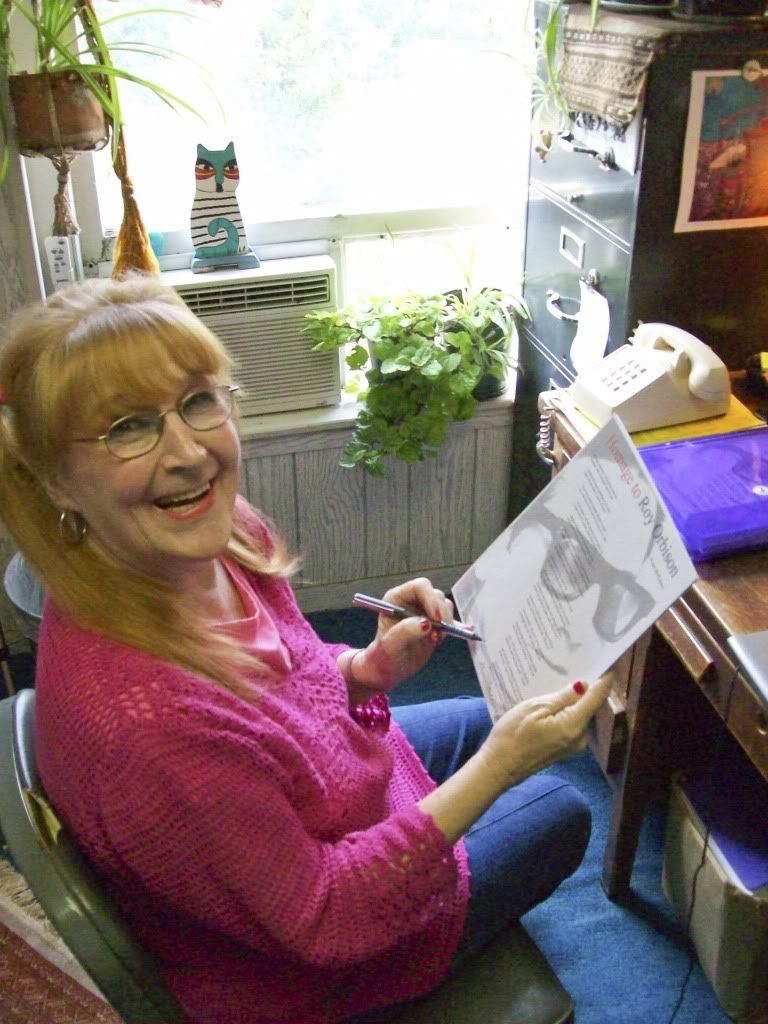
Was this picture taken in your office?  Maybe at home, but I'm guessing from the style of phone  it's at West Virginia Wesleyan. Frostburg used the photo for your reading in  September. Did you help them pick it out? It looks to me like a black and white version is used in part by the Intermountain in Elkins, so I'm guessing your family likes. So do I.

I did a little research and found out that you're holding a broadside of your poem, "Homage to Roy Orbison" which came out in 2009, after you published it Appalachian Heritage and in your fifth collection, Vivid Companion, in 2004.

Like Roy's, your
sense of form
shapes up this shard-filled life.
*

February 4 I wrote up a little piece telling folks the  news that you were gone.  Talbott Funeral says it will be receiving friends from four til nine tonight and it's already 3  p.m.  I could drive the four plus hours to Belington and still make it if I leave within an hour, but I haven't gotten any work done today, since I've spent the last four hours thinking on you.

I haven't got any work done and they're still blowing up our mountains, (Doh, of course nothing has miraculously changed since Saturday). I'm still looking for a community fund to apply for a Knight grant to  train more voices in our region  to tell their stories.  And  to interest the national press in better explaining what's going on.  Knight's  "live chat" for the grant is tomorrow at noon, just about when folks will be in the midst of the celebration of your life.  I could slip out, even though I don't own a laptop.  Google tells me the library over on Elliot is open all day and has net access computers.  I just liked  the library's page on facebook. 

I could drive the nine hours round trip, meet your family and friends.  Even walk around town and imagine your childhood.  Ask directions to the farm. But besides the grant, Dendron needs help stopping a new coal plant and in Giles they're still dumping ash on the banks of the New. And I've got pitches to write for The Guardian, which hasn't published me since December.

But you're a higher priority.

*
That song Leadbelly made famous  echoes in my mind.  Not the verses, mind you--the context is off--but the chorus:
Good night Irene
Good night Irene
Good night Irene
I'll see you in my dreams.
Makes me wonder what you thought of that song?  It's been recorded since by so many folks from The Weavers and Johnny Cash to  Michelle Shocked and Tom Waits.  Heck I was just now reading that even Raffi has a version.

I can't  ask you anymore in person--or in letters or facebook--unless I imagine your reply.  And that  isn't usually my nature.  Although it  would make an interesting writing prompt. The Gazette says they're burying you tomorrow.

*

And, even if I don't make the four-plus hour drive, I plan to sit shiva for at least the next week.  It's not as if  you were Jewish, nor am I close enough kin as it's usually defined.  But, that phrase comes to mind as an explanation: kindred spirits.

I thought about how I'd say we're connected, when I was searching images on Google to find a photograph to use at the top of this post. That word "connected" came to me when I found the photo at  a review of Jayne Anne Phillips Fast Lanes on Critical Mob.  It was tucked away on the tab labelled "connections," not the one marked "influences."

I can't claim that you influenced my writing. I hadn't read enough of you, even though West Virginia named you poet laureate years before we met in Charleston. I was off reading Bill Stafford, who doesn't write anything like me, except in the sense that all three of us were (and I am) writing from a set of common concerns, if not backgrounds.

*

Thanks to Vic, I'm listening to you reading three of  your poems from that October when I last saw you:
  • "Homage to Hazel Dickens"
  • "At 24"
  • "Sunday Morning, 1950"
I'll research later and try to add links to written versions or if I can't find any, I can check with your sister, Eileen Martin and see how to get permission to transcribe them here. But until then,  folks can listen here:

(I hadn't noticed when Vic posted it to his blog last April, but the West Virginia Book festival posted it in a remembrance. )

*

I'm also listening Llewellyn McKernan interview you at the West Virginia Writers Summer Conference:
  • your approach to how to start writing writing memoir, how she adapted her draft to write essays to be recorded on NPR and the feedback loop to the memoir
  • your  take on the status and history of the development of Appalachian literature from the times of Louise McNeill  and James Still, and
  •  your thoughts on writing process and teaching creative writing.


Just wish I had known about it before the Book Festival.  I might have asked you to continue the discussion, either when we were sitting on that bench together or during your reading when you asked for questions from the audience.


*

So, Irene, think of this as a wordy poem for you without line breaks.  Or NaNoWriMo by a poet and ten months early (Jeanne Larsen asked me Thursday night at Hollins, was I ever going to write a novel.)

Don't reckon I'll have more time to write you today.  I've been sitting here now, pushing aside other things.  And now it's been a good five hours and I've never even taken a break to get something to eat. The emergency Lemon Luna Bar from my purse is long gone. The last bit of  Lightlife organic Tempeh smells like it's  several days past turned.

So I don't reckon I'll have more time to write you today. But, if not, goodnight, Irene.  I'll hear you in my dreams.

2/4/12

Irene McKinney, ¡Presente!

Photo of of Irene (right), Denise Giardina and Jayne Anne Phillips at the 2010 West Virginia Book Festival accompanied Greg Moore's Charleston Gazette post:  "Live blog: Sunday at the West Virginia Book Festival."


This will be brief and I'll write more later.  I just wanted to let folks who loved Irene know, if they hadn't heard the sad news. The Poetry Foundation, publisher of Poetry magazine hasn't even posted the news yet at her bio, as I write this. The service is 11 a.m. Wednesday at Talbott Funeral Home in Belington,, WV (Barbour County), where Irene was born and grew up on her family's farm. That's about 2 1/2 hours from Charleston, 4 hours from here.


Phillips, who comes from Buckhannon, WV--where McKinney taught--told the Charleston Gazette,
She is a great loss to the state of West Virginia...She made West Virginia real, sensory and important in all its timeless variety, the land, farms, the people and animals, the rituals. She knew the meaning of home place.

I last saw Irene McKinney that Sunday in October 2010. Before her reading, she sat next to me on one of the benches in the cavernous Charleston Civic Center, talking about how excited she was to start a new low residency MFA Creative Writing Program at West Virginia Wesleyan and asked if I had any suggestions for faculty. I told her about Katie Fallon, whom I knew from her time at Virginia Tech. Irene's announcement followed the first week in November.

The program offers interested writers the opportunity to explore the connection between place and identity, focusing on their home area, one of the field study destinations, such as Ireland, or the Appalachian region itself. The program will officially launch in July, 2011 with a three-day literary festival, and the deadline for applications is March 1, 2011.

Irene was so approachable, so enthusiastic, treating folks as her equal. Outspoken and ironic, she often repeated the words which can be found penned in the introduction to the 2003 anthology "Listen Here: Women Writing in Appalachia."

I'm a hillbilly, a woman, and a poet, and I understood early on that nobody was going to listen to anything I had to say anyway, so I might as well just say what I want to.
Or in the poem "At 24",

"I don't know who I am, but you can't have me."

I had only met Irene once before, when I got to participate with her and Denise Giardiana as part of Ohio Valley Environmental Coalition's West Virginia Writers MTR project. I already knew Denise from Hindman and Jeff Mann from VirginiaTech, as well as Chris Green and Edwina Pendarvis, who had edited an anthology that included one of my poems, as will as Diane Gillam Fisher, whom I had just met that March at the Appalachian Studies Association conference. The project was where I met Katie, Bob Henry Baber and Rob Merritt.

UPDATE 2/7/2012  Good Night, Irene

1/18/12

"Dark Wednesday" : Proposed internet laws antipiracy or anti--freespeech?


Illustration is a screenshot from Mozilla.

January 18, websites are joining the Electric Frontier Foundation in calling for an end to current internet blacklisting legislation S. 968 PROTECT IP Act (PIPA) in the Senate and  H.R. 3261 Stop Online Piracy Act (SOPA) in the House. Under the current drafts, courts could order credit card firms, online payment companies like PayPal and advertising networks to stop doing business with those websites. They could also order search engines to stop linking to them and internet service providers (ISPs) to block their customers from accessing them.

Sounds like China?  No, we're talking about the USA.


Currently sites must remove specific copyrighted content if presented with a properly filled out DMCA takedown request. The notices require that the complainants must identify exactly what pages the content is on, and  prove that they are indeed the owners of the content. Even then, this process is often abused according to the Electric Frontier Foundation.

SOPA and PROTECT IP contain no provisions to actually remove copyrighted content.  Instead they focus on the censorship of links to entire domains.

Thus, if the AG served a site, it would be required to scrub every post and comment on the site containing the domain and censor the links out, even if the specific link contained no infringing content. Does this sound like free speech?

Think not?  Then join us and write and  call your Senators and Congressperson  to tell them to stop this legislation.

And to read about how to particpate in other ways, see this excellent rundown by Ars Technicha (h/t to Dan Radmacher)


1/7/12

Floyd Radio Show


January 7, 20 12, while  I was down at the LaPrelle's in Rural Retreat for the Big House Crafty Week, I was invited to participate in Season 1, Episode 5 of the Floyd Radio Show.  Beside helping with the final re-write and participating in some of the group skits, I  read my poem "Green Beans"

UPDATE:  The Floyd Country Store now has archived podcasts on its website.  You can hear me read "Green Beans  at 22:21.  In the above picture, Anna is wearing the dress she made during Crafty Week (from an original pattern.)  It's emerald green French eyelet lined in a gold-yellow.

1/6/12

Tanner Cultural Center: A Legacy to Preserve and Celebrate


In April 2010, a tornado ripped through Newport, Tennessee, damaging the roof of the Tanner Cultural Center. Although money to conduct repairs was distributed to the City through the Federal Emergency Management Agency, according to William Isom II and Friends of the Tanner Cultural Center, the City is now talking about demolishing the center.  This despite a the National Trust’s Rosenwald Schools Initiative to save the remaining Rosenwald Schools, of which Tanner Center is one.  Not to mention the National Rosenwald Schools Conference: 100 Years of Pride, Progress, and Preservation to be held at Tuskegee University in Alabama June 14-16, 2012.

 We need to ask that the City of Newport act as responsible stewards for this beloved community space of such great cultural significance. Won't you join me before January 10 by writing Scott Collins newportadm@newporttn.org or calling 423-623-7323 ext 18 and asking that the City of Newport instead proceed without further delay on the needed repairs and clean up of the center. (Please send a cc of your email to Issom william@800northfourth.com.)

Constructed in 1924, as a Rosenwald School with local funds and a donation from Sears-Roebuck magnate Julius Rosenwald, to serve the educational needs of the Black students in Cocke County, the Tanner Building is special because of its status as a surviving East Tennessee Rosenwald School and its utilization as a community space for the Black and rural populations of Cocke County.

There are many surviving alumni of the Tanner School living and working in the neighborhood in which the building is based. Groups that have been displaced from this structure include; AA, Families First, East Tennessee Human Resource Agency, Clean Water Expected in East Tennessee, Community House Cooperative, Head Start, The Farmers' Market, and Veteran's Affairs to name a few. The building also provided meeting space for other groups, community events and computer lab access to the neighborhood.

As noted in the the Cocke County Heritage Development Report from 2008 conducted under the direction of Dr. Carroll Van West, the school is a "legacy to be preserved and celebrated."