Showing posts with label economy. Show all posts

7/15/14

Beth Macy's Factory Man


Today is the publishing date for Beth Macy's first book, Factory Man (Little, Brown and Company, 464 pp) about John D. Bassett III, who got run off from Bassett Furniture in a family feud and instead of leaving the industry,started the smaller Vaughan-Bassett in nearby Galax, Virginia where he now employs 700.

 Beth Macy told Dave Davies on Fresh Air on 7/14 (transcriptpodcast) that Bassett:

 ...has promised the town that they're going to be hiring more people. Just last year - maybe it was in '12 - they reopened a vacant plant next door and christened it Vaughan-Bassett II. And they're trying to get ready. The housing market still hasn't come back up from the recession. I mean, it's kind of been the last thing to come back. And, you know, he was telling me this week that he had just read something - that wasn't really going to come fully black till 2017.

Last year, he broke even. This year, I think he's a little bit behind, but as he points out, we have a ...[balance] sheet at the rock of Gibraltar. You know, he's been very frugal. He's - he calls it Bassett 101 - you know, the techniques he learned from his father and his grandfather, in terms of, you know, having a lot of money in the bank and being very careful with his investments. And he's just determined he's going to keep that factory going because when the economy does come back and housing starts to improve, he's going to be poised to be what he calls the last girl standing on the desert island. You know, he's going to out-wait everybody. He's going to be the last guy. And he's going to get the business because no matter how good-looking you are, it doesn't matter. If you're the last one standing, you are going to get the business.

*

Factory Man started out in 2011 as  "Picking Up the Pieces,"  a  series on the effects of globalization on the towns of that once hosted the textile and furniture industries in Virginia, which Beth  wrote while she was a reporter for the Roanoke Times. As she writes for Nieman Storyboard:

For the next three years, I spent most of my waking moments turning that three-part series into a 120,000-word book, Factory Man: How One Furniture Maker Battled Offshoring, Stayed Local — and Helped Save an American Town....

 Among the reporting challenges I faced were American CEOs who avoided the press, Chinese businessmen who claimed that speaking candidly to me could jeopardize their profits, and a painful early chapter on race that kept me awake at night struggling with The Big Questions: Does it matter? Is it fair? A decades-long family feud gave the story an undercurrent and a universal element, but it was also the single topic my brash main character didn’t want to discuss (in fact, he grew agitated every time I brought it up).

My goal had been to write a business book that did not read like a business book — something that my octogenarian mom could read in order to finally understand why so many of the once-thriving factory towns she grew up in, and near, now look like ghost towns, with soaring rates of disability, food insecurity and underemployment My goal had been to write a business book that did not read like a business book — something that my octogenarian mom could read in order to finally understand why so many of the once-thriving factory towns she grew up in, and near, now look like ghost towns, with soaring rates of disability, food insecurity and underemployment.
*

 Macy left the paper in May, in order to devote her time to writing books.  Her next one is scheduled to come out in 2016.  Her last piece  for the Roanoke Times, "After the shouting: Macy shares a final chapter" came out June 8, updating a 1993 piece "Pregnant and Proud." (interview with Beverly Amsler, WVTF.)

 In October 2013, Chris Roush published "Turning a business feature into a book" on his blog Talking Biz News. In December 2013, the Ochberg Society printed an interview on how how the book developed including how she dealt with reluctant sources: "‘People get that you’re in it for the long haul’: Beth Macy and Factory Man."  Madelyn Rosenberg has an interview here.

You can check out Beth's blog, Intrepid Paper Girl for links to Factory Man reviews. and events.  For videos on the book, check out the video channel of her husband Tom Landon of Lucky Dog Productions LLC.

And don't forget the IPA/Macy tie-in from Parkway Brewing Company.


8/27/11

What Would Hal Willard Say About the North Anna Earthquake?


Illustration is an adaptation of the Google satellite view of the North Anna plant, 11 miles as the crow flies from the August 23 5.8 earthquake's epicenter. (H/T to Sue Sturgis at the ISS whose post  alerted me to the 1970's WaPo coverage).

Interesting that the The The Washington Post (WaPo)  writers didn't look in their own archives when writing about the August 23 earthquake, whose epicenter was 11 miles as the crow flies from Dominion Energy's North Anna nuclear power plant. As a result, no articles there about the 5.8 quake mention that officials of VEPCO  knew it was building on a fault line and got in trouble for concealing that from the NRC during the 70s. The paper started reporting on the story in 1973 when the Atomic Energy Commission began its investigation of  VEPCO. Hal Willard, the principle reporter on the story during that time, died in 2009. At the end of this post, you'll find a timeline compiled from the articles. More later when I can access the WaPo articles--anything before 1987 is not available for free online and the Roanoke County library doesn't have the the WaPo on microfilm.


The North Anna Environmental Coalition,  with the late June Allen as president (d. 2010), fought construction and operating licenses for the plant  during that time. By 2005, the Blue Ridge Environmental Defense League, fighting a third and fourth reactor at the North Anna site, issued a report from report on an earlier scandal regarding how the plant came to be constructed above a geological fault, which might be prone to earthquakes:
The story begins in 1967, the year Vepco [Virginia Electric Power--Dominion Energy's former name for a portion of the current corporation] awarded the initial contract of $446 million for the North Anna Nuclear Station on the banks of the Pamunkey River in Louisa County. Vepco hired Dames & Moore, an environmental consulting firm, to do geology studies in support of the license application. Within a year evidence of seismic faults were found but Vepco resisted the findings. The truth would not remain hidden for long.
 I found this is the court documents (see paragraph 10).  Of course we know in hindsight that the conclusion was not accurate, but I'm wondering if it was even scientifically accurate at the time:


the site was as stable as one without a fault and therefore it was determined that the presence of the fault did not require changes in design specifications for units one and two and also that the fault had no bearing on approval of the construction permits for units three and four.


Renee Parsons (email) writes of June Allen:

...Allen’s investigative talents and ability to cut-through utility and NRC double-speak were apparent as she became an eloquent, hard-nosed intervener in 1972 pointing out what she saw as collusion between the NRC and Virginia Electric Power Company.  A classical pianist who wore pearls, Allen testified before Congress identifying the “nuclear-industrial complex” as an inherently unsafe technology and frequently attended VEPCO stockholder meetings. On one occasion, when spied in the audience, VEPCO’s Chairman stopped the meeting, extended an arm,  pointed a finger directly at June and announced with great indignation, “There is Mrs. Allen.”

The Washington Post (35 articles):
  • August 28, 1973:  The Atomic Energy Commission (AEC) begins its investigation of whether the Virginia Electric and Power Co. (VEPCO) withheld information about a geological fault beneath its nuclear power plant under construction on the North Anna River in Louisa County, VA.((North Anna) "AEC Probes Vepco on Site Data, Hal Willard, August 29, 1973, B1)
  • September 21, 1973:  VEPCO ordered to try immediately to find out if the lake itself could cause an earthquake. (" Quake Check Ordered At Nuclear Plant Site," Hal Willard, September,  22, 1973, C2)
  • September, 1973: WaPo reports on the geology and North Anna  in a 2,000+ word story ("A Geologic Fault Bedevils Reactor: The 'Devil' and the Reactor -- A Haunting Question,  Hal Willard, September 27, 1973, G1)
  • AEC Officials testify there will be a tightening up of plant requiremenets and inspection procedures to avoid "surprises" like discovery of a geologic fault beneath North Anna. ("AEC Acts to Avoid 'Surprises,'"Hal Willard Washington Post Staff Writer, October 4, 1973, H1)
  • October 17, 1973:  AEC orders VEPCO to show why it should be allowed to continue construction of North Anna. ("Vepco Told To Defend A-Plant Site, Hal Willard, October 18, 1973, C1)
  • November, 1973: VEPCO tells AEC that North Anna construction should continue because of "probability that the site will ultimately be found perfectly safe" -- and it would cost $127 million to stop work for six months .("Continue A-Plant, Firm Asks," Hal Willard, November 12, 1973, C1)
  • March 2, 1974: AEC's regulatory staff reports regarding geological faults, that North Anna site is safe, ("AEC Staff Finds Site Of Va. A-Plant Is Safe," March 3, 1974; D4)
  • March 20, 1974: Citizens fighting construction of the North Anna charge that the federal government is withholding geological evidence in the case. "Secrecy Charged on Vepco A-Plant Plan Study" Hal Willard, March 21, 1974, C8)
  • April, 1974: AEC panel concludes that the partially North Anna plant is not on an active earthquake site and that work on it should continue.("AEC Finds In Favor of Va. A-Plant, April 17, 1974, B4)
  • August, 1974:  Environmentalists have been unable to block construction of North Anna, but economic and labor problems bring work there to a virtual standstill. ("Work Halts At Nuclear Power Unit, Hal Willard, August 3, 1974, A7)
  • February 5, 1975:   A piece on Dr. John W. Funkhouser, who discovered the geologic fault beneath North Anna ("Legalities Swirl Over Nuclear Plant:  What Was in Deleted Deposition?" Hal Willard, February 6, 1975,  F1)
  • November 7, 1974: Earthquake recorded about 30 miles southwest of North Anna.  Both AEC and VEPCO say such a tremor would have no impact on a completed plant. (" Quake Felt in Va. In A-Plant Vicinity," Ron Shaffer, November 16, 1974, E3)
  • February, 1975: The drinking habits of  the murdered Funkhouser brought up in hearing to determine whether VEPCO officials made false or misleading statements to the NRC. ("Geologist's Drinking Habits Unearthed," Hal Willard,  February 20, 1975, F1)
  • March, 1975: Post prints piece on rising electric rates (" Electric Companies Stub Toes in the Dark," Hal Willard,  March 20, 1975,  D1)
  • May 28, 1975:  NRC staff recommends that VEPCO pay the largest fine in the history of the peacetime atom for making false statements about the geologic fault beneath North Anna. ("Nuclear Panel Urged To Fine Vepco Heavily, Hal Willard,  May 29, 1975, B3)May 29, 1975:  A VEPCO VP testifies that customers, not stockholders, should have to pay any fines levied for the company managements accused errors in judgement. ("Vepco: Let Users Pay," Hal Willard May 30, 1975, C1)
  • June, 1975: Justice Department asks Atomic Safety and Licensing Board to say whether criminal action should be taken against VEPCO because of "material false statements" the utility allegedly made concerning the geologic fault underlying North Anna. (no byline, "Vepco Criminal Action Is Left to Atomic Unit,"  June 21, 1975, B7)
  • June, 1975:  NRC informs Justice Department that it has found no evidence of criminal intent on the part of VEPCO executives responsible for material false statements about the geological fault beneath North Anna ("No Criminal Intent Seen in Vepco Reply," June 24, 1975, C3)
  • September 11, 1975:  The $60,000 penalties levied against VEPCO for North Anna are the "strongest ever imposed on the industry" ("Vepco Fined $60,000 for A-Plant Fault, Hal Willard, September 12, 1975,  A1)
  • January, 1976: According to new findings by NRC staff, the $60,000 fine levied the previous September against VEPCO by the Atomic Safety and Licensing Board, should be raised to $90,000("Vepco's Fine Said Too Low, William H. Jones, January 25, 1976, B1)
  • January 1976: Justice Department investigates  VEPCO's alleged material false statements in the early 1970s ("North Anna Statements Are Probed," January 30, 1976, C7)
  • June, 1976:  NRC stays an appeals board ruling that reduced a record $60,000 fine against VEPCO for making "material false statements" about a geologic fault beneath North Anna. ("Nuclear Unit Alters Vepco Fine," Hal Willard, June 5, 1976, D5)
  • November 12, 1976: The NRC fines VEPCO $32,500 for making seven "material false statements" about the presence of a geologic fault beneath North Anna. ("Nuclear Agency Fines Vepco," Hal Willard,  November 13, 1976, D4)
  • February 23,1977: VEPCO pays $31,900 fine imposed by NRC for 30 violations discovered in an investigation of construction practices at North Anna. ("Vepco Pays $31,900 Fine For A-Faults," Hal Willard,  February 24, 1977, B4)
  • September 30, 1977:  Justice Department says high-level NRC officials covered up for almost three months knowledge that a geologic fault existed under North Anna"U.S. Cover-Up Seen on Fault At Vepco Site," Joanne Omang, October 1, 1977, A1)
  • October 3, 1977, It is disclosed that NRC reprimanded its staff last November for covering up knowledge of the geological fault underneath North Anna, but only in a footnote in its ruling.("Nuclear Agency Staff Criticized in Footnote," Joanne Omang, October 4, 1977, C4)
  • October 6, 1977: Federal Energy Administration chief John O'Leary dismissed categorically any implication that he or NRC were involved in concealing the existence of a geological fault under North Anna in 1973. ("O'Leary Denies Concealing Fault," Joanne Omang,  October 7, 1977, B2)
  • February 1978: VEPCO, saying costs are rising faster than revenues, requests a 12.2 percent rate increase plus another 8 percent later in the year."Vepco Asks Rate Rise Of 12.2 Pct.,"Thomas Grubisich,  February 16, 1978, A1)
  • March 1, 1978:   4th U.S. Circuit Court of Appeals upholds $32,500 fine on VEPCO for making false statements. ("Appeals Court Upholds $32,500 Fine on Vepco," Mar 2, 1978, C6)
  • June 1978: NRC investigates why staff gave contradictory dates on when it discovered that North Anna was being built on a geologic fault. ("Nuclear Agency Probes Vepco Plant Date Conflict," Thomas Grubisich,  June 15, 1978, C14)
  • September 7, 1978:  A witness charges that workers building North Anna are making up to $20,000 a month in unmonitored personal phone calls on VEPCO company phones. ("Witness Charges Waste at Vepco Plant," Phil McCombs,  September 8, 1978, B1)
  • October, 1978:  A thousand gallons of radioactive water accidentally flows out of a pipe on to a basement floor at North Anna, "slightly" contaminating 13 employes and causing a 12-hour  shutdown.(" Radioactive Water Spills At Va. Plant," Phil McCombs, October 28, 1978, C1)
  • March 1979:  In the wake of Three Mile Island Disaster, the Louisa County Board of Supervisors looks into construction of fallout shelters for county residents due to the location there of North Anna. ("Fallout Shelters Eyed For Residents in Louisa,"  March 22, 1979, C3)
  • May 1, 1979:  Critics talk about North Anna in wake of Three Mile Island ("Nuclear Critics Decry Vepco Safety Conditions, Karlyn Barker, May 1, 1979,C1)
  • September 25, 1979: A  series of malfunctions triggered a shutdown of  North Anna and a "small amount" of radio active gas is released. ("Radioactive Gas Emitted By Va. Plant: Malfunctions Shut Vepco North Anna Nuclear Facility Plant Emits Radioactive Gas," Stephen J. Lynton and Thomas Grubisich,  September 26, 1979, C1)
  • April 10, 1980:  NRC votes to let VEPCO begin trial operations of its second nuclear unit at North Anna.("NRC Lets Vepco Start Trial of 2nd North Anna Unit," Stephen J. Lynton,  Apr 11, 1980, A1)

See also one article in The New York Times

  • October,  1977: The Justice Department charges that high-ranking officials at the NRC covered up information the geological fault under North Anna. ("U.S. Panel Accused Of Secrecy on Fault Under Nuclear Unit," David Burnham, October 2, 1977)

UPDATES:

Peter Galuszka (email, bio) has a great piece for September 2 in Bacon's Rebellion, "The Ghost of June Allen."
Tammy Purcell, correspondent for The Fluvanna Review had a detailed piece including history of the opposition on October 26, 2011, "Shake up: Quake sparks concerns over North Anna’s past and future."

12/22/10

Book Review: Mike Hudson: The Monster


Cover from MacMillan Publishers.  Just heard back from Nona Walker, book editor of the Roanoke Times, that this review, with minor changes, is slated to run January 2, 2011.  Since there is usually non permalink for reviews there, I'm posting a copy here with a few links, along with a bit of an introduction.  


November 8, I had the pleasure of listening to Mike Hudson speak at Washington and Lee about the connection between predatory lending, Wall Street and the past two year's economic meltdown.  That's the subject of his new book, THE MONSTER: How a Gang of Predatory Lenders and Wall Street Bankers Fleeced America—and Spawned a Global Crisis, which came out in October from Holt/Times Books.

Here's a 2008 interview by Randall Chittum published by Columbia Journalism Review in which Mike talks about the leadup to the mortgage crisis and how the dots were there in the form of individual stories--which never got connected:

Mike currently covers business and finance for the Center for Public Integrity, an investigative journalism non-profit. Before that, he worked as a reporter for the Wall Street Journal and wrote for Forbes, the New York Times, the Los Angeles Times and Mother Jones, among others.

I met Mike when he was working for the Roanoke Times covering the low-income beat and graciously sent me a note to say our all-volunteer 8-12 page alternative monthly, the New River Free Press, had scooped his daily on the criminalization of panhandling.

Mike started on the trail of predatory lending long before the current melt-down, after he received a 1992 Alicia Patterson fellowship to research businesses that target low-income Americans, He edited the award-winning book Merchants of Misery:  How Corporate America Profits from Poverty (Common Courage Press, 2002 and appeared in the documentary film Maxed Out:  Hard Times, Easy Credit and the Era of Predatory Lending (Trueworks, 2006).

*

THE MONSTER: How a Gang of Predatory Lenders and Wall Street Bankers Fleeced America--and Spawned a Global Crisis, October 2010, Times Books, Henry Holt and Company, New York, New York, 365 pp.

 This fall's latest banking scandal revealed foreclosure lawyers backdating mortgage documents and faking affidavits to courts in order to evict families and resell their homes. After more than two years of stories on the sub-prime mortgage crisis, readers may have wearied . Was the resulting financial meltdown an unavoidable market accident--as former Federal Reserve Chairman Allen Greenspan called it, a “once-in-a-century credit tsunami?” If so, what's the purpose in studying it?

 In The Monster, Mike Hudson paints the larger picture, connecting the dots all the way back to the 80s, exploring how the “plain vanilla business” of mortgages was corrupted and who is to blame. Rather than a tome on finance, The Monster reads like a true-crime story--perhaps because Hudson's first job out of college was covering the Roanoke Times & World News's police beat. The compelling story he unravels stems from interviews with hundreds of individuals and from thousands of pages of court transcripts. Hudson pieces together a Rube Goldberg world of falsified income, forged signatures, and pressure on families to sign sub-prime loans as quickly as possible.   He shows large investments from Wall Street firms sustained these practices, concentrating on Roland Arnall--who created Ameriquest, one of the first and biggest predatory lending firms--and on the Wall Street firm of Lehman Brothers.

For Hudson, Arnall represents the birth of the sub-prime mortgage industry. An immigrant who originally opened up a savings and loan to bankroll his real-estate projects, Arnall figured out how to make lots of money making high-priced home loans to borrowers in mostly minority neighborhoods. His workers felt his impatience to grow the business. Dennis Rivelli, a former manager, told Hudson, Arnall

never cared how you got the volume and where it came from and what you had to do to get it...He could care less. Just pump it out and move on.
After being pressed by S&L regulators in the early 1990s, Arnall morphed his savings and loan into a lightly-regulated independent mortgage lender, Ameriquest. His company might have been advertising as the ""proud sponsor of the American dream" of home ownership, but it wasn't even generating new mortgages. In 2004, one quarter of 1 percent of Ameriquest loans went for home purchases. 99.75% went for refinancing deals with onerous fees and loan rates which increased the odds of foreclosure.

Take, for instance, the case of Carolyn Pittman, who had borrowed $58,859 in 1993 with her husband to buy a one-story, concrete block house near Jacksonville, Florida. They paid $500 per month on a fixed-rate FHA loan which included home insurance and property taxes.


Even after Charlie died in 1998, Pittman kept up with her house payments. But things were tough for her.... Like many older black women who owned their homes but had modest incomes, Pittman was deluged almost every day, by mail and by phone, with sales pitches offering money to fix up her house or pay off her bills. A few months after her heart attack, a salesman ... caught her on the phone and assured her he could ease her worries. He said Ameriquest would help her out by lowering her interest rate and her monthly payments.

 By the time Pittman had been churned through the mill, her house payment came to $1,069 per month. And Arnall's reaction to such stories, "Stuff happens."

Meanwhile Arnall's minions profited:

For those who gave themselves over to the breakneck pace of life inside Ameriquest, the rewards were dazzling. Twenty-three year old salesmen made $100,000 per year. Twenty-six-year-old branch managers groused $200,000, $200,000, even half a million dollars a year, and boosted their takes higher as they climbed within the companies ranks. Many would become millionaires as they made Roland Arnall a billionaire.

 After one aide left the company his consulting contract from Arnall yielded $35 million dollars.


 Nothing could have happened on this scale, however, without the infusion of huge amounts of capital by Wall Street firms such as Lehman Brothers. Lawrence McDonald, a vice president at Lehman explained that

The executives who ran the company's sprawling mortgage business...had direct access to CEO Dick Fuld and his inner circle ..."Their words were not so much heard as acclaimed...Whatever they needed--extra budget, permission for more risk, permission to invest colossal hunks of the firm's capital in their market--they got."

 Hudson first wrote about predatory lending in “Stealing home” for The Washington Monthly (1992) and “Poverty, Incorporated” for Southern Exposure (1993). What’s remarkable to me is how Hudson has stuck with this story. While other reporters wrote an account here or there before dropping the subject, Hudson pressed on, often as a freelancer, completing “Banking on Misery” for Southern Exposure in 2003 and “Workers Say Lender Ran 'Boiler Rooms' (on Ameriquest with E. Scott Reckard) for the Los Angeles Times in 2005, before writing a series of stories for The Wall Street Journal in 2006-7.

 As the Columbia Journalism Review's Dean Starkman (website) notes in his analysis, "Power Problem",

 Only after the crackup had already begun... [was] Wall Street's role in the subprime again laid bare...It referred...to documents available for years. There is really no excuse...as federal regulation folded like a cheap suitcase, the business press...lost whatever taste it had for head-on investigations of core practices of powerful institutions...it relies on [Wall Street and corporate subculture]...for its stories. Burning a bridge is hard.

Hudson now writes about business and finance for the Center for Public Integrity, a nonprofit journalism organization founded by Charles Lewis (bio) who explained his reason for founding the Center in 1989 (see IRE Journal, Spring 1990, "Mercenary, Not Public, Service."

 America's best and brightest reporters, working for the most respected national news organizations, too often do not investigate the country's most important stories.

Predatory lending's contribution to our current economic upheaval is one such story. Some might argue that the buyers should beware, that corporations and politicians will always be complicit. Such cynics probably see no place for investigative journalism. I'd disagree. Hudson digs deep and provides a compelling, convincing account for those who hope that an informed public can stimulate reform.

12/8/10

The foreclosure crisis won't go away easily


Photo of Mike Hudson, author of The Monster: How a Gang of Predatory Lenders and Wall Street Bankers Fleeced America – and Spawned a Global Crisis. This piece was commissioned the Guardian, which published it today as, "Let's not foreclose on financial reform:  The modest Dodd-Frank Act is under threat, yet the foreclosure crisis shows the dire risks of an unfettered mortgage industry."  I've only made minor changes and kept the British spelling.


*

This past week saw much coverage of the 1 December loan disclosures from the Federal Reserve, as required by the Dodd-Frank Wall Street Reform and Consumer Protection Act.  The act--so named because it was sponsored by Representative Barney Frank (Democrat, Massachusetts) and shepherded by Senator Chris Dodd (Democrat, Connecticut)--was signed into law on 21 July by President Obama, as a legislative response to the last two years' economic meltdown engendered by the sub-prime mortgage debacle.

Less reported was the 1 December hearing Dodd held on mortgage servicing – the latest place where fraud has surfaced. Servicers, now regulated under the Dodd-Frank Act, calculate principal and interest, collect payments from the mortgagor, act as an escrow agent and foreclose in the event of default.

This makes servicers pertinent, as the US finds itself in the middle of a  foreclosure crisis that isn't going away. According to an interview with law professor Kurt Eggert, who testified at the hearing, the problem is that:
No one agency has been given the job of regulating servicers, and so any oversight has been piecemeal and haphazard. And the regulators often have been worried more about the soundness of banks than the protection of borrowers.
This has resulted in folks losing their homes, because, consumer advocates say, it's more profitable to foreclose than to make the mortgage adjustments once promised by Obama.

Many initial loans, however, were fraudulent. For instance, just recently, on 3 December, SunTrust's Alexandro Aquinta pled guilty to:
transactions in which straw buyers and unqualified buyers obtained over $4m in … loan proceeds … [from] applications [which] contained materially false, fraudulent and misleading information … regarding applicants' employment, income and assets.
But worse, to my mind, are the falsified documents filed by attorneys in so-called "rocket-docket" courts. The resulting foreclosures severely stress families who lose their homes, as well as neighbours who see their property values decline.

To understand how we got to this state, I interviewed Mike Hudson, one of the first investigative journalists to link predatory lending to the economic meltdown and author of The Monster: How a Gang of Predatory Lenders and Wall Street Bankers Fleeced America – and Spawned a Global Crisis.

According to Hudson, fraud in the banking and mortgage industries dates back to the 1980s. The sub-prime crisis was long in the making and was facilitated by government through bad policy and lax enforcement. Its origins lay in
[A] philosophy of trusting financial players to police themselves. A lack of cops on the street, as it were, allowed fraud to flourish [with] faked paperwork and other ugly practices [in] the origination of loans – and, now, similarly dicey practices in the foreclosure process.
This lack of regulation was a bipartisan business:
The philosophy started getting traction in the Carter administration, gained even more steam in the Reagan years, continue apace under Clinton and saw its full flowering during the Bush Administration. One influential figure who was there through the Reagan-Bush I-Clinton-Bush II years was Alan Greenspan. Remember he was considered to be 'the maestro', a guy who could see around corners and could guide us to unprecedented prosperity.
The meltdown will continue as long as the bad policy and lax enforcement do. The growing foreclosure crisis is just the latest chapter:
The business model for loan servicers ensures that questionable foreclosures will continue to flood the system. With Republicans' Congressional victories, [Dodd-Frank's] financial reform is in danger. If you think the legislative battle was tough, wait until you see the bareknuckled lobbying and backroom armtwisting that are going to emerge as the new Consumer Financial Protection Bureau gets under way.
As far as the Dodd-Frank Act goes, Hudson says that the best hope lies in Elizabeth Warren's push to simplify mortgage paperwork, as a measure that could command bipartisan support. But I have my doubts about whether Warren will succeed.  Republican Senate leader Mitch McConnell's continued stated primary goal is to block all of Obama's initiatives to render him a one-term president. There's already efforts afoot to weaken the law. And the  financial industry and banking industries and their water-carriers in Congress opposed Warren's appointment to head Dodd-Frank's Consumer Financial Protection Bureau; Obama tapped her only as a special adviser to set up the Bureau. And there are other troubling developments including the Fed's recent move to strip a key protection for homeowners under the guise of reform.

The 1 December hearing was the last Dodd will chair for the Senate committee on banking, housing and urban affairs. He decided not to run for re-election after disclosures about his own sweetheart mortgage deal with the predatory Countrywide. In line for the chairmanship is Tim Johnson (Democrat, South Dakota), who has a record of supporting small predatory loan companies (pay-day lending) and fighting credit card reform. 

Some argue that the financial trauma brought on by sub-prime mortgages was an unavoidable market accident: Federal Reserve chairman Alan Greenspan called it a "once-in-a-century credit tsunami". Some hold that borrowers were to blame – folks took out variable rate mortgages for homes they couldn't afford, betting already-inflated prices would continue to rise, so increasing their equity faster than their ballooning payments.

Others disparage government, either for its lack of regulation or for overselling the dream of home ownership. They argue that the buyers should beware, that corporations and politicians will always be complicit. 

I disagree.  I join Hudson in hoping that an informed public can stimulate reform:
The foreclosure crisis is a serious issue; it's more than a series of paperwork snafus. The powers that be in Washington failed to get the facts and act the first time around – when lenders were engaged in a feeding frenzy of predatory lending. The foreclosure scandal is a second chance for leaders and regulators to prove that they can dig out the truth and take action.

3/22/10

NewsTrust: looking for how the recession is affecting New Yorkers

Illustration by Jonathan Keegan (website, email) from "Helicopter Parents Make Boomerang Kids" by an anonymous blogger with the nom de internet of "makeitadouble", an upstate NY "Dad, Writer, Poet, Sarcastic Malcontent" who also blogs here.
*
At the bottom of this post you'll find one of my reviews for today about how the recession is contributing to the phenonenom of boomerang kids. Thanks, in part to funding from the Omydar Network, NewsTrust will be spending the last two weeks in March rating local news coverage on how the recession is affecting New Yorkers. Some of you remember I served as community developer for NewsTrust back in 2008 and I've been hired to help w. this project. If you'd like to join us or have suggestions for sources or will be publishing on the topic, drop me a line.
*

During the New Hunt, we will review news and opinions on local economic issues ranging from unemployment to government cutbacks in New York City. Newstrust will be collaborating with the Huffington Post’s NYC portal and its Eyes and Ears team, as well as City Limits. Based on our collective ratings, we will feature the best (and worst) local news coverage and post them on the NewsTrust and HuffPo blogs on Wed. April 7th, 2010.

Starting this week, I'll be finding coverage and next week I'll be coordinating the coverage on goverment cutbacks. My assigned sources are:
Heading up the effort is NewsTrust associate editor Kaizar Campwala.

The other members of the team are freelance writer and editor Kristin Gorski (blog, email, bio--assigned to real estate and to Manhattan. ) and writer and musician Jon Mitchell (blog, email, twitter, bio--assigned to jobs and to Brooklyn, Staten Island).

And of course, NewsTrust founder and Executive Director Fabrice Florin willl be handling the business end of things, as well as adding his reviews.


*

So here's a piece I reviewed today from Sam Roberts (article archive)
"Facing a Financial Pinch, and Moving In With Mom and Dad" by Sam Roberts, NYT.

Roberts, who has written other pieces on the recession's effects in NYC, cites examples of several young people living at home, a census analysis by the NYT (no link) and links to a survey from last fall by Pew and the census's current population survey. He quotes Andrew Beverage of CUNY. In all, a thorough piece which also provides the reader with resources to dig deeper.

BTW in 1985, Roberts was the the second recipient of the Fund for the City of New York's annual Peter Kihss Award for excellence in reporting about New York City government (now seemingly defunct--Kihss has won the first award in 1994, shortly before his death at the age of 72 Nicholas Pileggi (IMDB listing), contributing editor of New York magazine got the award in 1986. Pileggi, Nora Ephon's husband, is the author of Wiseguy: Life in a Mafia Family, which he adapted into the film Goodfellas. ):

8/25/09

What ever happened to 1% for the imagination?


Pets are non-partisans, but should the arts be, too?

Back on February 2 my friends DC poets Ethelbert Miller and Melissa Tuckey, along with the executive director of the Institute for Policy Studies, had a piece in The Nation call for 1% of the stimulus package to go to the arts. After all, the Works Progress Administration.

Another friend--Amanda Michel--now has a job now tracking stimulus funds for ProPublica. I had collaborated with her on election coverage when I was community developer for NewsTrust and she ran Off the Bus for the HuffPo. So, I thought, why now take a look at what's going on with stimulus funds and the arts here in Virginia.

Over a year ago, on August 2, San Francisco Chronicle reporter Chris Cadelago(email) had observed that the Obama campaign
has an official arts policy committee, which is co-chaired by Margo Lion, the Broadway producer, and George Stevens Jr., founder of the American Film Institute. It calls for a national reinvestment in the arts as well as a national arts corps, made up of young artists who could work in inner cities.

12/23/08

New Jobs: Green, "Shovel Ready" or Military-Industrial?

As the economy continues to sputter, the WaPo's Paul Kane and Michael D. Shear front-page "Green' Jobs Compete for Stimulus Aid: Obama Weighs Them Vs. Traditional Projects" contrasts with "Defense Spending Would Be Great Stimulus: All three service branches are in need of upgrade and repair" by WSJ board of contributors member Martin Feldstein, chairman of the Council of Economic Advisers under President Reagan and a professor at Harvard. I've got to wonder about the latter, as Lawrence F. Skibbie paraphrased an observation by one of the members of his National Defense Industrial Association in his June 22, 1998 testimony to the Commission to Study Capital Budgeting:
it is unclear that a meaningful assessment can be made of the economic return on investment for resources committed to military capital assets
Kane and Shear write,
environmentalists and smart-growth advocates are trying to shift the priorities of the economic stimulus plan that will be introduced in Congress next month away from allocating tens of billions of dollars to highways, bridges and other traditional infrastructure spending to more projects that create "green-collar" jobs.
That's drawing flack from the Blue Dog Coalition of fiscally conservative House Democrats. Congressman Baron P. Hill (D-IN), incoming co-chairman told
If we're going to call it a stimulus package, it has to be stimulating and has to be stimulating now. I think there are members of our caucus who are trying to create a Christmas tree out of this
The Post paints this as "shovel-ready" union construction job v.s. green-collar job competition and in an example of stating opinion without supporting facts says the latter,
often have the long-term potential to revolutionize the economy but tend to lack the short-term bounce of old-fashioned infrastructure work
Anna Burger, chairman of Change to Win, a union group is quoted as saying,

In fact, we do have crumbling roads and bridges that need to be repaired. It's not about pitting one against the other. It's about how we find a sustainable economy.
Terence M. O'Sullivan, head of the Laborers' International Union of North America, adds
We're committed to green jobs and rapid transit and all the rest of it.
Senior aides in the new administration and the congressional leadership
suggest that there have been delays in identifying enough of the environmentally friendly projects to reach a dollar level that will truly jump-start the economy.

Democratic negotiators plan to reconvene around New Year's Day to try to hash out the final details of the plan before the 111th Congress starts Jan. 6, with a goal of passing a bill out of the House and Senate shortly after Obama is sworn in Jan. 20. At a meeting of Obama's transition team yesterday, Vice President-elect Joseph R. Biden Jr. vowed that the proposal would not become a "Christmas tree" for lawmakers' policy earmarks. He defended it against the criticism on the left that too much of its focus would be on old-fashioned projects.

"We've let our infrastructure crumble for a long, long time from water to roads to bridges. It makes sense to invest in them now," Biden said.

Colin Peppard, a transportation expert for Friends of the Earth was not as deferenital:

They're going to put a bunch of money through a broken system to stimulate the economy. That doesn't make sense to me....One minute they want to spend it quickly, the next minute they want to spend it well.
FOA has begun a Road to Nowhere campaign, saying that new roads would lead to "new pollution -- keep the economic stimulus clean." But what about existing roads that need repair?

Meanwhile, speaking of economic stimulus, you gotta laugh to keep from crying. Check out Chuck Collins's & Nick Thorkelson's Economic Meltdown Funnies from Jobs with Justice and the Institute for Policy Studies Program on Inequality and the Common Good.Check out Chuck Collins & Nick Thorkelson Economic Meltdown Funnies from Jobs with Justice and the Institute for Policy Studies Program on Inequality and the Common Good.

12/21/08

Can You Spell P O N Z I?

Cartoon by Mike Lane, Baltimore, Maryland --(archives at the Sun, where he took a buyout, email)

12/1/08

Bailing in Detroit

Cartoon from November 20, 2008 by David Horsey, The Seattle Post-Intelligencer (site, email)

December 4, Chris Dodd's Senate Banking Committee will hold a hearing The State of the Domestic Automobile Industry Part 2. This is a followup on the November 19 hearing Examining the State of the Domestic Automobile Industry.

Y'all remember the thrashing the execs got for their traveling to the bailout request in private corporate jets. Now they're reportedly thinking about carpooling. But that aside a lot of flack was anti-labor. The Washington Post's D. J. Dionne (email) has his column up for tomorrow, "Crunch Time for the Big 3," in which he writes
There is a paradox at the heart of the proposed bailout of the auto industry. The rescue would have no chance of passing without the muscle of the Big Three's unionized workforce. Yet you can't turn around without hearing someone trash autoworkers for the terrible crime of trying to earn a decent living.
That's clear from reviewing a multitude of editorial cartoons over at Cagle. In fact, the only cartoon I could find to illustrate Dionne's point was the one above by David Horsey, who is a treasure trove on labor issues in genral and more. Here's his his take on Prop 8 from 11/22. I admire his work because he goes a bit farther for an original image.

Dionne writes,

The failure of the Big Three is regularly attributed to the high wages and benefits earned by members of the United Auto Workers union, and it's true that the Detroit-based auto companies operate under heavy "legacy costs" for retirees' pensions and health coverage negotiated during the industry's fat times.

But the blame-the-workers-first cant ignores the fact that if the Big Three had designed better cars, they would not have lost as much market share to Toyota, Nissan and other competitors. The unions did not prevent management from producing a better product -- and I say that as someone who has enjoyed driving Saturns for the past 15 years.

It's also nonsense to say that the UAW has been indifferent to cost issues. The last auto contract included so many givebacks, on top of revisions in an earlier pact, that Ron Gettelfinger, the UAW president, was threatened with a rank-and-file rebellion. He told a House committee last month that because of "these painful concessions," the gap in labor costs between the Detroit-based auto companies and the "foreign transplant operations," as he called Toyota and the others, "will be largely or completely eliminated by the end of the contracts."

11/3/08

Where Do McCain and Obama Stand on Energy?


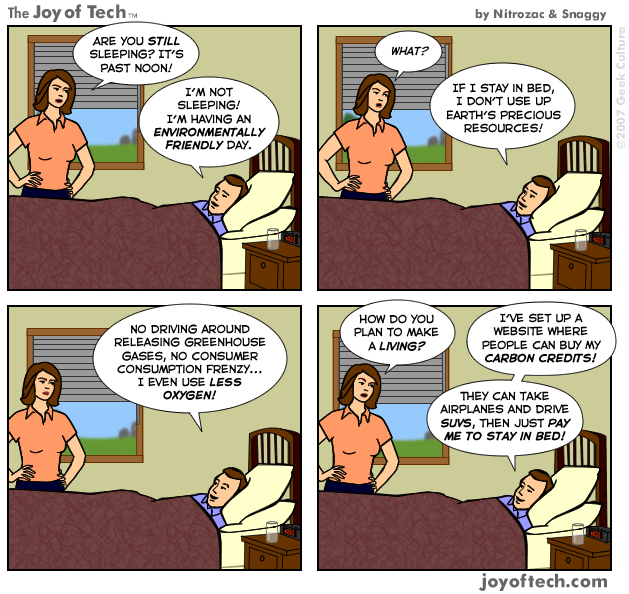
Cartoon by Nitrozac and Snaggy--the last panel of which was used to illustrate a blog post I wrote for the Daily Yonder, commissioned on the recommendation of Betsy Taylor. Nitrozaz is a.k.a. Liza Schmalcel (interview) and Snaggy is a.k.a. Bruce Evans.

The piece appeared 11/3/08 under the title, "How will Obama or McCain Power the Nation." I had the pleasure of the help of July Ardery (email) as my editor, who also selected the illustrations. Thanks also to my friend from NewsTrust, Chris Finnie, of Finnie communications, who gave me feedback on the rough draft and submitted and reviewed it at NewsTrust. Here's what I wrote...

*


Energy. Jobs. The environment. As Michael A. Livermore, Executive Director of NYU Law School's Institute for Policy Integrity, has written, "The challenge for the next administration is to find policies that produce simultaneous economic, environmental, and energy benefits, rather than force these policy goals to fight each other in a lose-lose battle."

Like other Americans, folks in rural areas are examining senators Barack Obama and John McCain in the light of fears about a faltering economy and with high gas prices a recent memory. Many worry that the U.S. has been delaying action on climate change, with possible dire effects on agriculture and forestry. And beyond the general concern about the carbon footprint of coal-fired electric plants, those of us in Appalachia face increasing destruction of our home places from mining as companies use mountaintop-removal to raze the mountains for coal -- what has been called “strip mining on steroids.”

During his acceptance speech at the Democratic National Convention on August 28, Obama explicitly linked energy, climate change and jobs, declaring his goal to "end our dependence on oil from the Middle East" in ten years:

"Washington's been talking about our oil addiction for the last thirty years, and John McCain has been there for twenty-six of them. In that time, he's said no to higher fuel-efficiency standards for cars, no to investments in renewable energy, no to renewable fuels. And today, we import triple the amount of oil as the day that Senator McCain took office.

"Now is the time to end this addiction, and to understand that drilling is a stop-gap measure, not a long-term solution. Not even close.

"As President, I will tap our natural gas reserves, invest in clean coal technology, and find ways to safely harness nuclear power. I'll help our auto companies re-tool, so that the fuel-efficient cars of the future are built right here in America. I'll make it easier for the American people to afford these new cars. And I'll invest 150 billion dollars over the next decade in affordable, renewable sources of energy - wind power and solar power and the next generation of biofuels; an investment that will lead to new industries and five million new jobs that pay well and can't ever be outsourced."

McCain, in his acceptance of the Republican nomination on September 5, did not make so specific a linkage between energy and jobs. Sen. McCain emphasized that he favors fuel economy and increased use of wind and solar energy but differentiated himself from Obama by supporting increased drilling and nuclear power.

"We'll attack the [energy] problem on every front. We'll produce more energy at home. We will drill new wells off-shore, and we'll drill them now."

"...We'll build more nuclear power plants. We'll develop clean-coal technology. We'll increase the use of wind, tide, solar, and natural gas. We'll encourage the development and use of flex-fuel, hybrid and electric automobiles.

"Senator Obama thinks we can achieve energy independence without more drilling and without more nuclear power. But Americans know better than that.

"We must use all resources and develop all technologies necessary to rescue our economy from the damage caused by rising oil prices and restore the health of our planet."

In the rural U.S., federal energy policy has special consequences, so let's look at where McCain and Obama stand on several key energy issues.

stated his opposition to the Yucca Mountain Repository (for spent nuclear fuel and radioactive waste), which McCain supports.

On June 25, McCain highlighted his plans for nuclear energy when he announced his "Lexington Project," “[n]amed for the town where Americans asserted their independence once before.” McCain described his plan "to achieve strategic independence" from imported oil supplies by 2025, calling for 45 new nuclear power plants by 2030 with the ultimate goal of 100 new plants.

Offshore drilling: Sen. McCain strongly supports increasing offshore drilling for domestic oil. Obama had opposed offshore drilling, but in August modified his position, saying he would consider permitting new drilling operations in order to reach a compromise on energy legislation. (The 27-year-old moratorium on offshore drilling expired September 30, after no such compromise was reached.) Despite government assessments that have concluded that such drilling would not affect gasoline prices significantly "before 2030," recent polls have shown public support for drilling.

Coal technology: Both candidates say that they support "clean coal" technology, including carbon capture and storage, although the economic viability of such technology has not been demonstrated. Both candidates support “cap and trade ” to reduce carbon emissions contributing to climate change. Under this system, companies would be bound by emissions limits and also receive carbon credits; to exceed their emissions limits, companies would have to buy credits from other operations that have brought their pollution below federally mandated levels. Obama's plan would charge for all carbon credits, while McCain would give an unspecified number of free credits to companies. Some experts have criticized “cap and trade” saying that this system has failed in Europe and that a carbon tax would be more effective.

Wind and Solar: Both candidates support increased use of wind and solar power, although development of both technologies has been hindered by tight credit and falling prices for coal and natural gas. According to the New York TimesThomas Friedman, McCain has missed eight votes on tax credits for wind and solar while campaigning, thus allowing the credits to expire in December. Obama also has missed votes on this issue but according to Friedman voted for the credits on three occasions.

The next president, alone, will not be responsible for U.S. energy policy. Energy issues were contentious during the passage of the 2007 bill and nothing of significance has passed in 2008. And, as the Washington Post noted on October 31, the Bush administration is pushing to promulgate additional regulations before leaving office, which may tie the hands of the next president.

To explore further the candidates' positions on energy and climate change see "The Candidates and Climate Change: A Guide to Key Policy Positions," by the Pew Center on Global Climate Change. The New York Times also has a good comparison of the candidates' energy policies, as does the Apollo Alliance.

10/26/08

The Economic Divide Widens

Cartoon by Peter Nicholson (email, bio)
www.nicholsoncartoons.com.au

This month, the United Nation's Organization for Economic Co-operation and Development released a new report, Growing Unequal? Income Distribution and Poverty in OECD Countries found that
Income inequality increased significantly in the early 2000s in Canada, Germany, Norway and the United States. But incomes in Greece, Mexico and the United Kingdom became more equal.
The AP summary is here.

10/15/08

The Last 2008 Presidential Debate


Cartoon (10/18/08) by Matt Bors.

As conservative James Joyner of Outside the Beltway said in his analysis this morning, McCain is getting crushed in the polls.

Here's the transcript for the final debate tonight.

And in a bit of intrigue, ABC's Jake Tapper reports that the Obama team accidentally released his "talking points."
This is John McCain’s last chance to turn this race around and somehow convince the American people that his erratic response to this economic crisis doesn’t disqualify him from being president.
Not sure what the surprise is that Obama would be saying this.

And in Ohio, Cleveland's Plain Dealer's Reginald Fields reports that voter registration remains a problem in 2008, as a battle wages between the Republicans and the the Democratic Secretary of State, Jennifer Brunner:


More than 200,000 Ohioans who registered to vote this year for the first time or updated their voting information since Jan. 1 could be affected by the latest court ruling requiring the state to set up a new registration verification system by Friday, Secretary of State Jennifer Brunner said. Brunner said she would comply with the U.S. 6th Circuit Court of Appeals ruling late Tuesday but said she is deeply concerned that the decision is a veiled attempt at disenfranchising voters. The court's 9-6 opinion, written by Judge Jeffrey Sutton, suggested that voters whose driver's license number or Social Security number does not exactly match those found on databases maintained by the Ohio Bureau of Motor Vehicles or Social Security Administration could be required to use provisional ballots instead of conventional ones.

9/29/08

President Bush on the Economy: He's no FDR

"Bailout Bonanza" by Nat Beeler in the September 26 Washington Examiner.

Given his behavior after 9-11, I cannot imagine Bush saying, as FDR did in his inaugural address on March4, 1933, that we have nothing to fear but fear itself. But look, too, at FDR's rhetoric of concerning the financial sector in that speech:
Only a foolish optimist can deny the dark realities of the moment....Practices of the unscrupulous money changers stand indicted in the court of public opinion, rejected by the hearts and minds of men....This nation is asking for action, and action now....There must be a strict supervision of all banking and credits and investments. There must be an end to speculation with other people’s money. And there must be provision for an adequate but sound currency.


Then look at President Bush's speech this morning on the bail-out plan for the financial sector, the Emergency Economic Stabilization Act. He sought to assure Americans that there is nothing wrong with business as usual and that
over time, much -- if not all -- of the tax dollars we invest will be paid back.
I have learned to supect such promises from this administration. Remember when Deputy Secretary of Defense Paul Wolfowitz testified before Congress on March 27, 2003 regarding Iraq,
There's a lot of money to pay for this. It doesn't have to be U.S. taxpayer money. We are dealing with a country that can really finance its own reconstruction, and relatively soon....oil revenues of Iraq could bring between $50 and $100 billion over the course of the next two or three years…We're dealing with a country that can really finance its own reconstruction, and relatively soon.

9/22/08

Mother Jones reports on McCain staff ties to financial lobbyists

At a Town Hall in Green Bay, WI September 18, according to the WaPo,

McCain accused Sen. Barack Obama of "cheerleading" the gloomy financial news, urged the ouster of the chairman of the Securities and Exchange Commission, and said that Obama's running mate believes raising taxes is "patriotic."
But while McCain excoriates the financial industry, it's interesting to remember that he started touting ethics after being involved with the Keating scandal and that that his chief financial guru was for so long former Senator Phil Gramm who helped deregulated the industry.

Now, the Democratic National Committee, using publicly available records, has identified 177 lobbyists working for the McCain campaign as either aides, policy advisers, or fundraisers. And in a post on September 19, Mother Jones named 83 of the 177 lobbyists,

have in recent years lobbied for the financial industry McCain now attacks.

9/6/08

While Rome Burns...


Cartoon by Mike Keefe from the Denver Post appeared 10/1/08, almost a month after the announcement of yet another takeover...

Happy birthday to me. After guaranteeing the takeover of Bear Stearns for J.P. Morgan, we taxpayers are going to pay for a direct underwriting of mortgage backers Fannie Mae and Freddie Mac. See today's NYT for an analysis.

4/2/08

McCain's economic advisors

The lucrative Bear Stearns guarantee in March was not the first time favor bestowed on the J.P. Morgan by the Federal Reserve Bank. Nine years prior to the 1999 Gramm-Leach-Bliley Act which effectively repealed the Glass-Steagall law separating regulation of commercial and investment banks,
In 1990, J.P. Morgan becomes the first bank to receive permission from the Federal Reserve to underwrite securities, so long as its underwriting business does not exceed the 10 percent limit.
One of McCain's economic advisers is none other that the bill's namesake, Phil Gramm, who as chairman of the Senate Finace Committee led the call for deregulation. The former Senator is
is a vice-chair of the UBS investment bank, which on April 1, announced continuing losses of billions of dollars because of sub-prime mortgage investments. Makes one wonder, huh?

But the Republicans were actually doing the Clinton Administration's bidding. Back in 1995, Treasury secretary told the House that the regulations
"conceivably impede safety and soundness by limiting revenue diversification." Rubin also said many legitimate concerns were addressed adequately outside the act, including the numerous steps taken to safeguard against risky and abusive bank transactions and to protect the deposit insurance fund.
As James A. Wilcox, Chief Economist, Office of the Comptroller of the Currency, wrote with two co-authors in 2000,
How regulators will in practice coordinate their efforts so that the safety and soundness of the banking system is maintained efficiently remains to be seen.
Evidently, not at all, at least according to Robert Kuttner, who in "The Bubble Economy," argued in September 2007 that deregulation has turned the economy into a "casino" with repeated bail-outs.

Another McCain adviser: Carly Fiorina, former CEO of Hewlett-Packard, forced to step down in 2005, who authorized spying efforts to uncover the source of boardroom leaks.

And, it's not like Barack Obama would bring back such regulations. As he said ,
The argument is not to go back to the regulatory framework of the 1930's because, as I said, the financial markets have changed substantially.
*
Today I headed backvia Roanoke to run some errands and then back to Blacksburg.

2/5/08

Mr. Unitary Executive's FY 2009 Budget Bypasses Congress


Cartoon by Daryl Cagle at the daily political cartoon section on his website.

Charlie Savage (email) of the Boston Globe won the 2007 Pulitzer Prize for his reporting on the Bush Administration's efforts to concentrate power for the executive branch and went on to write the book, Takeover: The Return of the Imperial Presidency and the Subversion of American Democracy.

The president embraces the theory of the "unitary executive" which according to "Rethinking Presidential Power—The Unitary Executive and the George W. Bush Presidency" a 2005 paper by Dr. Christopher S. Kelley (email) from the Department of Political Science at Miami University in Oxford, OH, has been used for unilateral action since Nixon's time when
modern presidents have had a difficult time relying upon the traditional powers of bargaining and persuading
While Kelley relied on the use of signing statements, executive orders, and the OIRA to advance the administration’s objectives, it appears that he has added a new tool: the budget.

Bush's FY 2009 Budget, which he submitted February 4 for the year starting this October is the topic of the WaPo's Stephen Barr, who in "Growing the Workforce but not the Payroll," writes,

Another item in the budget likely to stir controversy on Capitol Hill is the proposal to repeal parts of last year's consolidated appropriations bill, signed by Bush, that makes it more difficult for agencies to contract out jobs held by federal employees.

The legislation requires that private-sector bids show a savings of $10 million or 10 percent beyond the cost of keeping the work in agencies, prevents contractors from gaining an advantage by offering less generous health and retirement benefits to their workers, and extends to federal employees the same rights to appeal agency decisions as those that are available to contractors.
This is an example of solid, factual reporting citing sources on all sides of the issue. Although the hook is the lower % raises for civilians than for non-combat military and the reaction of legislators in the DC area, where a lot of federal employees reside, it contains the broader picture of how the Administration tries to reverse legislation passed by the bi-partisan agreement of Congress in trying to put limits n private-sector outsourcing and the repeal of better retirement benefits for customs and border patrol officers in the Department of homeland security, as well as reducing eligibility for loan forgiveness in last year's College Cost Reduction Act for individuals with current loans who have opted to work in public service and nonprofit jobs. At the same time as claiming fiscal responsibility, he has put war spending off the books.

I would have liked some links to the legislation in question which Bush has reversed through his budget. Also, for balance, there could have been something from the rebuttal by the Republicans of the Democratats' analysis. For additional information, see OMB Watch's The Bush Budget Legacy: Misleading Claims and Misguided Priorities.