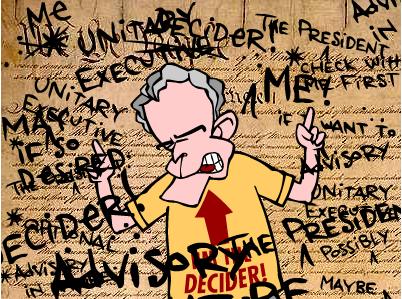
Cartoon
 by
Mark Fiore accompanied Jeff Hess's
blog post of May 13, 2006.
The following updates my post of February 8 and is a draft of this month's submission to LLRX.
*
President Bush embraces the theory of the "unitary executive" which
according to "Rethinking Presidential Power—The Unitary Executive and the George W. Bush Presidency" a 2005 paper by Dr. Christopher S. Kelley (
email) from the Department of Political Science at Miami University in Oxford, OH, has been used for unilateral action since Nixon's time when "modern presidents have had a difficult time relying upon the traditional powers of bargaining and persuading."
While Kelley wrote about the use of
signing statements, executive orders, and the
Office of Information and Regulatory Affairs to advance the administration's objectives, he omitted invocation of the
state secrets doctrine. And, since Kelley's article, it appears that Mr. Bush has added new tools: long term agreements in lieu of treaties
such as that he signed with Iraqi Prime Minister Nouri al Maliki on November 26, 2007 and, now, his proposed budget which reverses two pieces of legislation he signed, one which limited privatization and another which encouraged public service through college loan forgiveness.
On February 4, when the president submitted his
FY 2009 Budget for the period starting this October, the
Washington Post's Stephen Barr, wrote in
"Growing the Workforce but not the Payroll" that
Another item in the budget likely to stir controversy on Capitol Hill is the proposal to repeal parts of last year's consolidated appropriations bill [H.R. 2764], signed by Bush [December 26, 2007], that makes it more difficult for agencies to contract out jobs held by federal employees.
The legislation requires that private-sector bids show a savings of $10 million or 10 percent beyond the cost of keeping the work in agencies, prevents contractors from gaining an advantage by offering less generous health and retirement benefits to their workers, and extends to federal employees the same rights to appeal agency decisions as those that are available to contractors.
On
February 12,
Unbossed featured a post with an extensive quote from the Bureau of National Affairs, Inc. regarding the rollback.
Calling for agencies to continue identifying future opportunities for "competitive sourcing," or public-private job competitions where private sector firms can bid for the right to perform functions performed by federal employees, the budget request says the administration will work with Congress to eliminate the new legislative restrictions.
Among the contracting out restrictions from the DOD bill that should be repealed, according to the budget proposal, are:
provisions requiring public-private competitions, including the formation of an agency "most efficient organization" (MEO), before the conversion of agency functions involving more than 10 federal employees;
provisions requiring contractors to show savings of at least 10 percent or $10 million;
provisions stating that contractors cannot receive a cost advantage over federal agencies by spending less on health insurance or retirement benefits than the government does for federal employees;
provisions allowing federal agencies to hold competitions to evaluate the benefits of converting work currently being performed by contractors to performance by federal employees; and
provisions allowing federal employees to designate agents authorized to protest the results of competitive sourcing decisions.
Barr also indicated that the budget would reduce eligibility for loan forgiveness for individuals with current loans who have opted to work in public service and nonprofit jobs, which had been authorized when Bush signed the College Cost Reduction and Access Act of 2007 (H.R. 2669) September 27, 2007.
February 26, 2008 from 12:00 pm - 2:00 pm at the National Press Club, the
Constitution Project will be hosting a panel featuring Louis Fisher, specialist in constitutional law for the Library of Congress, author of
Constitutional Conflicts Between Congress and the President, as well as John P. MacKenzie, author of
Absolute Power: How the Unitary Executive Theory is Undermining the Constitution and Charlie Savage, Washington correspondent for The Boston Globe, author of
Takeover: The Return of the Imperial Presidency and the Subversion of American Democracy. Savage (
email) won the 2007 Pulitzer Prize for his
reporting on the Bush Administration's efforts to concentrate power for the executive branch and went on to write the book. I'll be interested to see if the speakers have comments on the use of the budget as a tool for the unitary executive.
*
So what's in the President's budget, and what has been the reaction?
While claiming fiscal responsibility through the eliminating or cutting of 151 programs (
see table S-5),
Bush has argued for making tax cuts permanent and taken war spending off the books.
The
February 8 newsletter of Taxpayers for Commonsense notes, "
While it's perfectly reasonable to claim that the costs of these military operations are difficult to estimate, it is ridiculous to not even estimate, given how long those operations have been in place and how much they have already cost. The 2009 budget plugs in a measly $70 billion for next year's costs, about enough for the first quarter, while just days after the release of said budget, the Secretary of Defense remarked that Iraq and Afghanistan could easily cost as much as $170 billion."Robert Greenstein, James R. Horney, and Richard Kogan at the Center for Budget and policy priorities
weighed in on February 7, saying, "
The President's budget would provide more tax cuts heavily skewed to the most well-off while cutting vital services for low- and moderate-income Americans, generating large deficits, and increasing the strain on states already confronting budget problems as a result of the economic downturn. The budget reflects misguided priorities that would leave the American people more vulnerable in a number of ways."
While the Heritage Foundation supports low taxes and domestic spending cuts, Alex Adrianson complained on February 11 that projected balanced budget in 2012 "doesn't include the costs of the war on terrorism. It also includes the unrealistic assumption that Congress will allow the Alternative Minimum Tax to ensnare tens of millions of additional taxpayers in 2009."
Meanwhile, director of economic-policy studies at the American Enterprise Institute Kevin Hassett acknowledged in a February 11 column for Bloomberg that Bush has "outspent Clinton by a mile," even disregarding the cost of the increases in the "War on Terror" and Iraq.
Here is where you will find the rebuttal by the Republicans of the Democratats' analysis of the proposed budget. For additional information, see OMB Watch's The Bush Budget Legacy: Misleading Claims and Misguided Priorities, as well as the information pages on the budget for the Coalition for Human Needs and Taxpayers for Common Sense.