Showing posts with label poem. Show all posts

1/16/18

Midwinter in the Land of the Dead


Photo by Jacques Descloitres of a low-pressure system swirling off the southeastern coast of Greenland, MODIS Rapid Response Team, NASA/GSFC, 9/4/2003

MIDWINTER IN THE LAND OF THE DEAD

January 4, it's single digits,
never mind the windchill
Arriving home at dark, 
knees stiff, feet numb, I contemplate
frostbite, burrow under thrift store
comforters lined with flannel sheets,
wait for the brittle waning moon to rise,
muse refusing to shed bed linens until 
Persephone surfaces.

Outside my window, winds barrel like
semis on the interstate.  I tell myself these gusts
could only pick up a hundred pound person
and I weigh far more,
could only snap small limbs off the maples.
It's not like forests will be flattened.
It's not like falling out of an airplane.
or racing NASCAR without a windshield.
It's not even like that winter in Beckley:
thirty-nine inches of snow overnight
power out, we countrd down the cupboard's contents
four wheel drive pointless until
a medevac humvie flattens a trail.
Keeping to its tread, we escaped to
the plowed road and Kroger,
only to find the roof stove in,
corrugated steel walls burst at the seams, shedding
bags of loaf bread forlorn, not even looted:
West Virginia, Bob Henry once wrote,  where
"the roads are crooked
 and the people are straight."

Yesterday, forecasters called for the barometer to fall so fast
low pressure would loose a bomb cyclone
off the coast of New England. On NPR,
a Vermonter complained she'd already
burned through a quarter of her cord wood
with no new dry to be had.

Here, in Blacksburg, there's no snow and we still have power.  
At midnight, I get up and steep hibiscus tea, 
crack open a pomegranate, loose its ruby arils.  
Tell myself there're dishes to wash, soup to simmer. 
Tell myself I've grown sturdy: 
when temperatures rise to the fifties next week, 
I'll almost regret it. 


9/29/16

Poem: Lucy Lee Shirley's Skirt


ad more here: http://www.mcclatchydc.com/news/nation-world/national/article103423762.html#storylink=cpy

Back then, if they saw us trying to read or write they would take our hands, take our eyes, if they saw us keep doing it, take our lives, and here I was being awarded one of the top literary awards in the country, having come from that land...That’s our spirit – you can kill us, some of us will die and some of us will take the stories of our grandparents to the next generation. I am the living embodiment of that.   

      ~  Nikky Finney on the dedication of the new Smithsonian National Museum of African American History and Culture, talking about one of the artifacts, a videotape of her acceptance speech for the National Book Award.

*

Six days after police shoot Keith Lamont Scott claiming he posed a threat,
Zianna Oliphant testifies before her hometown City Council:
It’s a shame that our fathers and mothers are killed, and we 
can’t even see them anymore. It’s a shame
that we have to go to their graveyard and bury them.

Scott's wife has released a video she took
as she yelled at police:
He has no gun.

His sister tells reporters,
He sits in the shade, reads his book
and waits on his kid to get off the bus
He didn’t have no gun, 

he wasn’t messing with nobody.

In the museum on the Mall, hangs that little skirt  
someone carefully sewed
using a whip stitch and natural thread:
fabric linen/cotton blend
patterned with small flowers:
red, purple, tan and blue.
Style typical of the day,
trimmed with a pleated self-fabric ruffle,
piped in blue, gathered into a yellow waistband.

Worn often, Lucy's skirt shows its age
in stains and holes and worn patches
and later alterations.
Her granddaughter Cornelia 
has shared it with us.
A Polaroid shows
how once it had a long-sleeved
matching peplum top.

The curator says:
people's ability to continue to love 
is something that I can never quite get over.

Picture Lucy, seven or eight or nine
at dusk on a summer Sunday forty miles south in Loudon County
a century and a half earlier
whirling at the edge of a dirt track
fringed in wild asters.

Zianna, the same age, now, crying at a Charlotte podium.


*


2/23/15

David Huddle: The Stile

Photos and poem used by permission as posted to Facebook on 2/21 by author David Huddle.

I found this poem lovely, It's fully as powerful as the Sharon Olds poem "I Go Back to May 1937,"  in The Gold Cell, but with the right man and the right woman. David commented that "Only after I posted the photos...did I see how clearly they connected with this poem that was written some years ago. It's in Blacksnake at the Family Reunion.

See: Blacksnake at the family reunion : poems. LSU Press, November 2012, 55 p..   I'm happy to report that the Virginia Tech library has a copy of this and many other of David's works. You can find it on the fourth floor of Newman (PS3558.U287 B53 2012).  Huddle comes from Ivanhoe Virginia in Wythe County.  I know him from Hollins, where he has taught.  He is professor emeritus (bio) at the University of Vermont and will be at Breadloaf this summer.

*

The Stile

A stile is a pair of steps or ladders that is accessible to pedestrians but generally inaccessible to animals. Stiles
often found in rural areas or along footpaths and allow access to a field or other area enclosed by a fence or
wall. Unlike a gate, there is no chance of forgetting to close it…. --Wikipedia

Between the house of my mother’s childhood
 and the one where my father grew up was

a field about the size of a city
 block, a fence on both sides, with a gate through

which he had to pass to enter the field,
 then a stile over which he had to pass

to leave the field and arrive in her yard.
 My brothers and I were specks of cosmic

dust floating far above the thistles, clover,
 alfalfa, and wild strawberries that grew

in that field--no bodies, brains, or spirits,
 we nevertheless witnessed a young man’s more

and more frequent trips through the gate, across
 the field, and over the stile that summer,

both their mothers watching from bedroom windows
 that faced each other across the shimmering

heat of June, July, and August. Desire
 is the sky, the grass, the smell of cedar,

specks of light shooting through blackness: it knows
 no authority. Our mother was fifteen,

compelling as fire seen for the first time,
 strong-willed as a young horse. Their mothers knew

better than to say no. My brothers and I kept
 our watch, drifting closer each time my father

approached the stile to find her on the porch,
 waiting in the wicker rocker. Her half-closed

eyes saw him flying to her. That’s when they
 must have felt us waiting out there in time.

*


5/30/14

Poem: Coal Strike


May 30, I'll be seeing the Participant Media film Cesar Chavez at the Lyric, which reminded me of this poem after I drove down to St. Paul in Wise County, Virginia on July 4, 1989 with other staff members of the New River Free Press.  Both Chavez and Jessie Jackson spoke that day.  The next day, U.S. District Judge Glen Williams in Abingdon would  fine the United Mine Workers and two union officers an additional $720,000 for violating his ban on forming convoys to slow down trucks delivering coal.  

I compiled the illustration from a photograph in the article on the strike which appeared in the March-April 2009 issue of the United Mine Worker's Journal and a photo from the archives of the United Farm Workers.  I first published this post 5/30/14 at 6:13 pm and updated it on 8/13/14, to incorporate the photo at the end of the poem and the following explaination, which I had first drafted earlier, but never posted.

*


Before striking April 5, 1989, the United Mine Workers
toiled sixteen months without a contract
after Pittston Corporation cut medical
benefits to families and pensioners. 
Pittston faults the union for blocking
prosperity in the region.


COAL STRIKE

Independence Day 1989
drizzles its way into
St. Paul, Virginia.
Miners, wives, kids,
supporters
in this mucked field
all decked out in camo
savor watermelon
handed off the back of pick-ups.
Beneath a banner by
New Jersey painters,
Caesar Chavez
farmworker organizer
come all the way from California
bolsters the Pittston strikers:

Non-violence will draw
others to your cause...
The judge cannot
put the whole world in jail.

                    *

West Virginia.
It was Pittston
who dumped slag in Buffalo Creek,
clogged the Middle Fork
starting back in '57.
Five underground mines,
two augers, one strip,
yielded up a thousand
tons of gob a day
black as the coal it came from
crisp as cinders till the rain
slushed it to an oily batter.
Wet or dry, gob steamed,
along with mine posts,
crib blocks, roof bolts
dumped sixty feet high
and behind it, the black lake.

February 1972.
Those days were wet days,
rain and flurries of snow.
And on the 26th
when the dam of uncompacted slag
began to seep
and the sheriff
sent two deputies around
to get the people up the hillsides
the company sent the lawmen home
and issued no warnings.

One minute before eight
black water roared through,
scraping a million tons of refuse,
fusing it to rolling lava,
hurling mushroom clouds of mud
hundreds of feet high
to land on Saunders
destroying the power line.

The one surviving clock
served by that line
abruptly stopped.
8:01 a.m..

                    *

This strike's
gone on a hundred days.
Miners, wives,
pensioners black-lunged
and crush-legged,
preachers from Roanoke
lie down in the roads,
slow their cars
to block the coal trucks.
The judge jails folks for lying down,
for driving slow.

Pittston prints full-page ads
boasting its generous spirit
its love of these mountains.

                    *

Think of that black lake
beginning to seep through the slag.
It is the voices that haunt you.

Someone near Saunders:
I was about 150 foot above
where the water come out.
It was burning there.
Water hit fire,
it shot right through the air
200 foot high, right through the air.
There was dust and black smoke
and when we looked again
the water was down
the smoke cleared
and we couldn't see nary a thing
not a living thing
nothing standing.

Or at Kistler
all the way down
by the mouth of the creek:
Have you ever pushed
a rubber ball
down in the water
and turned it loose?
The house jumped plumb up like that.
I cannot explain that water
as being water.
It looked like a black ocean
black as coal dust
where the ground had opened up.
If you had thrown a milk carton
out in the river that's the way
the homes skimmed along.
The water was a thing alive
coming after us to get us all.
I still think of it as a live thing.

Or at Amherst:
The whole town just raised
started moving down the hollow,
just like it was sitting.
I seen the first house hit the bridge
and then the second
then the third and fourth
and then a mobile home
just vanished underneath.
There was three women in it
they was standing
in a big picture window
and their mouths was moving.
I gathered they was hollering.

                    *

No warning issued.
Miles of track
coiled to barbed wire.
125 corpses
flood-lynched from tree limbs,
buried in silt piles,
washed up limp on the creek banks.
To this day
seven have not been found.
And three children's bodies
of identical size
too battered to tell apart
lie in anonymous graves.
The story is
that they were headless.

                    *

And when a tire is flatted,
a windshield broken out,
the judge calls this violence.


The above photograph is uncredited, but maybe Dave Peyton, who reported on the flood for the Herald Dispatch, along with the legendary Jack Hardin, could tell me who the photographer was.

Peyton is now with the Charleston Daily Mail, but he talks about going down to Man,  at the mouth of Buffalo Creek in Logan County, with Hardin here, in Bob Weaver's Hur Herald.  (h/t to Rachel) Weaver's account published his own account there last year, when he accompanied Peyton to the 4oth anniversary of  of the flood, having himself been on the scene in 1972, having left his funeral home in Spencer, WV to join his National Guard unit in Man.

In 1989, I started writing the poem you'll find above, juxtaposes the accounts recorded by Kai Erickson from survivors of Pittston's disastrous flood  with my observations of the coal strike against the company seventeen years later, when it canceled health insurance to benefits for approximately 1,500 retirees, widows, and disabled miners and refused to contribute to the benefit trust for miners who retired before 1974. The infamous Massey Energy latter bought out Pittston.

I had traveled down to the strike on July 4 that year with friends who worked on the late, great New River Free Press. (You can read about the end of the the Free Press here, but there are factual errors because the reporter took the word of those he interviewed.

As an all-volunteer advocacy journalism project, we believed that we were not constrained from activism, so long as our writing was fact-based and we disclosed our bias, which we did in a mission statement (which I don't have handy and have asked our one-time archivist if he can help me out.)  John Enangonio wrote about the strike for the paper, but it's not available online.


Erik Loomis who teaches history at the University of Rhode Island (emailwebsitewrote about the strike for the Lawyers, Guns and Money blog.

10/4/13

Poem: Marie Curie Remembers Radium

"Fireflies  Inside" by Alfredo Camargo.  Digital fractal posted to DeviantArt.com in 2009..


MARIE CURIE REMEMBERS RADIUM

Dew on periwinkles
fireflies
moon-bathed high plateau
Pierre in a French window

eyes clear with abandon
dreamer lost
in his reflections.
Light always lured me.
How can it surprise you
I was seduced
a gram of blue glow
coaxed from tons of pitchblende?

I tell you the instant of my calling:
uranium salts kept in dark for months
and black paper shrouded
exposed a photographic plate.

You assume
that radioactivity's escape
from the shroud fascinated a girl
who had lost her mother too young--

a girl, who even before the hacking cough,
noted her mother's avoidance
of kiss
or even an embrace.

Don't. As much as I mourned
and stiffened to others' touch
and even banished God
I tell you

a glass case, graceful instruments,
amber, silk, the gold-leaf electroscope;
I must have been only five
yet, I remember my father's tools.

Yes
light always lured me.

9/29/10

Green Beans

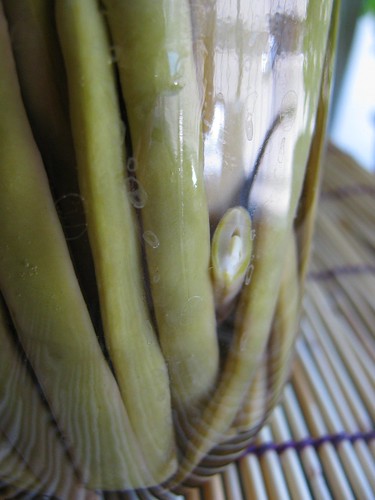
Photo from Flickr--no photographer identified--used by a cooking blog.


The original story in the Roanoke Times included a picture of white-haired Elizabeth holding a can of beans with a title something like, "Women Hasn't Opened Can of Beans for 57 years."  I wrote this to imagine why....

*

GREEN BEANS

"And as the years passed
the beans became a reminder
of her long-departed youth."

--Roanoke Times and World News, 10/26/78

*

Last week Elizabeth turned eighty.
She touches her hand to jar
blue against the velvet green of her beans
canned 1921, last year they had the farm.
The beans curve, green fingers
tip to tip
long, slender
as hers were that July
everyone said she'd the prettiest hands.

She feels cool weight of quart
thinks of pots steaming
so hot that July
Jonathan drug the woodstove out in the yard.
She is telling her daughter
a teaspoon of sugar
a teaspoon of salt
now wipe that rim.

Beans were scarce that year.
She paid her little ones
to pick beetles off
not before the vines all wilted.
Only one row in the new ground thrived
an odd row planted when she ran out of corn.
She sowed and picked beans by the moon
not enough to can
she canned them anyway
stacking beans upright
in concentric circles.

Nights she lay at Jonathan's side
stared at beans in the moon patterned ceiling.
At midnight
she finally slipped from the bed
counted stripe on stripe
tomatoes, peaches, corn
a hundred quarts

and that can of beans

cool fingers
soothing her to sleep.

*

Wish I  had a copy of the article in the Roanoke Times with me, so I could scan the picture of  Elizabeth.

This poem was originally published by Artemis, as I recall.  Although I started it in 1978, when I first joined a writers' workshop, I didn't finish it until several years later at the Hindman Settlement School's Writers' Workshop.  It turned out to be the first of a series about Elizabeth, called Weatherings, which take place over the course of a year in which the weather evokes earlier memories.  Fred Chappell used to sign notes to me Old Fred and tease me that I was writing about myself.  (He didn't know that my birth name is Beth, not Elizabeth, but maybe he was on to something.)


I read it for an audience most recently on September 25 at Voices from the Mountains (the lead-up to the march and sit-in on September 27) and got compliments from our emcee Reverend Billy, novelist Silas House, poet Bob Henry Baber, activists Roland Micklem and Sue Rosenberg and musician Carry Kline, among others, which was heartening.

 To tell the truth, following barn burners like Larry Gibson and Micky McCoy, I was glad that there was a musical interlude before I read  : ).  After this I finished out with Looking Out Over An Abyss in Boone County, one of my own barn burners.  The latter is about Larry Gibson's 50 acres at the edge of an mtr site and I don't think I had ever read to an audience when he was present.

UPDATE:  I also read the poem on the Floyd Radio Show January 7, 2012, where it was recorded and you can now listen on an archived podcast, which I've included at the link.

7/25/09

SHANNON WAMSLEY TALKS ABOUT THE SAGO MINE DISASTER


When the lightning strikes I shatter Elton’s coffee cup.
The moon new, Venus visible this week
I’d been staring out across the black, rinsing breakfast dishes.

Lightning’s queer in January here. I’d never
seen the likes of such, race down to the mine,
my mind a-swirl like the Buckhannon River.

Elton stands there, face black, but safe and sound.
I’m bound to joke, say some trite thing
about our lives cheating the blast,

when Elton’s face goes slack. Anna, last of the wives
comes up crying. Elton tries some small
comfort, sharing a word of hope he’s heard.

I realize her Randy’s still trapped and my own heart
goes cold inside my quilted vest, Christmas plunder
coal wage-bought. “The wages of sin” comes to mind.

I try to shake the thought, but how?
I have my husband. The others wait.
How can you sort happiness from guilt?

*

Guilt and thanks--what if it had been a normal day? His crew
waited ten minutes for a buggy big enough to take them in.
Ten minutes, I hear Elton say, he’d have been round that turn.

Ten minutes, he’d been trapped inside.
Ten minutes, I’d be waiting with the other wives
Ten minutes, if it had been a normal day.

*

Elton says when it starts getting hot, he never does see fire.
Just hears this roar and feels a rushing wind.
Heat and soot, dust and smoke keep coming

clammy air where you can’t make out your hand or breathe.
Monitors beep and blink and men fear they’re fixed to die and
all the time, this rushing wind. He says you feel your way along.

*

Sitting in his truck holding vigil, I can’t help but
fit my pinky to the hollow of his cheek. At two a.m-- I
must have nodded off--

I wake a-shiver, not from cold, but from
how long the other wives
must wait and wonder.

In the dim light a sliver of moon provides,
I stare as Elton snores, for a moment deep in sleep.
I used to fret when his noise would wake me up.


*

The illustration is from the Farmer's Almanac. That's what the moon looked like by January 3, 2000. The poem is the one I sent yesterday to Verbal Events, the quarterly compilation of poems in progress by those of us who studied with Bill Stafford back in 1985 at Atlantic Center for the Arts.. Francine Sterle had kind things to say about the poem when she received it and since I admire her work,, I thought I'd go ahead and post the poem, along with the discussion I sent her. Feel free to chime in on the discussion.

*

I tried to capture a sense of the protagonist from the interview she did, along with her husband, on CNN. "Plunder" is an old-time regional usage, she didn't use. Nor did she use "fret". Hope the perfect iambic pentameter of the last line didn't go over the edge. Had to imagine a few details--the kitchen scene, the truck scene, of course, which makes me wonder about using her name. On the other hand, not using seems like theft. Your thoughts?


*

Of course, Eliot would have recommended theft, I suppose, but, he's not such a nice fellow. As Virginia Wolf said of him to Roger Fry, May 18, 1923:


That strange figure Eliot dined here last night. I feel that he has taken the veil, or whatever monks do...Tom, though infinitely considerate [of his
wife], is also perfectly detached. His cell, is I'm sure, a very lofty one, but
a little chilly. We have the oddest conversations: I can't help loosing some
figure of speech, which Tom pounces on and utterly destroys.
Another curmudgeon than Eliot, but one who wrote more plainly, said something funnier about him. This from Robert Frost, as reported in The Letters of Robert Frost to Louis Untermeyer, pg. 321 (1940)

Eliot and I have our similarities and our differences. We are both poets and we both like to play. That's the similarity. The difference is this: I like to
play euchre. He likes to play Eucharist.
Here's a story about Frost's dark side in the lengthy article which our beloved Bill Stafford wrote August 18, 1974, entitled "The Terror of Robert Frost, which the New York Times republished April 25, 1999.

Lesley Frost has told about a midnight scene when she as a child awoke to find her father waving a revolver toward her mother, and threatening: "Take your choice. Before morning, one of us will be dead."
Bill also recounted the "Eucher" story, but attributes it as follows:

Elizabeth Shepley Sergeant in her "Robert Frost: The Trial by Existence" reports one such utterance: "Know what the difference is between me and T.S. Eliot? I play euchre. He plays Eucharist. We both play."

Bill also has something to�say about Frost'steaching, which might be of interest to those of us who studied with Stafford or read his books on creative writing.

Frost's poetic unorthodoxy had a direct link to his unorthodoxy in the classroom. "Don't work -- worry," he said to his students. He dreaded grading. He often urged students to buckle down less. He tried tagging students with their grades on the first day of class, an then allowing them to come in to persuade him, if they could, to change the grade. He asked if students wanted papers returned, and if they hesitated he swept the papers into the wastebasket.

When forced to give a final exam at the University of Michigan, Frost simply asked his students to write down what they had got from the course. Later, he reported to a friend that one student said he hadn't gotten a damned thing out of the course and that the student had received a B. Asked why not an A, Frost
said the student misspelled "damned."

In his book "Robert Frost Speaks," Daniel Smythe cites many Frost utterances that revealed the poet's cavalier attitude toward teaching and toward "the rules." For instance, Frost did not believe in investigating something in order to write about it:

You know, we don't need to be original or inventive. You don't need to find
new things. Just take the old things you find about you, the things people have
known all their lives, and say them with your style." Nor did he believe that
poetry should be studied: "You go to school to learn to read. The further you go
the more you have the attitude that everything is to study. That is the danger.
Once a person has learned to read, once he has gotten the flavor of it, he
should just let it rest.
Years earlier when he had begun to teach, he had written on the board what identifies that attitude:

To be read -- to be enjoyed. Not studied -- not skimmed.


5/25/08

Memorial Day at Poplar Forest

Photo of Poplar Forest from a nearby Baptist conference center's tourist info.

Tomorrow Barry and I will make our fourth trip to Poplar Forest for Memorial Day. Here's a poem I wrote on the first visit.


MEMORIAL DAY AT POPLAR FOREST for C.B.A.

Thomas Jefferson
rode the ninety miles
two days on horseback
three by carriage:
this octagon villa
his retreat from public life
at Monticello.

Sated on soda bread
a magnum of wine
we stretch out under the farthest surviving poplar
watch cumulous clouds dock and disolve.
One evokes a falcon
its swoop of wings, its talons.
Above us, the bough trimmed severely,
the poplar's leaves crowd in along remaining wood
as if to compensate for phantom limbs.

On the house tour we learn
Tom's slaves cast and laid a quarter million bricks
according to his design directly to clay
with no foundation.
After one hundred eighty-seven years
the skeleton of bricks remains intact
paint scaled off a coat at a time
then plaster, all stored to stoppered test tubes:
archeology essentially a deconstructive process.

Ghost marks on bricks
reveal a mantel here
a chair rail there,
let us glimpse the future restoration.
I prefer this bare brick:
strained backs of men and horses
beneath the great man's surfaces.


*
And speaking of Memorial Day, here's a baker's dozen from NewsTrust on the Iraq War, something to keep in mind as we mark the day tomorrow.

  1. The Sergeant Lost Within NYT--Reviews
  2. Book Review - 'Standard Operating Procedure' NYT --Reviews
  3. Soldier-Brothers See All Sides of War AP Reviews
  4. Feeling safer, Iraqis come home APReviews
  5. As soldiers fill Sadr City, militia fighters wait LA Times Reviews
  6. Iran 'paid Iraq insurgents to kill UK soldiers' Daily Telegraph Reviews
  7. The Return of Iraq's Ayatollah Time Reviews
  8. U.S. Teams Start Work Of Restoring South Iraq WaPoReviews
  9. Iraq Vets Get Poor Health Care, Americans Say in Harvard Survey Bloomberg
    Reviews
  10. War and service: Remembrance and debate Balt Sun Reviews
  11. Controversial Contractor's Iraq Work Is Split Up NYT Reviews
  12. Congress declares budget war LA Times Reviews
  13. Pentagon public relations program investigated AP Reviews

1/2/00

Poem: Olga Korbut on Chernobyl, 1991


Collage from photos by Heinz Kluetmeier (l), Kimberly Butler (c) and Taro Yamasaki (r)


OLGA KORBUT ON CHERNOBYL, 1991 (after reading "Olga Korbut's Deadly Foe," People, 3/4/91)

The radiation does this.
These pictures in the magazine
could be two different women.

At 17, smiling,
in pigtails
at the Munich Olympics,
I look, what, maybe 12.

At 35, these lined, swollen eyes
this brittle hair
this thin, thin mouth
remind me of my grandmother.

Only the shot
with my student
at the Minsk Sports School
balanced on the beam--
feet perfectly arched,
one hand flourished--
reveals some connection.

Funny, yes?
I didn't know I was smiling.
It's as if
a long-practiced gesture
creates the earlier time.

At our regional hospital
7,000 have come in for leukemia--
if you could see their pictures:
adorable children, each of equal desperation.

I stayed there myself last spring
for my liver
and even with my connections
could get no disposable syringes.
We found a needle
and we boiled it and boiled it.
It was so dull
I could not finish the treatment.
One learns to accept people dying.
(stanza break)

You in the West knew first.
They didn't tell us for four days.
And then only about the accident.
The papers called the radiation levels safe.

In Minsk, 180 miles away,
we were all outdoors.
It was close to May Day
and we were planting gardens,
enjoying the spring weather.
If we had been told
we could have stayed inside.

When people began to hear
our authorities might be
hiding the truth
we were afraid.
Of the water.
Of air.
At first, people were very ill.
Now all the time
we have headaches.
We always feel weary.
It has been five years
and we are still afraid.
When it rains we
cover our heads.

On the streets of Minsk
there used to be
so many pregnant women.
Now you see fewer and fewer.
We are scared and cautious.
We could go away
and maybe give birth to
healthy children.
But it is our home.
Our families are here.
It makes us torn.

Byelorussia used to be
the feeding ground.
Now it is poisoned.
In the past
when I would come to your country
I would buy blue jeans and shoes.
Now I buy chicken bouillon,
dried fruit.

Byelorussia used to be
the republic of mushroom gathering,
berry hunting,
flower picking--
now people don't go into the woods.
In some schools
when the children want to see
what nature used to be like
they go into a little courtyard
inside the building.
The teacher says,
"This is a bird"
and it is a plastic bird.
"This is a tree."
And it is also plastic.

11/17/91

1/1/00

Old Wives Tales


The photo  comes from a post by Susy Morris at her blog.


This poem comes from circa April 1988.I no longer have the email account which would let me know for certain, but I know I wrote it during the time of the Nellie's Cave Road controversy, which started that year. Here is my note on the inspiration:
April 25 it got up to 90 here & I bought my first glass of lemonade of the season. Because VE was floating on the horizon, I started to write in my journal about lemons. I went to the Tech library to investigate if lemons might have some mythic or folkloric significance I could use in a poem & discovered the Cleveland Public Library's Popular Beliefs and Superstitionsfrom the Ohio Collection of Newbell Niles Puckett (G. K. Hall & Co., Boston, 1981). This seemed the perfect resource, given our Cleveland connection. I wrote down lots of Mr. Nile's superstitions. Since I had a horrendous cold, many were of the ilk of  "To cure a cold, boil rabbit tobacco leaves with goose grease and lemon. Drink the liquid with the grease that falls in the bottom." The two that found their way into the poem, though, were the most intriguing. The one about the ghost brought to mind a man who haunts the life of a friend of mine. The Roanoke Times had just had an article on a prof at Hollins who was interviewing women on how their husband's ex-wives haunted them. A woman in my office who read the article had said, "The last few days I've had nightmares about Steven's first wife & in real life she's not the type to cause nightmares." So in the poem, I started to toy with bringing in the ex-wife. Then I thought, my friend is also an ex-wife, hence I had the ending. & the title. My journal entry about lemons found its way into the piece, displaced as to person. All that remained was to get all the loose ends to tie together. This is one of my favorite kinds of writing, the poem that comes out of the ozone, a serendipitous mix of ideas glomming together at some pt. in time to make a new whole.


OLD WIVES TALES (for Angela, after reading Newbell Niles Puckett)

1.

"The eating of lemons will cause you
to have a good sense of humor."

He grins, clicking
the rind in front of
his teeth with his tongue.
They are drinking iced-tea
and he always says this
before finishing off the yellow wedge,
bumpy skin and all.

He is the man who makes her laugh.
It is only later
when they cling to each other
in her poster bed at the farmhouse
she's restored with her bland husband
that the woman pictures
the man in a gauze mask
in an ivory-tiled room
timing contractions.
Not hers, the college abortion
and grapefruit-sized tumor
have foreclosed such options.

But isn't jealousy love?
He has told her he stole his daughter
because her mother didn't love her as
he does,
because he didn't want
his daughter raised by a Kansan
who never laughed at jokes.
The woman is always dreaming of
his pale midwestern wife
who appears at her door
takes the girl and
this man, who's so clever,
so misunderstood.


2.

"To ward off the ghost of a dead
person, hang a lemon in your front
window."

In the front window
of her new, compact apartment,
the woman hangs out a lemon
to ward off his ghost.
He is not dead,
only gone.
And not gone.
With her first husband
it wasn't like this,
nor her second.
Only this man in between.
This one who had beat her.
Not with his hands
but his words

which linger acrid in the air,
sarcasm with a sound
like the smell of cabbage cooking.
And since he had been in her life
she cannot feel alone.

She cannot enjoy the quiet
to pursue reading her stories
canning cloved peaches
sewing lace curtains.
Instead she feels guilt.
That she stayed so long.
That she'd gone so soon.
The woman is always hearing
the small daughter
left with him, whimpering
"Didn't you love me?"

The woman should be combing
the girl's hair.  Sewing
rick-racked smocks,
buying a tiny silver ring
with an amethyst birthstone.
He always said he stole
the girl for love.

She'd overlooked
that he'd put a four-year old
to bed on a matress without sheets
with their dishes piled
filthy in the sink, their food
dessicated in the oven.
That the girl would approach
even strangers to be cuddled.
She'd told herself it was the wife
who'd depressed him like this.

So the woman let her husband go, and
clung to the man, and took the girl
shopping for contour cartoon sheets.
She hung lemons to freshen the air,
polished every surface with lemon-
fresh Pledge, filled their life
with lemon meringue pie,
hot tea with lemon and honey.
Come summer they'd
drive to the drugstore and order
their first glass of lemonade
iced down, hand squeezed.

And wasn't jealousy love?
He'd been so possessive
he hadn't let her girlfriends
or even her sisters visit the farm.

It wasn't until
they'd spirited the woman away,
ordered her to sell the house,
for gadsakes, out from under him
if he wouldn't leave,
it wasn't until she'd
married a second time to avoid him
and divorced within a year
that she began to think, maybe
jealousy was something different.

Who was this wife,
the mother of the girl?
At night, the woman can hear
the wife sob for her firstborn.
Is this lemon--lit by the street lamp
outside the pane glass of an in-town
apartment that he has never seen--
really for him
or is it for the child and her mother?

And how do ties bind--
the woman's ex-husbands
who now have new wives--
are those wives hanging lemons
in their front windows
to exorcise her?

5/31/94

Poem: MEMORIAL DAY AT POPLAR FOREST


Photo:  Ghost marks on the bricks at Poplar Forest.  

MEMORIAL DAY AT POPLAR FOREST for C.B.A.

Thomas Jefferson
rode the ninety miles
two days on horseback
three by carriage:
this octagon villa
his retreat from public life
at Monticello.

Sated on soda bread
a magnum of wine
we stretch out under the farthest surviving poplar
watch cumulus clouds dock and dissolve.
One evokes a falcon
its swoop of wings, its talons.
Above us, the bough trimmed severely,
the poplar's leaves crowd in along remaining wood
as if to compensate for phantom limbs.

On the house tour we learn
Tom's slaves cast and laid a quarter million bricks
according to his design directly to clay
with no foundation.
After one hundred eighty-seven years
the skeleton of bricks remains intact
paint scaled off a coat at a time
then plaster, all stored to stoppered test tubes:
archaeology essentially a de-constructive process.

Ghost marks on bricks
reveal a mantel here
a chair rail there,
let us glimpse the future restoration.
I prefer this bare brick:
strained backs of men and horses
beneath the great man's surfaces.

Beth Wellington
5/31/94

11/30/85

POEM: OYAKO SHINJU


Photo of Fukimo Kimura, h/t Tom Schnabel (bio, radio program) who used it in his post about Kimura, in response to Jarissa MacFarquhar's article, "A Buddhist monk confront's Japan's suicide culture" about Ittetsu Nemoto in the 6/24/13 issue of The New Yorker.

*

OYAKO SHINJU*


"I am sitting in a room different from the one you are in now." 
        

      --Alvin Lucier
Oyako Shunju translates as "parent-child suicide, a practice traditional in Japan. 

"Like most traditional Japanese women, Fumiko Kimura considered 6-month-old Yuki and 4-year-old Kazutaka to be extensions of herself. She loved them passionately, almost obsessively.

"She took them everywhere with her--even to die."
       
      --Leslie Pound, "Mother's Tragic Crime Exposes a Culture Gap," reprinted from the 6/9/85 Dallas Morning News.

After reading Leslie Pound's account,  I decided to write a poem in her persona, as if Kimura was writing me back from jail.

1.  YOU ASK WHY I'D WALK INTO THE PACIFIC WITH TWO BABIES

Childless in your room
other coast of a wide country
you steam rice for supper
write me this question.
I sit in a cell
fill legal pads with pencil:
The ocean cleansed my heart and my body.
The ocean breeze blows the past away.

                               
                               *

My first love was always the ocean.
I was born on a small island.
Old ones called the year of my birth
firehorse--
poor chance to find a husband;
I would burn him, cause his death.

The ocean breeze played a scale,
waves washed my ankles.
I was standing in music.

                                *

Girls take up flower arranging
or tea ceremony
waiting for their husbands.
My aunts advised:
"Polish harder.  Become a piece of jade."

Since they found Western arts
desirable, I practiced piano for ten years.
The ocean breeze taught its scales to my fingers.
All the time I kept one secret.

                                *

All the time I kept this secret:
with no hope for a husband
I was strangely free.
Windy nights at low tide
moon scrubbed waves ivory
against ebony of ocean.
Such a friendly omen
sent me to the keyboard, avid.
One evening, grandmother,
listening to the fifteenth hours'
practice, suspected me
possessed,
gravely counseled magic.

                                *

For her sake I frequented the shrines
lowering eyes
to demonstrate some small despair;
questioned my husband-less
fate, picturing instead
(to get the gesture right)
a hesitation on the keys,
the ruined examination.

The time came; it came to pass.
National Music University not my future
you'd say I brought failure on myself.
The truth:  I misread the ocean's omen.

2.  TIDES TRAVEL OUT

I hoped this
was what ocean counseled.
Maps showed your country of long coastlines.
I had the ear for language,
liked the sound of California,
hummed it as I bought my ticket.

All night I dreamed
a long but easy boat ride, something
I cannot remember--night tides,
a bell, the pier.

                                *

In your country I sold hot dogs, nights,
three blocks from the pier.
Grease frying, coins clinking,
the bell on the cash register:
I was listening for the ocean.

Cars honked at the drive-in window;
teenagers back from the game
yelled across the lot.
The day-cook, Japanese,
was born in your country.
One evening in the back
room he proposed marriage.

                                *

Suppose
the old ones had told you
you would never marry.
Would you notice
he lacked ambition,
a desire for children?
He promised a piano,
an apartment by the ocean.

For eight years
we lived downtown
in a noisy walk-up.
I had to keep my job.
each night I dreamed
I hadn't failed the examination.
In a quiet room
the audience waited.
My hands stretched above the keys.


                                *

I started to walk down to the Santa Monica sea:
I like the sea.  I like the Santa Monica sea
when I lose my way it comes to meet me.
And when I have something sad, it comes to meet me.
Although this was not acceptable
I ask for a divorce.

                                *

I found an auspicious job.
At the Japanese restaurant
I could save up for my lessons.
The cook, Mr. Kimura, was a painter.
He'd graduated in Tokyo
from Musashi Arts University.
He spoke of pink curl of shrimp,
translucent winter melon.

If you could have
heard him in the kitchen--the drawing cut
the thrusting cut,
the clack of lacquer soup bowls.
He spoke of sea bass in August,
sea trout in May.
Shiny eyes,
bright scales,
clean taste of ocean.

3.  HOW TRADITION COMES INTO YOUR ROOMS

Six years ago we married.
He bought me a piano.
Soon owned his restaurant.

Home, evenings, I always
cooked our simple meal:
miso soup, bowls of rice,
cups of scalding tea.
I washed white porcelain, black
lacquer, humming to myself.
The piano waited for my practice.

My hands stretched above the keys,
belly rounding like the sea bass.

                                *

Our son Kazutaka came,
his gurgles the uneven ocean currents.

I spent days at home now,
wished to teach tradition.
I bathed his father's feet each night.
We removed the bed and slept on mats,
left our shoes outside the doorway.

Soon Kazutaka crawled.  We took
all furniture from the living room,
all sharp edges,
the piano.

                                *

I named my daughter Yuri.
Neighbors exclaimed over my tiny porcelain doll.
To hide any sign of pride
I lowered my eyes, spent
whole days dressing her and Kazutaka.
Combing their hair, walking by the ocean.

Kazutaka ran ahead
scooping fists of sand, watched
them pouring through his fingers.
I took his hand,
pointed to the ocean; we watched
tides wash in from Japan.

I told him of my life on the island
of walks on that shore,
of practicing the piano.

                                *

You can imagine my dishonor.
Mr. Kimura's mistress called,
implied to support us
he had abandoned his dreams to paint.
He'd seen her several times each week
and since he hadn't wanted another child
she'd undergone the shame of an abortion.
Now she had found out about Yuri.

4.  THE SECRET OF FIRE AND OF WATER

She sat down with us.
In our home.  Offered me
his love letters,
returned his gifts.
One week later, she sent a boy
with a note to the door.
Offered to sacrifice her own life,
if the problem could be settled.

Mr. Kimura
came home 2, 3, 4,
even 6 o'clock in the morning.
Still I washed his feet, only asking
that he paint my picture.

He never noticed I couldn't
eat, lost my concept of
memory, of sleep.  Left toys
strewn across the apartment floor.
I was not qualified as a mother:
the ocean's omen beckoned.

                                *

A quiet moon, washing waves.
A piano started playing first quietly,
then louder, out of tune.
I heard again grease frying,
the bell on the cash register.
My eyes squeezed shut.
Street lights dazzled, then
again the quiet moon, the washing wave
and the old ones whispering firehorse,
firehorse.

                                *

On the appointed afternoon
my dress was the pink of seashells.
Santa Monica beach nearly deserted,
a teen-age couple mocked the shrieking gulls.
Along the windy shore, an old man
stooped to gather seashells.

You ask how I could walk into the Pacific with two babies?
You must understand
my children were me--
I couldn't leave them behind.

Kazutaka fought; my nails
dug crescents in his wrist as we walked into the sea.
I lay face down in the cold water waiting for our death.

                                *

Living is hard and dying is hard.

Mr. Kimura visits me daily in jail.
I put away the legal pads.
Agree to his plans--we will
start over, have other children.
I lower my eyes to demonstrate
regret, picturing instead
the hesitation of the ocean's waves.

And all the time I keep my secret:
the children were me.
The sea will hold me tight
and it helps me forget my sorrows.