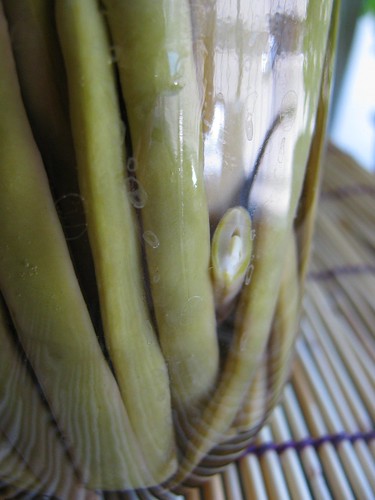
Photo from Flickr--no photographer identified--used by a cooking blog.
The original story in the Roanoke Times included a picture of white-haired Elizabeth holding a can of beans with a title something like, "Women Hasn't Opened Can of Beans for 57 years." I wrote this to imagine why....
*
GREEN BEANS
"And as the years passed
the beans became a reminder
of her long-departed youth."
--Roanoke Times and World News, 10/26/78
*
Last week Elizabeth turned eighty.
She touches her hand to jar
blue against the velvet green of her beans
canned 1921, last year they had the farm.
The beans curve, green fingers
tip to tip
long, slender
as hers were that July
everyone said she'd the prettiest hands.
She feels cool weight of quart
thinks of pots steaming
so hot that July
Jonathan drug the woodstove out in the yard.
She is telling her daughter
a teaspoon of sugar
a teaspoon of salt
now wipe that rim.
Beans were scarce that year.
She paid her little ones
to pick beetles off
not before the vines all wilted.
Only one row in the new ground thrived
an odd row planted when she ran out of corn.
She sowed and picked beans by the moon
not enough to can
she canned them anyway
stacking beans upright
in concentric circles.
Nights she lay at Jonathan's side
stared at beans in the moon patterned ceiling.
At midnight
she finally slipped from the bed
counted stripe on stripe
tomatoes, peaches, corn
a hundred quarts
and that can of beans
cool fingers
soothing her to sleep.
*
Wish I had a copy of the article in the Roanoke Times with me, so I could scan the picture of Elizabeth.
This poem was originally published by Artemis, as I recall. Although I started it in 1978, when I first joined a writers' workshop, I didn't finish it until several years later at the Hindman Settlement School's Writers' Workshop. It turned out to be the first of a series about Elizabeth, called Weatherings, which take place over the course of a year in which the weather evokes earlier memories. Fred Chappell used to sign notes to me Old Fred and tease me that I was writing about myself. (He didn't know that my birth name is Beth, not Elizabeth, but maybe he was on to something.)
I read it for an audience most recently on September 25 at Voices from the Mountains (the lead-up to the march and sit-in on September 27) and got compliments from our emcee Reverend Billy, novelist Silas House, poet Bob Henry Baber, activists Roland Micklem and Sue Rosenberg and musician Carry Kline, among others, which was heartening.
To tell the truth, following barn burners like Larry Gibson and Micky McCoy, I was glad that there was a musical interlude before I read : ). After this I finished out with Looking Out Over An Abyss in Boone County, one of my own barn burners. The latter is about Larry Gibson's 50 acres at the edge of an mtr site and I don't think I had ever read to an audience when he was present.
UPDATE: I also read the poem on the Floyd Radio Show January 7, 2012, where it was recorded and you can now listen on an archived podcast, which I've included at the link.
Showing posts with label my poetry readings. Show all posts
9/29/10
Green Beans
Posted by
Beth Wellington
at
3:54 PM
Green Beans
2010-09-29T15:54:00-04:00
Beth Wellington
Appalachia|arts and activism|my poetry readings|poem|political art|
Comments
Labels:
Appalachia,
arts and activism,
my poetry readings,
poem,
political art
3/20/08
Split This Rock Poetry Festival

Sonia Sanchez at Bus Boys and Poets, and Martin Espada, Ethelbert Miller, Naomi Shihab Nye (pictured above) and Alix Olson at Bell Multicultural High School. Quite the lineup. I walked over to the latter w. Steve, who lives in the city. Interestingly he was talking about a poet who's work impressed him and it turned out to be Diane Gilliam. Adrianne Rich could not attend but sent a letter and a poem. Sam Hammill had had a series of minor heart attacks, so likewise.
This one by Naomi Shihab Nye earned a standing ovation:
Wandering Around an Albuquerque Airport
After learning my flight was detained 4 hours, I heard the announcement: If
anyone in the vicinity of gate 4-A understands any Arabic, Please come to the
gate immediately.
Well — one pauses these days. Gate 4-A was my own gate. I went there.
An older woman in full traditional Palestinian dress,
just like my grandma wore, was crumpled to the floor, wailing loudly. "Help,"
said the flight service person. "Talk to her. What is her problem? We told her
the flight was going to be four hours late and she did this."
I put my arm around her and spoke to her haltingly. "Shu dow-a, shu- biduck
habibti, stani stani schway, min fadlick, Sho bit se-wee?"
The minute she heard any words she knew — however poorly used – She
stopped crying.
She thought our flight had been cancelled entirely. She needed to be in El Paso
for some major medical treatment the Following day. I said "No, no, we’re fine,
you’ll get there, just late, Who is picking you up? Let’s call him and tell him."
We called her son and I spoke with him in English.
I told him I would stay with his mother till we got on the plane and would ride next to her — SouthWest.
She talked to him. Then we called her other sons just for the fun of it.
Then we called my dad and he and she spoke for a while in Arabic and found
out of course they had ten shared friends!
Then I thought just for the heck of it why not call some Palestinian Poets I
know and let them chat with her. This all took up about 2 hours.
She was laughing a lot by then. Telling about her life. Answering questions.
Soon after, she pulled a sack of homemade mamool cookies — little powdered
sugar crumbly mounds stuffed with dates and nuts — out of her bag and was
offering them to all the women at the gate.
To my amazement, not a single woman declined one. It was like a Sacrament.
The traveler from Argentina, the traveler from California, the lovely woman from
Laredo — we were all covered with the same
powdered sugar. And smiling. There are no better cookies.
And then the airline broke out the free (non-alcoholic beverages from huge
coolers and the two little girls for our flight--one African
American, one Mexican American — ran around serving us all Apple Juice and
Llemonade and they were covered with powdered sugar too.
And I noticed my new best friend — by now we were holding hands – had a
potted plant poking out of her bag, some medicinal thing, with green furry
leaves. Ah, an old country traveling tradition: always carry a plant. Always
stay rooted to somewhere.
And I looked around that gate of late and weary ones and thought, "This is the
world I want to live in. The shared world."
Not a single person in this gate — once the crying of confusion stopped – was
apprehensive about any other person.
They took to the cookies. I wanted to hug all those other women too.
This can still happen anywhere.
Not everything is lost.
~

And this one by Martín Espada is the title poem from a collection of the same name:
Imagine the Angels of Bread
This is the year that squatters evict landlords,
gazing like admirals from the rail
of the roofdeck
or levitating hands in praise
of steam in the shower;
this is the year
that shawled refugees deport judges
who stare at the floor
and their swollen feet
as files are stamped
with their destination;
this is the year that police revolvers,
stove-hot, blister the fingers
of raging cops,
and nightsticks splinter
in their palms;
this is the year
that darkskinned men
lynched a century ago
return to sip coffee quietly
with the apologizing descendants
of their executioners.
This is the year that those
who swim the border's undertow
and shiver in boxcars
are greeted with trumpets and drums
at the first railroad crossing
on the other side;
this is the year that the hands
pulling tomatoes from the vine
uproot the deed to the earth that sprouts the vine,
the hands canning tomatoes
are named in the will
that owns the bedlam of the cannery;
this is the year that the eyes
stinging from the poison that purifies toilets
awaken at last to the sight
of a rooster-loud hillside,
pilgrimage of immigrant birth;
this is the year that cockroaches
become extinct, that no doctor
finds a roach embedded
in the ear of an infant;
this is the year that the food stamps
of adolescent mothers
are auctioned like gold doubloons,
and no coin is given to buy machetes
for the next bouquet of severed heads
in coffee plantation country.
If the abolition of slave-manacles
began as a vision of hands without manacles,
then this is the year;
if the shutdown of extermination camps
began as imagination of a land
without barbed wire or the crematorium,
then this is the year;
if every rebellion begins with the idea
that conquerors on horseback
are not many-legged gods, that they too drown
if plunged in the river,
then this is the year.
So may every humiliated mouth,
teeth like desecrated headstones,
fill with the angels of bread.
3/7/08
Lineup for the Women Activist Poetry Reading at Gillies March 10
Lissa Bloomer, lives in Radford in an old Victorian monster of a house with her three little kids and her husband. She is a potter, kayaker, gardener, a writer and researcher of women's and gender issues, and has been teaching writing at tech for 18 years. She has been writing stories and nature journals since she was 4, so we can't call her a new writer; but instead, prefers to be called an emerging voice-- an essayist, poet, and children's book author, who's topics range from the politics of febreeze to women in physics. Her activism comes from her anger of the treatment of our environment and women -- and the humor in noticing the smallest of these things.
Katie Fallon, an Instructor in the English Department at Virginia Tech, writes primarily creative nonfiction with an emphasis on wildlife, nature, and the environment. Her essays and memoir pieces have recently appeared in the literary journals Fourth Genre, River Teeth, Appalachian Heritage, Ecotone, and elsewhere. She is involved with several local and regional environmental organizations, and she serves on the Board of Directors of the West Virginia Raptor Rehabilitation Center, a nonprofit organization dedicated to 'restoring injured and orphaned birds of prey to the wild while inspiring environmental understanding through education for the benefit of all living things.' Katie's first word was 'bird,' and thirty years later, she's still obsessed with them.
Aileen Murphy got her BA in creative writing from Oklahoma State University and her MFA from Colorado State University. She is currently the Assistant Director of Creative Writing at Virginia Tech, where she teaches creative writing. She has published poetry in Midland Review, New Voices, Galley Sail Review, Ambergris, and Weird Sisters. She believes that the word "activist" describes other people, although as the youngest of seven daughters, and as a "recovering catholic" it is sometimes an appropriate synonym for "feminism."
Beth Wellington graduated from William and Mary with a B.S. in Psychology. She started writing and publishing poetry in her late twenties, after attending the writers' workshop at the Roanoke Women's Resource Center with Dara Wier. She's attended the Hindman Settlement School Writers' Workshop and is a member of the Southern Appalachian Writer's Cooperative. She studied with both Fred Chappell and Bill Stafford at the Atlantic Center for the Arts and has given workshops and/or readings in Florida, Wisconsin, Ohio, Utah, Michigan, Massachusetts, Vermont, Kentucky, West Virginia and, of course, Virginia. In 2006, Katie and Beth met while attending the Ohio Valley Environmental Coalition's Mountaintop Removal Writers' Tour. She's had recent poems published in Pine Mountain Sand and Gravel, Coal: A Poetry Anthology, Appalachian Heritage and Verbal Events.
Posted by
Beth Wellington
at
5:53 PM
Lineup for the Women Activist Poetry Reading at Gillies March 10
2008-03-07T17:53:00-05:00
Beth Wellington
my poetry readings|political poetry|
Comments
Labels:
my poetry readings,
political poetry
Subscribe to:
Posts (Atom)