11/17/11

Nikki Finney's Remarkable Head Off and Split Takes National Book Award


Affrilachian Poets  member and UK English Department prof  Nikky Finney wins National Book Award for Head Off and Split. I was wowed when I got to hear her read at the  Symposium on Affrilachia  @ UK in March.

In a November 11 interview with WUKY, Finney explains the title of her collection:

When I was a girl, my mom would send me to the fish monger. I would go in, choose the fish, hand it over to him. He would inevitably say, "Head off and split" question mark.

I went back five years ago. The same phrase was said to me. I'd heard it a thousand times. I thought, wow, that's a great metaphor for what we dismiss or cut away or don't want to see. The cold grey eyes, the scales, the fins, and then we're handed over the succulent fish without all those nasty details.

I wanted to bring that in to talk about how, as a culture and a community and a country, that I think we have to stay involved in all the details. We can't hand the fish over and just get it back with the succulent fish. I think we're in a time where we really we have to sort of get our hands in there and do the dirty work and not hand it off to somebody else.


Here's Finney reading some of her poems:

"Left" (pdf of poem)


"Condoleeza Suite"


"My Time Up with You"


"Red Velvet" [about Rosa Parks]


"Dancing with Strom"

And a long reading at the New School (starting @ 12:20) starting with her recounting the story of when Nikki Giovanni came to Tallladega College.


There's  an interview available at Oxford American and one at Poets & Writers for the February-March 2011 issue which you will have to read at the library, if you don't have a copy of the magazine..  The Virginia Festival of the book doesn't have its schedule up yet for March 2012, but announced via facebook that Finney is one of its readers.

Here's her acceptance speech (@16:50)
http://www.ustream.tv/recorded/18565428  (I couldn't embed because evidently only YouTube works with Blogger.

9/29/11

Maria Gunnoe: We're Sick of Dying for Your Bottom Line

September 26, House Republicans stages its Subcommittee on Energy and Mineral Resources Oversight Field Hearing on "Jobs at Risk: Community Impacts of the Obama Administration’s Effort to Rewrite the Stream Buffer Zone Rule" 

Say what?  It was the Bush administration which tried to eliminate the Stream Buffer rule.  You can listen to the whole hearing and read the testimony here, with Bo Webb and Maria Gunnoe start their testimony at 99:22. and 106:27 respectively.

As Bo Webb wrote in the comments he submitted:
  
The very title of this hearing indicates a bias against those of us who are living (and dying) in mountaintop removal mining communities. The title suggests that jobs are at risk if the SBZ rule is corrected. The SBZ rule must be corrected in order to protect The People’s health. It’s been broken and it needs fixed.
Let us not forget, President Ronald Reagan, your president, my president, in 1983 created the Stream Buffer Zone Rule because he realized the responsibility he had to protect America’s water supply in the face of an industry that was moving more rapidly toward a method of mining that would turn entire mountains into ruin and destroy head water source streams that carry drinking water to millions of American citizens. This committee now shares that responsibility because President George W. Bush, with the stroke of a pen, trashed the Reagan SBZ rule just before leaving office as a present to a coal industry that wills itself to increase profit at all cost, even at the cost of human health. 
Or as Maria Gunnoe told Gene Kitts of Alpha as he was leaving the hearing, "We're sick of dying for your bottom line.

9/2/11

Do we need the EPA?


Table adapted from Beyond Red vs. Blue Political Typology, Pew Research Center for the People & the Press, May 4, 2011.  See question  on pp 136-7 on public support for environmental regulation.  This is a first draft of a piece commissioned by The Guardian,"Why the GOP is going after the EPA: Republican lawmakers aim to cut back or even abolish the Environmental Protection Agency, even though it pays for itself, published September 12, 2011.


*

Who is following the U.S. public in its strong support for protecting the environment?

If you can rely Pew's 2011 survey (see above chart), 71% of those questioned--across the political spectrum--agree with the statement, "This country should do whatever it takes to protect the environment." Yet, on September 2, President Obama joined Environmental Protection Agency (EPA) critics in Congress and  GOP  presidential candidates  in  arguing that the agency unnecessarily burdens U.S. industry.

As the clever Erica Grieder (writing as E.G., Austin, in The Economist) says in "The Hole in the Ozone Standards,":

When the White House makes an announcement on the Friday before a holiday weekend, you can bet that it won't be anything in which they take special pride.

Obama stated that while his commitment to public health and the environment is "unwavering,"  he has ordered the EPA to withdraw its draft Ozone National Ambient Air Quality Standards in order to
underscore the importance of reducing regulatory burdens and regulatory uncertainty, particularly as our economy continues to recover.
Ground level ozone is the primary constituent of smog. In June, EPA Administrator Lisa Jackson testified before the Senate Environment and Public Works Committee (EPW) hearing on the Clean Air Act and Public Health.  In July she responded to EPW member Tom Carper (D, DE) that she had opted to review the 2008 ozone standards, rather than keep them in place until the next mandated review in 2013.  Bush's standards--which he  weakened at the last-minute in  2008 and are under court challenge were
not legally defensible given the scientific evidence in the record for the rulemakeing, the requirements of the Clean Air Act and the recommendations of the CASAC [the Congressionally-established, independent  Clean Air Science Advisory Committee.]
Further, were Bush's standards to be
overturned in court, it would have resulted in more financial and planning uncertainty for Cities and States, when they could affort it the least.
The most recent suit may be the one filed June 23 against the EPA for failing to enforce industrial emissions.  Ironically, Republicans on the Senate Committee on Environment and Public Works reacted with glee, posting this and this, only days after complaining about litigation costs, which had led them to order this study.

Will critics of EPA regulation see the irony, if the cancellation of ozone standards lead to more litigation costs?  Probably not.  Rather they will continue to complain that environmental groups are profiting from the taxpayers by suing the federal government.  What ever happened to concern for the public's health and safety?

Juliet Eilperin--who reports on on science, policy and politics in areas including climate change, oceans, and air quality for the Washington Post--called Obama's statement "a win for the business community."

Of course, Obama's position is nowhere near as extreme as that of Congressman Mike Rogers (R-AL), who told an anonymous radio host (listen to the full interview at about 16:45 for context):

You know the fact is, if in fact I think the American people do next November what they started last November, that is, cleaning house, and we do get a Republican-controlled Senate and a Republican president, I think you going to see some dramatic structural changes in this country... Who says the federal government has to have an EPA. Every state has their own environmental protection agency. Why does the federal government need to be doing that? ... I think we’ll have to look at a lot of things that we’re doing at the federal level and ask ourselves, ‘is this really what the federal role?’ And if not, discontinue it.

As far as abolishing the EPA, investigation reporter Mark Schapiro--Senior Correspondent for the
Center for Investigative Reporting(CIR)--tells me,

It's an economic catastrophe to remove incentives and oversight.

Nor, is Obama's position as extreme as that of Sen. Richard Burr (R-NC), who has filed a bill to merge the EPA w. the Department of Energy.  Other Republicans and some Democrats would weaken the agency through budget riders or reduce its authority in specific areas, arguing against needless "job killing"  regulations.  This despite the fact that reports show the EPA’s regulations to be cost effective.

The CIR's Schapiro--author of  Exposed: The Toxic Chemistry of Everyday Products and What's at Stake for American Power--also tells me,
The dialogue between ‘jobs’ and ‘regulation’ is endless and repetitive, and in almost every instance the claims by industry that new, more protective regulations would result in job losses and harm competitiveness have turned out to be dramatically overstated.
 In the past,  the EPA's  Jackson  countered critics of federal regulation, saying that "[s]mart environmental protection can actually drive innovation."  Are some U.S. industries resisting innovation?  Are there ways--other than through their  lobbying against regulation--that they are putting themselves at a disadvantage in the world market?

The answer to both questions--according to Shapiro--is yes.

*

More information coming soon:

The Guardian had asked for the following, but I ran out of space because of the breaking news from the Obama admnistration:
  • who funds the critics
  • what things were like before the EPA existed
  • the EPA's budget


To give a more complete picture I'll also add:
  • Cass Sunstein's explanation to Jackson for Obama's September 2 statement
  • reactions to Obama's statement
  • the acceleration of funders' power because of the Supreme Court
  • the more moderate Republican critics with conservative cred  that say the EPA's methods are outdated but the severe critics are misguided:
  • the Democrat-sponsored legislation to weaken the EPA
  • the Republican-sponsored legislation for the same
  • the EPA's cost-benefit ratio, despite its critic's contentions
  • the  current weaknesses in EPA's power (standards of proof before regulation, etc, v.s. European standards)
  • Schapiro's  explanation of  how lobbying for weak regulation undermines U.S. status in the global economy

      9/1/11

      Are Republicans Doing Oppo Research on Don Langrehr


      Photo of Don this July at the Ruritan fish fry by his neighbor Carol Brandt used with permission.

      *

      Don Langrehr received the Democratic nomination for 12th District to the VA House of Delegates July 29. August 31, my friend and retired organizer Mark Barbour forwarded me something from Don's campaign.  Don says  that this week, the Town of Blacksburg received a Freedom of Information Act Request (FOIA) for Town Council meeting minutes over the last 6 years from National Republican Congressional Committee.

      I'll update this as soon as I have time.  I need to interview some folks before I can write a decent piece, not just stenography, but given midnight September 1 deadline for donation reporting, I thought I'd pass on Don's rationale for why he needs your help.  I donated a bit at this link yesterday and some of my readers may want to do the same.  I think Langrehr, a Blacksburg Town Council member and Radford University education professor is someone who genuinely stands for equality and shared prosperity. 

      Don writes,

      I have a feeling that someone, perhaps a local Congressman, is not very fond of my candidacy for the General Assembly. I also get the feeling that our campaign will surely heat up over the next couple months with some blatantly negative advertising targeted at me.


      I must be prepared for any negative attacks on our campaign. Tomorrow at midnight is the filing deadline for the current financial reporting period and I need your financial help! A strong showing of financial support will demonstrate our resolve towards anything our opponents have planned....Please help send the message that any future dirty tricks are not going to derail our House of Delegates campaign.

      BTW, if you prefer to send a check:

      Don Langrehr for Delegate
      PO Box 10612
      Blacksburg, VA 24062


      8/31/11

      Fracking Caused the Virginia Earthquake, NOT!


      Illustration adapted from a photo of the seismograph from Virginia Tech at the time of the August 23 earth quake with a epicenter near Mineral, Virginia.  If readers have additional questions, please add them in the comment section and I'll pass them on to Klose.  You can read reviews of this piece and/or add your own at NewsTrust.


      Life on the internet imitates  art

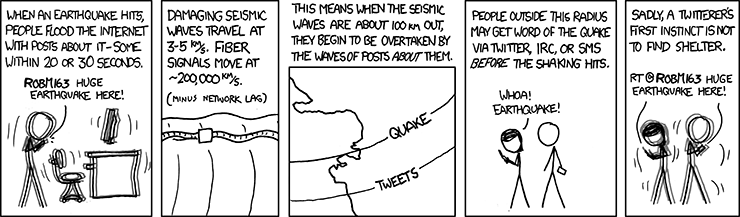
       Hurricane Irene, and before that Virginia's August 23  5.8  earthquake with its epicenter only  eleven miles as the crow flies from Dominion Energy's North Anna nuclear plant in Virginia--how much more havoc can we expect in the East? On August 23, art --in the form of a 2010 cartoon by Randall Monroe (website, blog)--predicted life:   The Twitterverse and other social media spread news the earthquake faster than the quake itself sent out its tremors.


      Click on the cartoon and it will appear large enough to read the captions.  Unfortunately, this was the only version I could find.  And, by the way, Monroe's strip, one of my favorites,  comes with a  warning:

      this comic occasionally contains strong language (which may be unsuitable for children), unusual humor (which may be unsuitable for adults), and advanced mathematics (which may be unsuitable for liberal-arts majors).


       Unfortunately, new media can rapidly deploy misinformation

      Evidently, poor science writing can also be unsuitable for liberal arts majors.  Opponents of fracking were quick to send me (and others) an article attributing the Virginia earthquake to fracking. The author was  Stuart Jeanne Bramhall and her article appeared widely:  on Alternet, Open Salon, OpEdNews, and her own blog,The Most Revolutionary Act. And the misinformation spread from there, reaching even the news clipping services for the chemical industry.

      At least she signed her piece and included links, unlike an the author(s?) of even worse piece syndicated by Reader Supported News from Russia Today.

      I still had my doubts and asked my friend Rory McIlmoil (twitter), Project Manager of the Energy Program for Downstream Strategies to weigh in.  Rory wrote back,
        
      fracking has been associated with increased earthquake activity in Arkansas and Braxton County, WV. But fracking in no way could have caused the Virginia quake. There's no fracking anywhere near there.

      Cut-and-paste, rush-to-publish-and-syndicate "journalism"

      While Bramhall's  tone seems reasonable, her piece still has a fatal flaw.  Consder how she writes:

      According to geologists, it isn’t the fracking itself that is linked to earthquakes, but the re-injection of waste salt water (as much as 3 million gallons per well) deep into rock beds.
      Braxton County West Virginia (160 miles from Mineral) has experienced a rash of freak earthquakes (eight in 2010) since fracking operations started there several years ago. According to geologists fracking also caused an outbreak of thousands of minor earthquakes in Arkansas (as many as two dozen in a single day). It’s also linked to freak earthquakes in Texas, western New York, Oklahoma and Blackpool, England (which had never recorded an earthquake before).
       The problem:  Branhall  failed to interview said geologists about this particular quake.


      So what does a geohazard expert say about fracking and  the Virginia earthquakes?

      According to  Christian Klose (website, pictured below in a photograph he provided), while fracking can be associated with earthquakes, global statistics say that the geomechanical effects occur in a radiius of up to to 50 km radius.(That's only 31.068 miles--not the 160 miles cited by Bramhall.) 


      Klose--who studies human influences on geological events, or what he calls "geomechanical pollution"--says that according to his global study on human-triggered earthquakes
      the processes of injecting fluids deep underground [such as for fracking] can induce and trigger earthquakes of magnitudes greater than 4.5 if a) stress changes due to the injected fluids extend over a larger area and b) fault zones nearby are large enough and favorably oriented to set off earthquakes...As the name says, fracking is a controlled way to destroy intact impermeable rock to make it permeable for gas and fluids to flow. Each fracking indecent is a tiniy-tinty tremor. The goal is, however, to avoid large tremors (earthquakes).
      He tells me that at 4.5 magnitude, "earthquakes start to get are more or less damaging at that point."


      How I learned about my interview source

      Alexis Madrigal, who interviewed  Klose for Wired in 2007.  As someone who doubts the wisdom of  nuclear energy and mountaintop removal coal mining, I laughed at Madrigal's imaginative frame for his piece:

      In the first Superman movie, supervillain Lex Luthor plans to trigger a massive, California-detaching earthquake by detonating a couple of nuclear weapons in the San Andreas Fault.

      Crazy Lex! That scheme never would have worked, geologists will tell you. But, if he’d been serious about creating an earthquake, there are ways he could have actually done it. He would just have to inject some liquid (as some carbon-sequestration schemes propose) deep into the Earth’s crust, or bore a few hundred thousand tons of coal out of a mountain.
      Another geohazard: mining

      Mining operations account for bout half of human-triggered earthquakes, according to Klose's research.  Madrigal writes about the example of  Australia's only fatal earthquake in 1989 .  The quake killed 13 people, injured 160, and caused 3.5 billion U.S. dollars worth of damage.

      Klose tells me that's currently  equivalent currently to $5 billion--equal to 20% of the value of the produced coal  and  more than the the profit that was made on the coal extracted in the area.


      Australia had previously been a "stable area" --one with faults that did not produce earthquakes in the last 10,000 years.

      As for mountaintop removal, it's

       polluting, however, the question is whether a) there is a fault zone nearby that is large enough to produce an earthquake and greater than a magnitude of  4.5 and b) this fault zone is favorably oriented within the pre-existing tectonic stress field in the crust.
      And how about the proposed uranium mining in Virginia?  Klose tells  he needs more information, but that  it's

      possible but it depends on the geology in each specific mining area (50 km radius).
       

      When stable areas erupt

      Klose explained to me that even stable regions--those without earthquakes in the 500  to million year range--are still under stress.  That stress will  build up and be released during an earthquake at some point.
      A  "tiny" stress alteration... can set off an earthquake, because such faults are close to failure....

      What's tiny? According to Klose, a 1/10th of an atmosphere--which is the pressure equivalent to that exerted by 3'4" of water at 60 degrees F at sea level at the same latitude as Paris.The stress can have natural causes such as tectonic forces or changes on the the surface such as erosion or sedimentation of rivers.  But, if
      human activities are large enough, then they can...trigger earthquakes. [Thus]...stable regions have a higher chance to become active regions due to large-scale geoengineering....
      Klose adds that earthquakes in stable regions, for reasons not yet explained, tend to occur at half the depth of what national seismic networks estimate.  He adds,
        
      That's why they are so dangerous and can be easier triggered from...[alterations to]the surface of the earth's crust...

      Other geohazards:  dams, carbon sequestration and drilling

      Geoengineering can also include  dam reservoir construction (about one-third of human-triggered quakes); injecting liquids into the ground and drilling a gusher dry.


      Klose thinks carbon sequestration could generate earthquakes too and worries, according to Madrigal, that sequestration could occur near heavily populated regions.
      Unfortunately, coal-fired power plants are closer to cities.

      Klose told me more research needs to be done because
      There are no experiences and examples so far. Again, besides the used technology of mining, injection etc. it mainly depends on the geology in each specific area (50 km  [31 mile]radius.

      More information:
      USGS, FAQ on earthquakes caused by human activity
      Virginia Division of Geology and Mineral Resources, earthquake information page, with useful links

      8/27/11

      What Would Hal Willard Say About the North Anna Earthquake?


      Illustration is an adaptation of the Google satellite view of the North Anna plant, 11 miles as the crow flies from the August 23 5.8 earthquake's epicenter. (H/T to Sue Sturgis at the ISS whose post  alerted me to the 1970's WaPo coverage).

      Interesting that the The The Washington Post (WaPo)  writers didn't look in their own archives when writing about the August 23 earthquake, whose epicenter was 11 miles as the crow flies from Dominion Energy's North Anna nuclear power plant. As a result, no articles there about the 5.8 quake mention that officials of VEPCO  knew it was building on a fault line and got in trouble for concealing that from the NRC during the 70s. The paper started reporting on the story in 1973 when the Atomic Energy Commission began its investigation of  VEPCO. Hal Willard, the principle reporter on the story during that time, died in 2009. At the end of this post, you'll find a timeline compiled from the articles. More later when I can access the WaPo articles--anything before 1987 is not available for free online and the Roanoke County library doesn't have the the WaPo on microfilm.


      The North Anna Environmental Coalition,  with the late June Allen as president (d. 2010), fought construction and operating licenses for the plant  during that time. By 2005, the Blue Ridge Environmental Defense League, fighting a third and fourth reactor at the North Anna site, issued a report from report on an earlier scandal regarding how the plant came to be constructed above a geological fault, which might be prone to earthquakes:
      The story begins in 1967, the year Vepco [Virginia Electric Power--Dominion Energy's former name for a portion of the current corporation] awarded the initial contract of $446 million for the North Anna Nuclear Station on the banks of the Pamunkey River in Louisa County. Vepco hired Dames & Moore, an environmental consulting firm, to do geology studies in support of the license application. Within a year evidence of seismic faults were found but Vepco resisted the findings. The truth would not remain hidden for long.
       I found this is the court documents (see paragraph 10).  Of course we know in hindsight that the conclusion was not accurate, but I'm wondering if it was even scientifically accurate at the time:


      the site was as stable as one without a fault and therefore it was determined that the presence of the fault did not require changes in design specifications for units one and two and also that the fault had no bearing on approval of the construction permits for units three and four.


      Renee Parsons (email) writes of June Allen:

      ...Allen’s investigative talents and ability to cut-through utility and NRC double-speak were apparent as she became an eloquent, hard-nosed intervener in 1972 pointing out what she saw as collusion between the NRC and Virginia Electric Power Company.  A classical pianist who wore pearls, Allen testified before Congress identifying the “nuclear-industrial complex” as an inherently unsafe technology and frequently attended VEPCO stockholder meetings. On one occasion, when spied in the audience, VEPCO’s Chairman stopped the meeting, extended an arm,  pointed a finger directly at June and announced with great indignation, “There is Mrs. Allen.”

      The Washington Post (35 articles):
      • August 28, 1973:  The Atomic Energy Commission (AEC) begins its investigation of whether the Virginia Electric and Power Co. (VEPCO) withheld information about a geological fault beneath its nuclear power plant under construction on the North Anna River in Louisa County, VA.((North Anna) "AEC Probes Vepco on Site Data, Hal Willard, August 29, 1973, B1)
      • September 21, 1973:  VEPCO ordered to try immediately to find out if the lake itself could cause an earthquake. (" Quake Check Ordered At Nuclear Plant Site," Hal Willard, September,  22, 1973, C2)
      • September, 1973: WaPo reports on the geology and North Anna  in a 2,000+ word story ("A Geologic Fault Bedevils Reactor: The 'Devil' and the Reactor -- A Haunting Question,  Hal Willard, September 27, 1973, G1)
      • AEC Officials testify there will be a tightening up of plant requiremenets and inspection procedures to avoid "surprises" like discovery of a geologic fault beneath North Anna. ("AEC Acts to Avoid 'Surprises,'"Hal Willard Washington Post Staff Writer, October 4, 1973, H1)
      • October 17, 1973:  AEC orders VEPCO to show why it should be allowed to continue construction of North Anna. ("Vepco Told To Defend A-Plant Site, Hal Willard, October 18, 1973, C1)
      • November, 1973: VEPCO tells AEC that North Anna construction should continue because of "probability that the site will ultimately be found perfectly safe" -- and it would cost $127 million to stop work for six months .("Continue A-Plant, Firm Asks," Hal Willard, November 12, 1973, C1)
      • March 2, 1974: AEC's regulatory staff reports regarding geological faults, that North Anna site is safe, ("AEC Staff Finds Site Of Va. A-Plant Is Safe," March 3, 1974; D4)
      • March 20, 1974: Citizens fighting construction of the North Anna charge that the federal government is withholding geological evidence in the case. "Secrecy Charged on Vepco A-Plant Plan Study" Hal Willard, March 21, 1974, C8)
      • April, 1974: AEC panel concludes that the partially North Anna plant is not on an active earthquake site and that work on it should continue.("AEC Finds In Favor of Va. A-Plant, April 17, 1974, B4)
      • August, 1974:  Environmentalists have been unable to block construction of North Anna, but economic and labor problems bring work there to a virtual standstill. ("Work Halts At Nuclear Power Unit, Hal Willard, August 3, 1974, A7)
      • February 5, 1975:   A piece on Dr. John W. Funkhouser, who discovered the geologic fault beneath North Anna ("Legalities Swirl Over Nuclear Plant:  What Was in Deleted Deposition?" Hal Willard, February 6, 1975,  F1)
      • November 7, 1974: Earthquake recorded about 30 miles southwest of North Anna.  Both AEC and VEPCO say such a tremor would have no impact on a completed plant. (" Quake Felt in Va. In A-Plant Vicinity," Ron Shaffer, November 16, 1974, E3)
      • February, 1975: The drinking habits of  the murdered Funkhouser brought up in hearing to determine whether VEPCO officials made false or misleading statements to the NRC. ("Geologist's Drinking Habits Unearthed," Hal Willard,  February 20, 1975, F1)
      • March, 1975: Post prints piece on rising electric rates (" Electric Companies Stub Toes in the Dark," Hal Willard,  March 20, 1975,  D1)
      • May 28, 1975:  NRC staff recommends that VEPCO pay the largest fine in the history of the peacetime atom for making false statements about the geologic fault beneath North Anna. ("Nuclear Panel Urged To Fine Vepco Heavily, Hal Willard,  May 29, 1975, B3)May 29, 1975:  A VEPCO VP testifies that customers, not stockholders, should have to pay any fines levied for the company managements accused errors in judgement. ("Vepco: Let Users Pay," Hal Willard May 30, 1975, C1)
      • June, 1975: Justice Department asks Atomic Safety and Licensing Board to say whether criminal action should be taken against VEPCO because of "material false statements" the utility allegedly made concerning the geologic fault underlying North Anna. (no byline, "Vepco Criminal Action Is Left to Atomic Unit,"  June 21, 1975, B7)
      • June, 1975:  NRC informs Justice Department that it has found no evidence of criminal intent on the part of VEPCO executives responsible for material false statements about the geological fault beneath North Anna ("No Criminal Intent Seen in Vepco Reply," June 24, 1975, C3)
      • September 11, 1975:  The $60,000 penalties levied against VEPCO for North Anna are the "strongest ever imposed on the industry" ("Vepco Fined $60,000 for A-Plant Fault, Hal Willard, September 12, 1975,  A1)
      • January, 1976: According to new findings by NRC staff, the $60,000 fine levied the previous September against VEPCO by the Atomic Safety and Licensing Board, should be raised to $90,000("Vepco's Fine Said Too Low, William H. Jones, January 25, 1976, B1)
      • January 1976: Justice Department investigates  VEPCO's alleged material false statements in the early 1970s ("North Anna Statements Are Probed," January 30, 1976, C7)
      • June, 1976:  NRC stays an appeals board ruling that reduced a record $60,000 fine against VEPCO for making "material false statements" about a geologic fault beneath North Anna. ("Nuclear Unit Alters Vepco Fine," Hal Willard, June 5, 1976, D5)
      • November 12, 1976: The NRC fines VEPCO $32,500 for making seven "material false statements" about the presence of a geologic fault beneath North Anna. ("Nuclear Agency Fines Vepco," Hal Willard,  November 13, 1976, D4)
      • February 23,1977: VEPCO pays $31,900 fine imposed by NRC for 30 violations discovered in an investigation of construction practices at North Anna. ("Vepco Pays $31,900 Fine For A-Faults," Hal Willard,  February 24, 1977, B4)
      • September 30, 1977:  Justice Department says high-level NRC officials covered up for almost three months knowledge that a geologic fault existed under North Anna"U.S. Cover-Up Seen on Fault At Vepco Site," Joanne Omang, October 1, 1977, A1)
      • October 3, 1977, It is disclosed that NRC reprimanded its staff last November for covering up knowledge of the geological fault underneath North Anna, but only in a footnote in its ruling.("Nuclear Agency Staff Criticized in Footnote," Joanne Omang, October 4, 1977, C4)
      • October 6, 1977: Federal Energy Administration chief John O'Leary dismissed categorically any implication that he or NRC were involved in concealing the existence of a geological fault under North Anna in 1973. ("O'Leary Denies Concealing Fault," Joanne Omang,  October 7, 1977, B2)
      • February 1978: VEPCO, saying costs are rising faster than revenues, requests a 12.2 percent rate increase plus another 8 percent later in the year."Vepco Asks Rate Rise Of 12.2 Pct.,"Thomas Grubisich,  February 16, 1978, A1)
      • March 1, 1978:   4th U.S. Circuit Court of Appeals upholds $32,500 fine on VEPCO for making false statements. ("Appeals Court Upholds $32,500 Fine on Vepco," Mar 2, 1978, C6)
      • June 1978: NRC investigates why staff gave contradictory dates on when it discovered that North Anna was being built on a geologic fault. ("Nuclear Agency Probes Vepco Plant Date Conflict," Thomas Grubisich,  June 15, 1978, C14)
      • September 7, 1978:  A witness charges that workers building North Anna are making up to $20,000 a month in unmonitored personal phone calls on VEPCO company phones. ("Witness Charges Waste at Vepco Plant," Phil McCombs,  September 8, 1978, B1)
      • October, 1978:  A thousand gallons of radioactive water accidentally flows out of a pipe on to a basement floor at North Anna, "slightly" contaminating 13 employes and causing a 12-hour  shutdown.(" Radioactive Water Spills At Va. Plant," Phil McCombs, October 28, 1978, C1)
      • March 1979:  In the wake of Three Mile Island Disaster, the Louisa County Board of Supervisors looks into construction of fallout shelters for county residents due to the location there of North Anna. ("Fallout Shelters Eyed For Residents in Louisa,"  March 22, 1979, C3)
      • May 1, 1979:  Critics talk about North Anna in wake of Three Mile Island ("Nuclear Critics Decry Vepco Safety Conditions, Karlyn Barker, May 1, 1979,C1)
      • September 25, 1979: A  series of malfunctions triggered a shutdown of  North Anna and a "small amount" of radio active gas is released. ("Radioactive Gas Emitted By Va. Plant: Malfunctions Shut Vepco North Anna Nuclear Facility Plant Emits Radioactive Gas," Stephen J. Lynton and Thomas Grubisich,  September 26, 1979, C1)
      • April 10, 1980:  NRC votes to let VEPCO begin trial operations of its second nuclear unit at North Anna.("NRC Lets Vepco Start Trial of 2nd North Anna Unit," Stephen J. Lynton,  Apr 11, 1980, A1)

      See also one article in The New York Times

      • October,  1977: The Justice Department charges that high-ranking officials at the NRC covered up information the geological fault under North Anna. ("U.S. Panel Accused Of Secrecy on Fault Under Nuclear Unit," David Burnham, October 2, 1977)

      UPDATES:

      Peter Galuszka (email, bio) has a great piece for September 2 in Bacon's Rebellion, "The Ghost of June Allen."
      Tammy Purcell, correspondent for The Fluvanna Review had a detailed piece including history of the opposition on October 26, 2011, "Shake up: Quake sparks concerns over North Anna’s past and future."

      8/26/11

      Style over Substance: Jay Rosen on why political coverage is broken

      Jay Rosen (with whom I got to work on a project when I was at Newstrust) is in Australia today giving the keynote address at New News 2011, part of the Melbourne Writers Festival, co-sponsored by the Public Interest Journalism Foundation at Swinburne University of Technology. He's posted "Why Political Coverage is Broken" and I'm looking forward to reading this closely and commenting in detail.  (Right now I'm on deadline on a North Anna piece).


      In politics, our journalists believe, it is better to be savvy than it is to be honest or correct on the facts. It's better to be savvy than it is to be just, good, fair, decent, strictly lawful, civilized, sincere, thoughtful or humane. Savviness is what journalists admire in others. Savvy is what they themselves dearly wish to be. (And to be unsavvy is far worse than being wrong.)


      One of his examples is Texas Governor and presidential aspirant Rick Perry's assertion that climate change is a hoax (a story that's been leading Memeorandum, which is why I find that site less than helpful for identifying good reading (v.s. trendy reading.)

      Rosen calls this  “verification in reverse” and asks about this whole thing of capitalizing on the creation of a political controversy over established facts.

      How should political journalists stand toward this technique?...As savvy insiders who know how the game is played and need to maintain their innocence? If they do that, and verification in reverse grows and succeeds, it will be the equivalent of running over the press with a truck. Journalism will become superfluous.

      See also:
      http://www.theatlantic.com/politics/archive/2011/08/what-if-journalists-stopped-trying-to-be-political-insiders/244167/
      http://www.poynter.org/latest-news/romenesko/144116/rosen-calls-for-political-reporters-to-stop-being-savvy-insiders-and-start-calling-out-fiction/


      8/24/11

      The Earthquake and North Anna

      Illustration adapted from Google Maps.  


      Author's note: the date stamp reflects when I first posted this piece, it is being  updated as other sources of information become available.

      I already knew that nuclear power presented problems with waste disposal and potential terrorism. Now I know about earthquakes.

      Some pundits on the right used the quake as an opportunity to take a dig at a vacationing Obama or Paul Krugman, for his alleged statement on quakes being an economic stimulus on a faked google+ page. Some on the the left, such as Media Matters and Washington Monthly  took it as an opportunity to take a dig at the right.

      I'm more concerned, though, with what Victor Gilinsky, an NRC commissioner at the time of Three Mile Island told Reuters,
      It is important to review the seismic design of the plant in terms of current knowledge... "Instead, the NRC has been relicensing plants without any real safety review - they do not question any of the original licensing conditions, they only check to see whether the plant has a program to deal with old equipment. It's an irresponsible approach.
      37.936°N, 77.933°W.  That's Tuesday's 5.8  earthquake epicenter and only  eleven miles as the crow flies,  from Dominion Energy's North Anna nuclear plant in Virginia.

      The Nuclear Regulatory Agency (NRC) tells us Dominion's reactors lost external power and had to switch to four diesel generators.  According to Bloomberg, the NRC's David McIntyre one of those four diesel generators stopped working after startup.  Chris Gadomski, a nuclear analyst for Bloomberg explained why that's problematic:
      If we lose the backup diesel generators at North Anna, you can have a similar situation as Fukushima developing there. Virginia Power should try to restore offsite power as soon as possible.

      Just this spring, in the wake of the Fukushima disaster, the Nuclear Regulatory Commission (NRC) had rated North Anna as the seventh most vulnerable plant. in the U.S., based on plant design and probability of earthquakes. Virginia's central seismic zone, where Tuesday's quake occurred, is one of the areas in the state where quakes are more common.

      After the  quake, former Department of Energy official Bob Alvarez told the watchdog group POGO, 

      The spent fuel pools at North Anna contain 4-5 times more than their original designs intended. As in Japan, all U.S. power nuclear power plant spent fuel pools do not have steel lined, concrete barriers that cover reactor vessels to prevent the escape of radioactivity. They are not required to have back-up generators to keep used fuel rods cool, if offsite power is lost. Even though they contain these very large amount of radioactivity, spent reactor fuel pools in the U.S. are mostly contained in ordinary industrial structures designed to protect them against the elements.
      Alvarez's complete blog post is here.  In it he discusses a concern beyond core damage, presented by earthquakes:  what would happen to the water-filled pools used to store spent fuel at most U.S. nuclear plants.

      On April 25,Reed Williams (email) at the Richmond Times-Dispatch reported 

      Tuesday's earthquake apparently shook small protective devices at the North Anna Power Station enough to shut down the plant's two nuclear reactors....Dominion Virginia Power would not say exactly when it expects the reactors — representing nearly 13 percent of the state's electric generating capacity — will start producing power again, but it will likely take days....


      Data journalist David Kroodsma (email) put together interactive maps of earthquake risks to U.S. nuclear power plants.  I've asked him for specifics on North Anna after the August 23 quake.  He wrote back that he's on vacation, but I hope to get some answers upon his return to work.

      In Blacksburg, Virginia  Tech  evacuated the library because the sixth floor was shaking. On the second floor, where I was sitting,  the floor merely  jiggled, as if the person in the next computer carrel was rocking in his chair. According to the University's Department of Geosciences, a magnitude 5.5 eastern U.S. earthquake usually can be felt as far away as 300 miles and sometimes causes damage as far away as 25 mi.  The Department has a page dedicated to the August 23 quake here.

      With dense surface rock and and an origin only 3.7 miles deep, Callan Bentley of Northern Virginia Community College and Alexis Madrigal over at The Atlantic explain why  the Virginia quake spread to 22 states and Washington, D.C.  In Washington, three pinnacles on the National Cathedral crumbled, the Washington Monument cracked  and National Mall monuments closed. NBC's Jim MiklaszewskiI says that he, like many other people in the Pentagon,  thought they'd been hit again, as they had been on 9-11.  In New York City, the police ordered the evacuation of City Hall.

      Dominion spokesman Jim Norvelle said the plant was designed to withstand an earthquake of this size. But Edwin Lyman of the Union of Concerned Scientists told Reuters,
      It was uncomfortably close to design basis...If Fukushima wasn't a wake-up call, this really needs to be to get the NRC and industry moving to do seismic reviews of all the nuclear power plants in the country.

      As recently as August 1, his group had questioned why the NRC wasn't implementing its own task force recommendations on safety:
      If the Commissioners delay action on the grounds that they do not yet have enough information about what happened at Fukushima to move forward with the recommendations, then it means the NRC also does not have enough information to move forward with relicensing existing reactors or licensing new reactors. In this case, the NRC should institute a moratorium on such business dealings until enough information about Fukushima is available to move ahead on both safety and business issues
      It's not like problems at North Anna are new, As Sue Sturgis at the Institute for Southern Studies Studies pointed out :

      The risks of a quake at North Anna were known as far back as 1970. In 1975, then-owner Vepco was fined $60,000 -- the maximum allowed by law -- for building the plant over a known geologic fault, the Washington Post reported at the time. Vepco was convicted of making 12 false statements to the NRC about the fault's existence.

      So, despite the assurances from the utility and its supposed regulators, I'll continue to wonder about the wisdom of our nuclear renaissance, especially in the wake of Fukushima.  Despite the campaign by the purveyors of nuclear power and fossil fuels, there are better ways to meet our needs for electricity.

      *

      More earthquake coverage: 

      East Coast earthquake: How does a 5.9 temblor happen in Virginia?: Fault lines in the East are not as apparent or as active as in the West, but certain stresses can lead to a rupture. Tuesday's East Coast Earthquake was the biggest in 100 years.

      8/17/11

      More MTR Madness


      Photo montage from Razing Appalachia, a PBS Independent Lens film from Sasha Waters Freyer . After I published this, The Guardian commissioned me to do a slightly longer version, published on August 19 as "The myth of mountaintop removal mining: The myth of mountaintop removal mining: Big Coal says it's a tough choice: we can have prosperity and jobs or a pristine environment, but not both. That's a Big Lie."  In it I was able to link to some additional sources including: Don Shelby's piece on Xcel's retiring CEO;Todd L Cherry and Jason Shogren's 2002 study on the social cost of coal; the Environmental Law Institute's research on subsidies to the coal industry; and the National Renewable Energy Laboratory's evaluation of  viable alternative energy sources.  Thanks to my editor there, Matt Seaton for his valuable help, as well as to my friend from newstrust, Patricia L'Herrou  for her valuable feedback, as well as my other readers there for their reviews.  The site selected this post for recognition in its weekly newsletter as one of two top independent media opinion pieces (the other was Mother Jones on Rick Perry.)

      *


      Soledad O'Brien's piece on mountaintop removal  is now up online with the troubling title, "Steady job or healthy environment: What would you choose?" 

      How about both?  The mono-economy of coal is not exactly a sustainable development plan, despite what the industry would have you believe.  The Appalachian Regional Commission's study noted,

      As employment in Central Appalachia’s mining sector has declined over time, with levels of employment in the mining industry being 10 percent in 1960 and declining to only 2 percent in 2000, many counties that were already typically experiencing relatively poor and tenuous economic circumstances in the past have been unable to successfully adapt to changing economic conditions...The counties that have emerged from distress in the region have consistently had fewer jobs in mining and a greater number of jobs in manufacturing when compared to the counties that have remained persistently distressed.

      Or as Dr. Michael Hendryx at West Virginia University and Dr.  Melissa M. Ahern of Washington State University have pointed out, "The heaviest coal mining areas of Appalachia had the poorest socioeconomic conditions."

      And the health toll is steep, as a number of studies have pointed out. Yesterday,  West Virginia's junior senator Joe Manchin was at a  constituent breakfast in Huntington bashing the EPA.  The Senate now has before it the House plan, the so-called "Clean Water Cooperative Federalism Act of 2011," (H.R. 2018), which would restrict U.S. EPA's ability to veto permits issued by the Army Corps of Engineers.

      Janet Keating, Exectutive Director of Ohio Valley Environmental Coalition  attended and publicly pointed out to Manchin that he said on the CNN program that there is no clear evidence of health impacts from MTR.  She then handed him copies of the eighteen studies showing or suggesting health impacts, Manchin told Keating that at the time the CNN show was taped, these studies were not available. Huh?  I had copies.  Surely a U.S. Senator and former governor has better access than I?

      Maybe the health and economic problems brought on by coal explain why we're not buying the attacks on the EPA:  a  majority of voters in four Appalachian states want their water protected and disapprove of mountaintop mining.  The same day as Manchin was in Huntington, Lake Research Partners and Bellwether Research & Consulting released  the results of a poll  commissioned by Appalachian Mountain Advocates, Earthjustice and the Sierra Club.  Of 1,315 people interviewed  in Kentucky, West Virginia, Tennessee and Virginia, 

      Three-quarters  support fully enforcing—and even increasing protections in—the Clean Water Act to safeguard streams, rivers, and lakes in their states from mountaintop removal coal mining. Fully 76% of voters across these four states support this proposal, including a 62% majority who feel that way strongly. Just 8% of voters oppose it. Support for this proposal is farreaching, encompassing solid majorities of Democrats (86%), independents (76%), Republicans (71%), and Tea Party supporters (67%).
      Additionally, 57 percent were opposed to mountaintop mining. Forty-two percent of those said they "strongly oppose" the process.  20 percent of the registered voters polled said they support mountaintop mining and ten percent of those said they "strongly support" it. 

      The reaction to the poll from Jason Hayes, the communications director for the American Coal Council?  "They're doing a numbers job. They need to frighten people. They need more membership dollars...It's all very frightening if you don't understand what's going on."

      I don't know about dollars, although this seems to be a case of the pot calling the kettle black. Of course, this is the industry which spends money for fancy websites  to "dispel myths" by telling you that reclamation looks like this:


      And speaking of dollars, they appear to be profiting our local politicians, including Mr. Manchin. As Manuel Quinones and Elana Schor pointed out,


      "Sen. Joe Manchin (D-W.Va.) is more than just a supporter of his state's influential coal producers -- he's a full-fledged industry insider.
      On his financial disclosures for 2009 and 2010, Manchin reported significant earnings from Enersystems Inc., a coal brokerage that he helped run before his political star rose. In the 19 months before winning his Senate seat in a hard-fought special election, Manchin reported operating income of $1,363,916 from Enersystems. His next disclosure showed $417,255 in Enersystems income.

      Of course Manchin says his investments are in a blind trust, but do you he doesn't know that what's good for the coal industry is good for Joe Manchin? 

      As filmmaker Mari-Lynn Evans has said  the CNN program,
      Mountain Top Removal Mining is not an issue of jobs v the environment. It is an issue of corporate profits and corrupt politicians v the health and safety of human beings living under MTR sites in Appalachia. WVU scientists estimate over 11,000 people die in Appalachia each year because of coal. MTR mining provides less than 4000 direct MTR jobs in West Virginia. Does that mean, for every MTR job, we must accept that those jobs will cost each of us the lives of two or three of our friends and loved ones?This is jobs v genocide. If you don't understand that, then you don't understand the story.

      6/15/11

      Is Facebook founder Mark Zuckerberg Tone Deaf About Privacy?

      5/23/10 Cartoon by Atlanta Journal Constitution's Pulitzer Prize winning Michael Luckovich, used by permission (blog including bio, email)

      *

      Remember the uproar when Facebook made your list of friends, pages you are a fan of, gender, geographic region and networks publicly available to everyone? Now, the social networking behemoth has silently enabled facial recognition software without your permission under the rather benign tag "Suggest photos of me to friends." Even if you choose to disable the option, Facebook still will have the technical ability to connect your name with your image.

      Mark Zuckerberg might say his company is just evolving on privacy – witness his comments in this video interview that:
      We view it as our role in the system to constantly be innovating and be updating what our system is to reflect what the current social norms are.
      Contrast this with his former claims that privacy is "the vector around which Facebook operates".

      Imagine if, in the name this vector, his company had labelled the new feature "facial recognition photo tags" and required users to opt in, rather than disable it after the fact. Methinks Zuckerberg would have had fewer takers.

      But already, the deck is stacked against privacy. As media activist Cory Doctorow noted in a TED lecture, Facebook employs 
      very powerful game-like mechanisms to reward to disclosure – it embodies BF's Skinner's famous thought experiment, the notion of the Skinner box … lavish[ing] you with attention from the people that you love … in service to a business model that cashes in the precious material of our social lives.

      Is this new feature really designed to make the site more useful to users or to boost its commercial value as it nears an initial public stock offering?

      As Joan Goodchild, senior editor of CSO (chief security officer) Online, noted to me:
      Many privacy advocates feel Facebook needs to do a better job of educating folks about what the new feature is, what it does, and how to opt in or out. Many also feel a user should always be opted out of new features automatically, and should then have to opt in themselves. But it is often the other way around when Facebook rolls out these features.
      My concerns go deeper: once data is available to third parties, however temporarily, the cat is out of the bag and beyond retrieval. And it's not just this constant meddling with our settings that's releasing our information – there are also security holes, not to mention scams and release of our data by third-party apps, which the Wall Street Journal found "were sending Facebook ID numbers to at least 25 advertising and data firms, several of which build profiles of internet users by tracking their online activities". More recently, Facebook was adding apps to our profiles that we hadn't requested and which we were unable to permanently disable.

      And I'm also concerned about the front doors – also back doors--available for governments, including our own, which has been surveilling such security "risks" as the Quakers and calling Virginia opponents of mountaintop removal "terrorists" (pdf) (while excluding the Ku Klux Klan). There are already huge government-controlled facial databases: your photo on your driver's licence, government-issued identity card, travel visa and passport ends up in a government office. If the government wants to see a photo of your face, it often wouldn't need Facebook to get it. But Facebook's facial recognition feature certainly adds data points and a social graph. As Bruce Schneier, chief security technology officer of BT wrote me:
      "Right now, Facebook has the largest collection of identified photos outside of governments. I don't think we know what the ramifications of that will be."
      All this reminds me of Steven Spielberg's Minority Report: the 2002 film, based on a 1958 short story by Philip K Dick, featured law enforcement preventing "precrimes" and corporations bombarding passersby with holographic advertisements which crawled up the sides of walls, addressing them by name. 

      Goodchild recently listed some of the hidden dangers of Facebook. And this is nothing new. As early as 2005 (the year after Facebook's rollout), MIT students were already detailing (pdf) what they saw as Facebook's threats to privacy:
      "Users disclose too much, Facebook does not take adequate steps to protect user privacy, and third parties are actively seeking out end-user information using Facebook."
      Facial recognition on Facebook arrived with no notice in the US, unless you kept up with the social network's blog last December. The feature came to general light last week, when Facebook extended the feature to other countries and European regulators started investigating.

      In the US, Congressman Edward Markey (Democrat, Massachusetts), co-chairman of the bipartisan congressional privacy caucus, has complained:
      "Requiring users to disable this feature after they've already been included by Facebook is no substitute for an opt-in process … If this new feature is as useful as Facebook claims, it should be able to stand on its own, without an automatic sign-up that changes users' privacy settings without their permission."
      Marc Rotenberg, executive director of the Electronic Privacy Information Centre (Epic), spearheaded a complaint with the Federal Trade Commission on 10 June that Facebook's deployment of facial recognition software rises to the level of "unfair and deceptive trade practices". Joining Epic were the Centre for Digital Democracy, Consumer Watchdog and the Privacy Rights Clearinghouse, all of which asked (pdf) 

      the commission to investigate Facebook, determine the extent of the harm to consumer privacy and safety, require Facebook to cease collection and use of users' biometric data without their affirmative opt-in consent, require Facebook to give users meaningful control over their personal information, establish appropriate security safeguards, limit the disclosure of user information to third parties, and seek appropriate injunctive and compensatory relief.

      Facebook provides valuable ways to stay in touch with our friends and families, to network with our colleagues and customers and to coordinate activism. But is hypervisibility really in our best interest, and shouldn't we be the ones making the decisions about what to disclose? Markey submitted legislation in May outlawing the tracking of children online. He might need to add something for adults.
       *
      UPDATE:  This piece was originally commissioned by the Guardian and appeared with minor changes as "What Facebook fails to recognise: Facebook has form for being cavalier with users' privacy, but its new facial recognition software has truly dangerous implications."  In response to its publication, FB issued this statement on the FTC complaint: 
      We have heard the comments from some regulators about this product feature and we are providing them with additional information which we are confident will satisfy any concerns they will have."

      2/22/11

      Eisenhower: And They Are Stupid


      Poster from Labor is Not A Commodity blog

      Many have heard of the quotation of Ike on the military-industrial complex, but my friend Mark Barbour brought my attention via his facebook post to a less known Eisenhower quotation about those who would

      abolish social security, unemployment insurance, and eliminate labor laws
      Something to think about as the Governor of Wisconsin would end collective bargaining for public workers and  Democrats in Indiana have refused to contribute to a quorum, to evade a similar law there.

      As Snope notes
      One favorite tactic in political debate is to put words in the mouth of a respected elder statemen [sic] to make it appear he presciently anticipated some modern issue.
      Except, the site continues, the Eisenhower quotation, as used in 2005--when George Bush wanted to privatize Social Security--was not a fabrication and can be found in his 11/8/1954  letter to his brother Ed.  

      Here's the whole paragraph from the letter:

      Now it is true that I believe this country is following a dangerous trend when it permits too great a degree of centralization of governmental functions. I oppose this--in some instances the fight is a rather desperate one. But to attain any success it is quite clear that the Federal government cannot avoid or escape responsibilities which the mass of the people firmly believe should be undertaken by it. The political processes of our country are such that if a rule of reason is not applied in this effort, we will lose everything--even to a possible and drastic change in the Constitution. This is what I mean by my constant insistence upon "moderation" in government. Should any political party attempt to abolish social security, unemployment insurance, and eliminate labor laws and farm programs, you would not hear of that party again in our political history. There is a tiny splinter group, of course, that believes you can do these things. Among them are H. L. Hunt (you possibly know his background), a few other Texas oil millionaires, and an occasional politician or business man from other areas.  Their number is negligible and they are stupid.
      Mark noted in quoting Eisenhower  that the splinter group today is the Tea Party.  But, consider that the wealthy backers of the Tea Party, such as the Koch brothers in their opposition to Obama and now their role in Wisconsin,  appear a lot more savvy than Howard Hunt.  They are getting ordinary folks to embrace actions that advance their agenda.


      As Ike said, " to attain any success it is quite clear that the Federal government cannot avoid or escape responsibilities which the mass of the people firmly believe should be undertaken by it."

      The Koch brothers, et. al., would have you believe that the "mass of people" no longer think government is responsible for the common good.  And media advances this, quoting folks who say that unions were once necessary, but no longer.

      Actually, according to the Gallop Poll reported today in USA Today, 61% of folks oppose laws taking away collective bargaining rights for public employees versus 33% who support them. 

      2/16/11

      Winnie Fox, ¡Presente!


      This photograph is a screen shot of Winnie Fox from my friend Jordan Freeman's film Low Coal @ 46:51. Fox is telling the officer at the West Virginia Department of Environmental Protection --aka " Department of Every Polluter"about things "going right down the toilet. The corporations are so corrupt.  They'll do anything to make a dollar." 

      Juanita "Winnie" Fox would have been 91 this March.  She died this morning after a fall yesterday, according to Janet Keating of the Ohio Valley Environmental Coalition (OVEC), when Fox had served as a Board Member.

      Vernon Haltom of Coal River Mountain Watch shares his favorite memory,
      I'm thinking of the occupation of [then West Virginia Governor and now U.S. Senator Joe] Manchin's office during Mountain Justice Spring Break 2007. It was Winnie's 87th birthday and we all sang Happy Birthday to her. When the cops dragged her out into the hall and were trying to drag her our of her chair, she said to the cop, "I'm ready to die today. Are you?" A few days later then-state senator Vic Sprouse posted on his blog that he wished the cops had tasered her.

      Winnie will always be one of those brilliant examples of someone completely unafraid to call it like it is. She will be sorely missed. What are these raging Grannies in heaven going to do if they get access to the lightning bolts?


       Vivian Stockman of Ohio Valley Environmental Coaltion shared this article which included a photo by Jesse Mwaura (and Viv's camera) showing
       Winnie at the big rally near the fountain at the State Capitol—waving a pink (undergarment) slip that was a signal for then-DEP head Stephanie Timberminer to give herself a pink slip.


      Fox was one of the arrestees June 23, 2009 at at the Marsh Fork School, protesting that the school  sits just 150 feet from  Massey coal silo, under a 2.8 billion gallon toxic coal sludge impoundment held back by only an earthen dam, which is shaken by blasts from the 1,849 acrea mountaintop removal (MTR) site.  The disaster evacuation plan for the school stated that if  the dam broke, the kids at the Pettus Head Start would have 12 minutes before the sludge is 5.7-feet-deep, 31.5 feet in 20 minutes and 72 feet in 30 minutes--that's an average of 4 feet per minute. (I've read the actual plan, but right now it's not available online.  I've written the site to apprise them.)

      Fox was using a fancy walker (the kind with the seat) to get about.  I can still see her, decked out in khaki shorts, sunglasses, and white matching tennis shoes, baseball cap and  t-shirt (the latter bearing a message and adorned w. buttons).  With one hand, Fox  steadied herself on the walker.  The other, she raised high above her head in a fist.  Behind her state police were milling about, and behind them, Massey employees and their wives were decked out in their black gear with orange reflective tape. Things were tense that day.  The miners and supporters were restive--one wife shoved Judy Bonds. Others revved their motorcycles to try and drown own the MTR opponents.  There were snipers on the roof.  We walked from the school to the Massey site.  Fox and others including former WV Congressman and Secretary of State Ken Hechler (four years her senior) refused to move off the premises.  Her friends have told me how proud she was to finally get arrested that day (she had been trying for years at other protests.) Here's Viv's photo of Winnie being released from custody.


      Born in the eastern Kentucky coalfields, Fox's roots as a protester go back to 1930, according to Jeff Biggers,
      when she insisted on drinking from a segregated water foundation in Huntington, West Virginia, where her family moved when she was a child...Fox has been involved in stopping reckless pollution in the rivers and watersheds for decades, dating back to her earliest movement against Ashland Oil's pulp mill dumping of toxic material in the waterways.
       
      You can read some of her friends' comments on my facebook post, which is public. Memories of her life have also been coming into the Friends of Mountains mailing list. Here's what Bill Price of the Sierra Club Environmental Justice Program wrote, reprinted with his permission:
      Winnie was a strident activist. She was always looking for the next thing that needed to get done (including risking arrest) and always had a kind word for everyone. Except for Bill Raney of course. One of my favorite pictures of Winnie is of her standing over Raney with this fierce look. He looked like he was afraid of being whipped. And I imagine that fear was justified.
      [Raney, for those not familiar with his name is President of the West Virginia Coal Association--this link is to a Bill Moyers episode, The Cost of Coal, which includes Raney.  I have no desire to drive more traffic to Raney's site.  Vivian Stockman is searching the archives for a copy of that photo, too,  and I'll post it if she finds it.]

      Winnie's granddaughter,  Melissa Fox, wrote OVEC,
      In true Winnie fashion there will be no funeral but instead a party honoring her life. 
      Please join us this Saturday, February 19, at Wesvanawha, 825 4th Avenue in Huntington from 7:00pm-8:30pm.   All are welcome.  I know that she had many friends at OVEC and throughout the community so please spread the word and pass this along.
       Her daughter, Jan Fox, sent on a draft of the obituary:
      Juanita “Winnie” McClure Fox, 90, died on February 16, 2011 at Saint Mary’s Hospital.  She was preceded in death by Jack Leo Fox, her husband for more than 50 years. She was an outspoken environmentalist and fiercely committed to social justice her entire well-lived life. In 2010, she was presented the West Virginia Environmental Council’s Mother Jones Award.   She was the loving mother of John Fox of Logan, WV, Jim Fox of Huntington, WV, Dr. Julia Fox of Eugene, OR and Dr. Jan I Fox of South Point, OH.   She was the grandmother to Wendy  McQuad of Albany, OH, Jack Fox of Logan, WV,  Jim Fox of Mount Vernon, OH, Dr. Melissa Fox of South Charleston, WV, James Paul Fox of Huntington, WV, Vlad and Che Fox-Cisco of Eugene, OR, Catherine and Bethany Cremeans of Cincinnati, OH.  A celebration of her life will take place on Saturday February 19th, 2011 from 7:00 pm – 8:30 pm at Wasvanawha’s at 825 4th Avenue in Huntington, WV.  In lieu of flowers, donations may be directed to OVEC, PO Box 6753, Huntington West Virginia 25773 or  CRMW,P.O. Box 651,Whitesville, WV 25209
      Although, like Fox,  I was there that day at Marsh Fork, I never had the chance to talk with her, unlike her lucky friends, who shared many conversations over the years.  But,  I have had the opportunity to read her words, speaking truth to power:  she often wrote letters to the editor of  the Huntington Herald-Dispatch.   I'll quote from her in an upcoming post, "What Would Winnie Say."  Right now I'm due at Roanoke College, ironically, for a reading and symposium at Roanoke College, "Writing about Grief:."