Showing posts with label Florida. Show all posts

2/17/18

Guest Post by Elizabeth Englander: Ten Ways Schools, Parents and Communities Can Prevent School Shootings Now


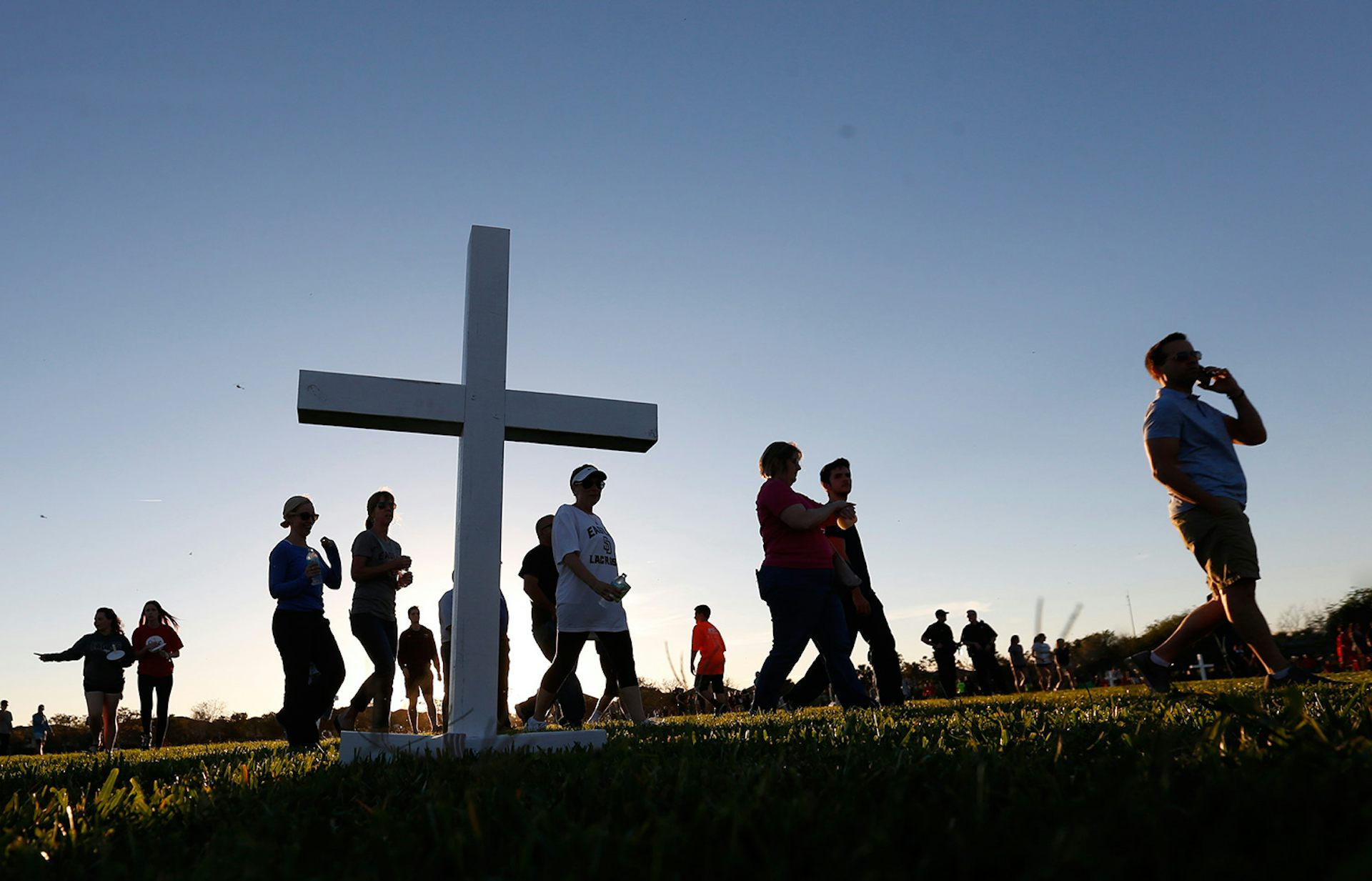
Photo by Miami photojournalist Wilfredo Lee for AP accompanied this piece of the same title published by The Conversation published 2/16/18 by Elizabeth Englander (profile, email) Professor of Psychology, and the Director of the Massachusetts Aggression Reduction Center  at Bridgewater State University.


The Conversation is a collaboration between editors and academics to provide news analysis and commentary that is free to read and republish using a Creative Commons, no derivatives licence.

*

After a shooter killed 17 people at a Florida high school, many have expressed frustration at the political hand-wringing over gun control and calls for prayer.

As a parent, I understand the desire for practical responses to school shootings. I also absolutely believe the government should do more to prevent such incidents. But the gun control debate has proven so divisive and ineffective that I am weary of waiting for politicians to act.

I study the kind of aggressive childhood behavior that often predates school shootings. That research suggests what communities and families can start doing today to better protect children. Here are 10 actions we can all take while the federal government drags its heels.

What schools can do


Because educators observe students’ emotional and behavioral development daily, they are best positioned to detect troubled behaviors and intervene. In Los Angeles, for example, schools have successfully used outreach and training to identify potentially violent students before problems occur.

1. Teach social and emotional skills 

Children learn social skills from everyday interactions with each other. Playtime teaches young people how to control their emotions, recognize others’ feelings and to negotiate. Neighborhood “kick the can” games, for example, require cooperation to have fun – all without adult supervision.

Today, frequent social media use and a decrease in free play time has reduced children’s opportunities to learn these basic social skills.

But social and emotional skills can – and should – be taught in school as a way to prevent student violence. Students with more fluent social skills connect better with others and may be more able to recognize troubled peers who need help.

2. Hire more counselors and school resource officers


Due to budget cuts, many schools have few or no trained school psychologists, social workers or adjustment counselors on staff. These mental health professionals are society’s first line of defense against troubled students – especially with the current increase in adolescent depression and anxiety.

In my opinion, school resource officers – trained police officers who work with children – are also helpful for students. While untrained officers may pose a threat to students, well-trained school resource officers can connect with kids who have few other relationships, acting as a support system. They are also on hand to respond quickly if crime or violence erupts.

Putting trained school resource officers and counselors in every school will cost money, but I believe it will save lives.
3. Use technology to identify troubled students

Technology may challenge kids’ social development, but it can also be harnessed for good. Anonymous reporting systems – perhaps text-message based – can make it easier for parents and students to alert law enforcement and school counselors to kids who seem disconnected or disturbed. That enables early intervention.

In Steamboat Springs, Colorado, one such tip appeared to prevent extreme violence in May 2017. Police took a young man who’d threatened to harm his peers into protective custody before he could act on his words.

What communities can do


Communities also help raise children. With many eyes and ears, they can detect often smaller problems before young people grow into violence.

4. Doctors should conduct standard mental health screenings


Extreme violence is almost always preceded by certain behavioral problems. These typically include a propensity toward aggression, a marked lack of social connectedness, indications of serious mental illness and a fascination with violence and guns.

Doctors could detect these problems early on with a standardized screening at health checkups. If concerns arise, referrals to counseling or other mental health professionals might follow.
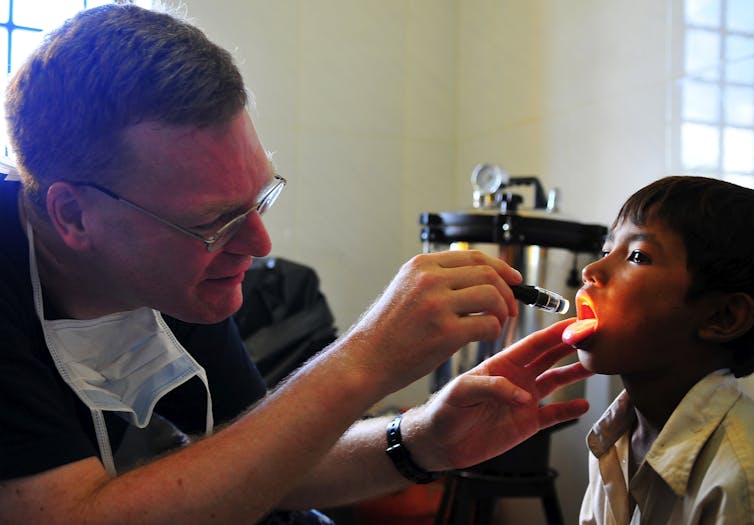


Doctors are an underutilized community resource. Regular check-ups could help prevent violence. Myfuture.com, CC BY-ND


5. Enlist social media companies in the effort to detect threats


Most young people today use social media to express their feelings and aspirations. In the case of school shooters, these posts are often violent. A single violent post is hardly a guarantee of homicidal acts, of course. But evidence strongly indicates that repeated expressions of this nature can be a sign of trouble.

I would like to see companies like Instagram, Twitter and Snapchat create algorithms that identify repeated online threats and automatically alert local law enforcement. 

What parents can do

Parents and guardians are often the first to detect their child’s emotional struggles. Here are some tips for monitoring and promoting healthy emotional development at home.

6. Think critically about your child’s social media use

From virtual war games to cruel trolls, the internet is full of violence. The relationship between violent content and aggression hasn’t been consistent in research: Some studies see no relationship at all, while others find some correlation between violent video games and violent behavior.

This mixed evidence suggests that online content affects children differently, so parents must assess how well their child handles it. If your daughter likes “Assassin’s Creed” but is gentle, socially successful and happy, the onscreen violence may not be strongly impacting her.

But if your child is drawn to violent games and tends to be aggressive or troubled, discuss the situation with your pediatrician or school counselor.

7. Consider what your child is missing out on

Is your child sleeping properly? Do your kids socialize with other young people? These two behaviors are linked to mental health in children, and excessive screen time can reduce or diminish the quality of both.

Make sure digital devices aren’t disrupting your kids’ sleep, and schedule play dates if your kids don’t make plans on their own.

8. Assess your child’s relationships

Like adults, children need confidants to feel invested in and connected with their community. The trusted person can be parent, a family member or a friend – just make sure someone’s playing that role.

For children who struggle to make friends and build relationships, there are programs that can help them learn how.
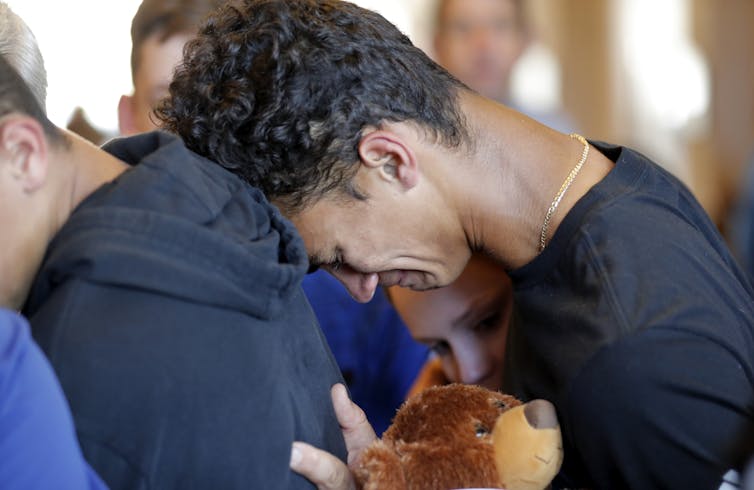


Children need confidants to feel connected to their communities. AP Photo/ by Louisiana-based Gerald Herbert


9. Fret productively about screen time

Research shows that excessive screen time can damage kids’ brains. That’s alarming in part because parents can’t realistically keep kids entirely off devices.

So rather than just fret over screen time, focus instead on how children can benefit from a variety of activities. Evidence shows that children who experience different pursuits over the course of their day – from sports and music to an after-school job – are happier and healthier for it.

10. Talk with your child


This is both the easiest and hardest way to make sure your kids are doing OK. Children, especially teenagers, don’t always want to talk about how life is going. Ask anyway.

My research shows that simply asking children about their friends, their technology use and their day is an important way to show you care. Even if they don’t respond, your interest demonstrates that you’re there for them.

Try this one now. Ask your children what they’re thinking about the shooting in Florida and how they like their friends and school. Then listen.

2/16/18

Guest Post by Brian DeLay: The American Public has Power Over the Gun Business – Why Doesn't It Use It?


Photo
by Miami photojournalist Wilfredo Lee for AP accompanied this piece by Brian DeLay published by The Conversation published an updated version of an article, "How the US government created and coddled the gun industry," published by the Conversation on 10/9/2017.  The photographs in the body are also from the piece.


The Conversation is a collaboration between editors and academics to provide news analysis and commentary that is free to read and republish using a Creative Commons, no derivatives licence. DeLay, Associate Professor in History at the University of California, Berkeley (bio and contact information) is the author of War of a Thousand Deserts: Indian Raids and the U.S.-Mexican War (Yale, 2008), and is now at work on a book for W. W. Norton about guns, freedom, and domination in the Americas, called Shoot the State. Brian DeLay receives funding from the American Council of Learned Societies and the Harry Frank Guggenheim Foundation. University of California provides funding as a founding partner of The Conversation.
*

On his facebook page, DeLay advocates even more specifically for how we might take on the NRA:

People who are sick and shamed by the way things are should take inspiration from the NRA and try to mobilize public consumers. Government contracts account for something like 40% of gun-maker revenue in this country. While citizen activism isn’t likely to influence military contracting anytime soon, states, counties, and municipalities buy lots of guns, too.

Again, take Smith & Wesson, maker of the AR-15 used to kill 14 kids and 3 teachers on Wednesday. S&W won the main handgun contract for the LAPD a few years ago. Most of Los Angeles’s leaders and their constituents support common-sense gun legislation, legislation that Smith & Wesson pays to prevent. And yet it doesn’t seem that Smith & Wesson’s political interventions hurt their ability to win the LAPD contract. In effect, gunmakers have learned to be highly sensitive to the NRA, but have not yet been made to worry that doing so will imperil the government contracting side of their business.

Why not make them worry? Ask your local, county, and state representatives where they get their guns. Gunmakers don't all kiss the NRA ring in the same way, but they're all locked in intense competition with one another. Big contracts matter. Even smaller public contracts matter, if for no other reason than the prestige of being able to say "X number of police departments across the country use our handguns." If enough concerned citizens make enough noise, our representatives might consider taking a firm's political activities into account when awarding contracts.

If a firm like Smith & Wesson lost even one major contract because its political activities imperiled public safety, that could be a powerful precedent and a check on their seemingly unrestrained embrace of the NRA and NSSF. It could be a start.


*


As teenagers in Parkland, Florida, dressed for the funerals of their friends – the latest victims of a mass shooting in the U.S. – weary outrage poured forth on social media and in op-eds across the country. Once again, survivors, victims’ families and critics of U.S. gun laws demanded action to address the never-ending cycle of mass shootings and routine violence ravaging American neighborhoods.

The 14 children and three adults shot dead on Feb. 14 at Marjory Stoneman Douglas High School were casualties of the nation’s 30th mass shooting this year – defined by the Gun Violence Archive as involving at least four victims including the injured – and one of the deadliest in U.S. history. A question on many minds is whether this massacre will finally compel Washington to act. Few commentators seem to believe so.

If advocates for reform despair, I can understand. The politics seem intractable. It’s easy to feel powerless.

But what I’ve learned from a decade of studying the history of the arms trade has convinced me that the American public has more power over the gun business than most people realize. Taxpayers have always been the arms industry’s indispensable patrons.


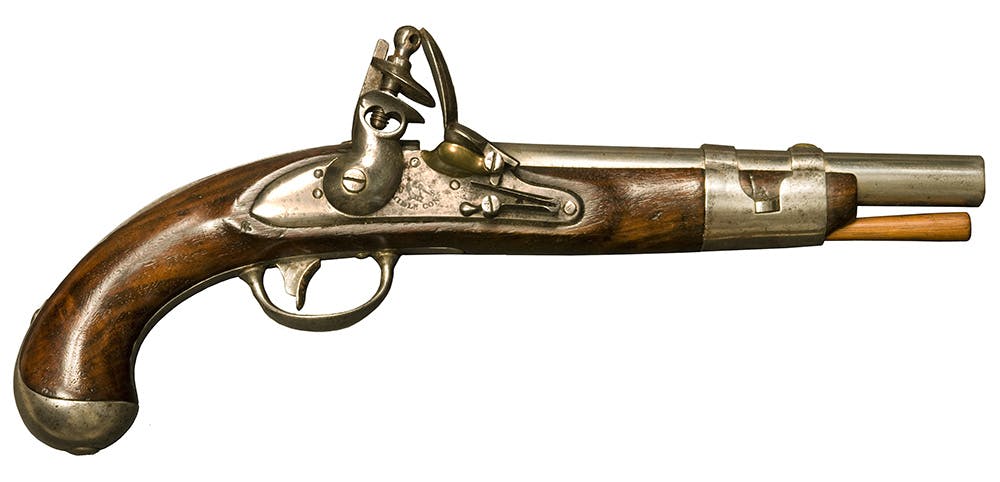
Gun maker Simeon North made this flintlock pistol around 1813. Balefire/Shutterstock.com

Washington’s patronage

The U.S. arms industry’s close alliance with the government is as old as the country itself, beginning with the American Revolution.

Forced to rely on foreign weapons during the war, President George Washington wanted to ensure that the new republic had its own arms industry. Inspired by European practice, he and his successors built public arsenals for the production of firearms in Springfield and Harper’s Ferry. They also began doling out lucrative arms contracts to private manufacturers such as Simeon North, the first official U.S. pistol maker, and Eli Whitney, inventor of the cotton gin.

The government provided crucial startup funds, steady contracts, tariffs against foreign manufactures, robust patent laws, and patterns, tools and know-how from federal arsenals.

The War of 1812, perpetual conflicts with Native Americans and the U.S.-Mexican War all fed the industry’s growth. By the early 1850s, the United States was emerging as a world-class arms producer. Now-iconic American companies like those started by Eliphalet Remington and Samuel Colt began to acquire international reputations. Even the mighty gun-making center of Great Britain started emulating the American system of interchangeable parts and mechanized production.


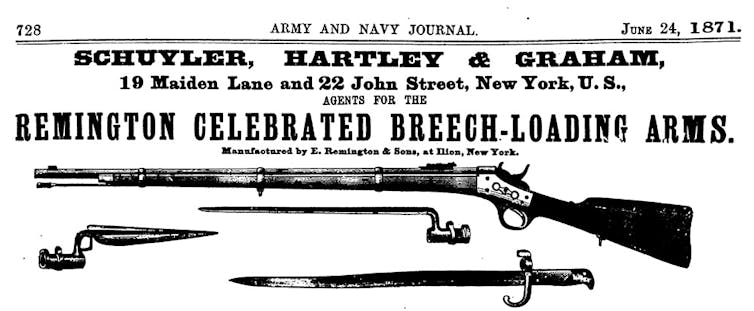
This is an advertisement for a Remington rifle in the Army and Navy Journal in 1871. Army and Navy Journal

Profit in war and peace

The Civil War supercharged America’s burgeoning gun industry.

The Union poured huge sums of money into arms procurement, which manufacturers then invested in new capacity and infrastructure. By 1865, for example, Remington had made nearly US$3 million producing firearms for the Union. The Confederacy, with its weak industrial base, had to import the vast majority of its weapons.

The war’s end meant a collapse in demand and bankruptcy for several gun makers. Those that prospered afterward, such as Colt, Remington and Winchester, did so by securing contracts from foreign governments and hitching their domestic marketing to the brutal romance of the American West.

While peace deprived gun makers of government money for a time, it delivered a windfall to well-capitalized dealers. That’s because within five years of Robert E. Lee’s surrender at Appomattox, the War Department had decommissioned most of its guns and auctioned off some 1,340,000 to private arms dealers, such as Schuyler, Hartley and Graham. The Western Hemisphere’s largest private arms dealer at the time, the company scooped up warehouses full of cut-rate army muskets and rifles and made fortunes reselling them at home and abroad.


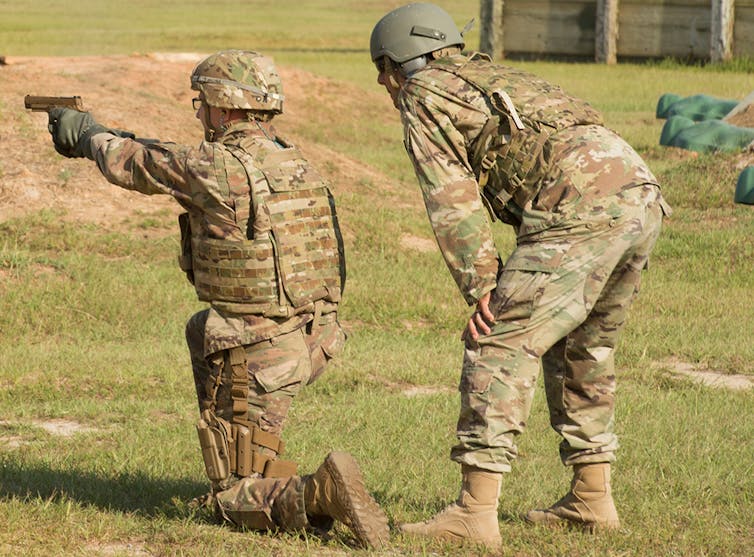
A soldier fires the Sig Sauer P320, which the Army has chosen as its new standard pistol. U.S. Army

More wars, more guns

By the late 19th century, America’s increasingly aggressive role in the world insured steady business for the country’s gun makers.

The Spanish American War brought a new wave of contracts, as did both World Wars, Korea, Vietnam, Afghanistan, Iraq and the dozens of smaller conflicts that the U.S. waged around the globe in the 20th and early 21st century. As the U.S. built up the world’s most powerful military and established bases across the globe, the size of the contracts soared.

Consider Sig Sauer, the New Hampshire arms producer that made the MCX rifle used in the Orlando Pulse nightclub massacre. In addition to arming nearly a third of the country’s law enforcement, it recently won the coveted contract for the Army’s new standard pistol, ultimately worth $350 million to $580 million.

Colt might best illustrate the importance of public money for prominent civilian arms manufacturers. Maker of scores of iconic guns for the civilian market, including the AR-15 carbine used in the 1996 massacre that prompted Australia to enact its famously sweeping gun restrictions, Colt has also relied heavily on government contracts since the 19th century. The Vietnam War initiated a long era of making M16s for the military, and the company continued to land contracts as American war-making shifted from Southeast Asia to the Middle East. But Colt’s reliance on government was so great that it filed for bankruptcy in 2015, in part because it had lost the military contract for the M4 rifle two years earlier.

Overall, gun makers relied on government contracts for about 40 percent of their revenues in 2012.
Competition for contracts spurred manufacturers to make lethal innovations, such as handguns with magazines that hold 12 or 15 rounds rather than seven. Absent regulation, these innovations show up in gun enthusiast periodicals, sporting goods stores and emergency rooms.


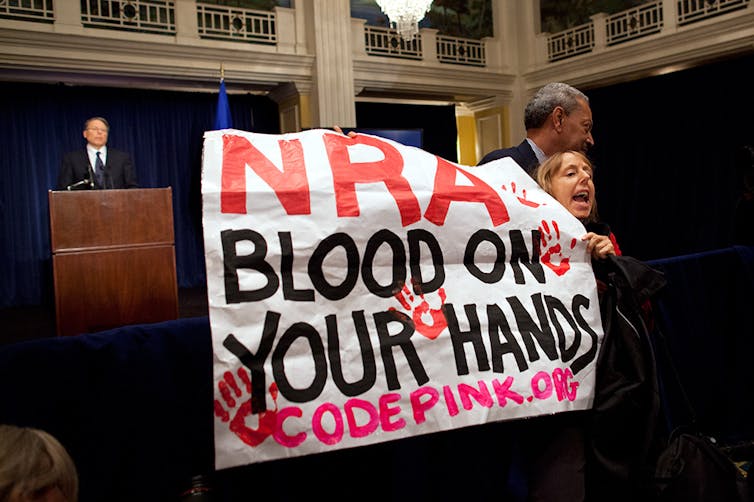
An activist [Medea Benjamin] is led away by security after protesting during a statement by NRA CEO Wayne LaPierre, left, during a news conference in response to the Connecticut school shooting in 2012. AP Photo/Evan Vucci [instagram
twitter, vimeo, facebook.]

NRA helped industry avoid regulation

So how has the industry managed to avoid more significant regulation, especially given the public anger and calls for legislation that follow horrific massacres like the one in Las Vegas?

Given their historic dependence on U.S. taxpayers, one might think that small arms makers would have been compelled to make meaningful concessions in such moments. But that seldom happens, thanks in large part to the National Rifle Association, a complicated yet invaluable industry partner.
Prior to the 1930s, meaningful firearms regulations came from state and local governments. There was little significant federal regulation until 1934, when Congress – spurred by the bloody “Tommy gun era” – debated the National Firearms Act.

The NRA, founded in 1871 as an organization focused on hunting and marksmanship, rallied its members to defeat the most important component of that bill: a tax meant to make it far more difficult to purchase handguns. Again in 1968, the NRA ensured Lyndon Johnson’s Gun Control Act wouldn’t include licensing and registration requirements.

In 1989, it helped delay and water down the Brady Act, which mandated background checks for arms purchased from federally licensed dealers. In 1996 the NRA engineered a virtual ban on federal funding for research into gun violence. In 2000, the group led a successful boycott of a gun maker that cooperated with the Clinton administration on gun safety measures. And it scored another big victory in 2005, by limiting the industry’s liability to gun-related lawsuits.

Most recently, the gun lobby has succeeded by promoting an ingenious illusion. It has framed government as the enemy of the gun business rather than its indispensable historic patron, convincing millions of American consumers that the state may at any moment stop them from buying guns or even try to confiscate them.

This helps explain why the share price of gun makers so often jumps after mass shootings. Investors know they have little to fear from new regulation and expect sales to rise anyway.

A question worth asking

So with the help of the NRA’s magic, major arms manufacturers have for decades thwarted regulations that majorities of Americans support.

Yet almost never does this political activity seem to jeopardize access to lucrative government contracts.

Americans interested in reform might reflect on that fact. They might start asking their representatives where they get their guns. It isn’t just the military and scores of federal agencies. States, counties and local governments buy plenty of guns, too.

Take Smith & Wesson, maker of the AR-15 Nikolas Cruz just used to kill his teachers and classmates at the Marjory Stoneman Douglas High School. Smith & Wesson is well into a five-year contract to supply handguns to the Los Angeles Police Department, the second-largest in the country. In 2016 the company contributed $500,000 (more than any other firm) to a get-out-the-vote operation designed to defeat candidates who favor tougher gun laws.

Do voters in LA – or in the rest of the country – know that they are indirectly subsidizing the gun lobby’s campaign against regulation? Concerned citizens should begin acting like the consumers they are and holding gun makers to account for political activities that imperil public safety.