Showing posts with label freedom of speech. Show all posts

12/22/10

Half a loaf: the FCC's Weak Rule on Net Neutrality

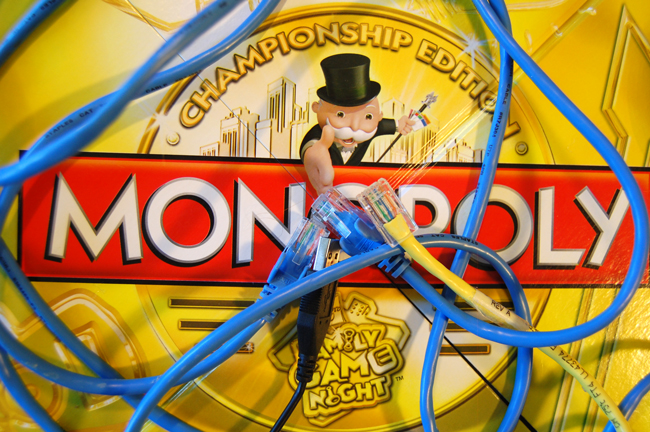
Graphic from the Florida non-profit journalism site, Flaglerlive, on its September 12, 2010 post," Net Neutrality: The First Amenment Issue of Our Time."  The following is a draft my next piece commissioned by The Guardian.

*
 
Net neutrality is the First Amendment issue of our time. Today, a blog can load as fast as the Wall Street Journal — and, if the blog is good, it can get more traffic than any media conglomerate.


But if bigger companies can pay for faster, priority Internet access, that blogger no longer has a shot. And these big companies know that when they pay for access, they win. They want preferred treatment on the Internet like the preferred treatment they get in the rest of their lives. --Al Franken on August 19, 2010


I wasn't surprised  December 21 to learn the Federal Communications Commission (FCC) had passed its rule governing net neutrality 3-2 along party lines.  The topic's been a source of partisan wrangling for years.  Advocates of net neutrality argue users should control content viewed and applications used--that a level playing field promotes democratic participation and free speech. Broadband providers and telephone companies want freedom to boost profits by deciding which content gets to whom first and fastest. Both sides argue theirs is the course encouraging economic innovation. 

My take: the new rule is another example of the Democrats' "half-a-loaf" thinking and falls short of pledges by President Obama and his administration to protect the Internet against phone and cable gatekeepers. The order's text wasn't available immediately, only FCC news releases and statements by its members--Chair Julius Genachowski, joined by Democrats Mignon Clyburn and Michael Copps, who voted to approve, and Republicans Meredith Attwell Baker and Robert McDowell, who voted nay.  Based on those, the rule

  • leaves wireless networks unregulated, anointing Verizon, AT&T, et. al. as gatekeepers to the rapidly expanding world of mobile Internet access;
  • fails to explicitly prohibit internet service providers from turning  the "information highway"  into a toll road favoring corporate partners, while  detouring the rest of us onto the cyber-equivalent of a pothole-ridden dirt road; and
  • continues to ground its rationale in legal arguments rejected by the DC Federal Court of Appeals April 6, by defining the Internet as an information service, rather than reclassifying broadband and wireless as a public utility under the Communications Act.  As an information service, the court allowed broadband provider Comcast to block or slow specific sites and charge video sites like YouTube to deliver their content faster to users.  The suit came after Comcast attracted attention in 2008 for secretly using a program called Sandvine to hamper peer-to-peer file sharing applications.
Republicans hate the measure. Senate Minority Leader Mitch McConnell (KY) criticized the FCC for taking "what could be a first step in controlling how Americans use the Internet by establishing federal regulations on its use."  He promised to "push back against new rules and regulations” once Republicans take the majority in the House of Representatives in January.  Senator Kay Bailey Hutchison (TX), the Commerce Committee's ranking member, called the vote an “unprecedented power grab by the [FCC's] unelected members” and promised a resolution condemning the rule. She had offered an amendment to block the agency from using any omnibus budget funds to implement net neutrality. Last September, Republicans already had beaten back House Energy and Commerce Committee Chairman Henry Waxman (D-CA) net neutrality bill.

Public interest groups also are up in arms.  Free Press
calls it a squandered opportunity. Public Knowledge says it falls short.  Media Access project finds it  riddled with loopholes.  Center for Media Justice  criticizes its minimal protections.
 
I expected a weak rule after Genachowski held closed-door meetings with industry lobbyists opposing net neutrality and with the industry's Open Internet Coalition, but locked out public-interest and consumer groups.  And, as Greg Sargeant noted in the Washington Post:
 

The problem is...that Dems...don't think they're capable of winning a protracted political standoff, even on an issue where the public is on their side, once Republicans start going on the attack....As a result, they tend to telegraph weakness at the outset...that they'll essentially give Republicans what they want as long as they can figure out a way to call it a compromise.


According to Bloomberg, AT&T, in its attempts to influence policy, met more frequently with the Commission in recent days than any other provider.  Verizon, on the other hand, wanted  the FCC out of the picture. Industry sources told The Hill that given Congressional gridlock, Verizon's call for  legislation suggests the company might not want any resolution at all.  These approaches seemed borne out when AT&T praised the FCC for ending its "hamstrung [status preventing] needed action on...real problems " while Verizon, called for "statutory underpinnings."


Copps, a strong consumer advocate, issued a statement prior to voting, saying he’d battled  since his 2001 appointment "to make sure the Internet doesn't travel down the same road of special-interest consolidation and gatekeeper control that other media and telecommunications industries—radio, television, film and cable—have traveled."  While not the proposal he would have crafted, the rule “could represent an important milestone…[i]f vigilantly and vigorously implemented by the Commission—and if upheld by the courts.”

Those, Mr. Copps, are pretty big ifs.

9/11/07

Who Profits from Fear?


The Political Compass and U.S. Presidential Politics: Was tagging old entries this evening and looking up current versions of sites I had liked. This is an update from Political Compass. I had taken the test in 2006 and landed near the center, a bit left libertarian, the quadrant for Nelson Mandela and Gandhi , or Mozart, all of whom I regard as fine and admirable company. As the authors explain,

If we recognise that this is essentially an economic line it's fine, as far as it goes. We can show, for example, Stalin, Mao Tse Tung and Pol Pot, with their commitment to a totally controlled economy, on the hard left. Socialists like Mahatma Gandhi and Robert Mugabe would occupy a less extreme leftist position. Margaret Thatcher would be well over to the right, but further right still would be someone like that ultimate free marketeer, General Pinochet.

the social dimension is also important in politics. That's the one that the mere left-right scale doesn't adequately address. So we've added one, ranging in positions from extreme authoritarian to extreme libertarian.

Just to show the state of American politics, I'm left of any of the presidential candidates except Kucinich and Gravel, neither of whom would be my choice for this office. The skewing brings to my mind that quote about the American eagle needing both left and right wings to fly. Mario Savio attributes it to Jessee Jackson. Or there's the Pat Paulsen version:

Assuming either the Left Wing or the Right Wing gained control of the country, it would probably fly around in circles.

In looking at particular candidates, I'm interested how tight a cluster there is for the Democratic Party candidates (again, other than Kucinich and Gravel.) And that Edwards and Clinton are the most libertarian. Also that Ron Paul, who considers himself the libertarian falls above the dividing line. Contrast his placement with that of a conservative libertarian, Milton Friedman, on this chart:
An aside about Paulsen: according to his memorial he came in second in the 1996 New Hampshire Presidential Primary (makes me wonder how Colbert would have done if SC Dems had let him on the ticket.) And although I did not find the context for the above quotation, I found a site which includes his political editorials, as well as a now dead link I've revived thanks to the Internet Archive to Paulsen's quite serious answers to the 1996 Presidential Primary Natioinal Political Awareness Test from Project Vote Smart.

Since it's 9-11, I'll provide some content devoted to terror: How's this for Keystone Kops? NYC will deter nuclear attack with concentric circles of Geiger counters according to the New York Times today in "Suburban Police Enlisted to Help Protect the City" by Corey Kilgannon. Don't you feel safer now?

The counters didn't work so well in the latest dirty bomb scare. According to "MTA didn't tell us of dirty bomb scare: officers," by Alison Gendar in the NY Daily News on September 10, one officer who works at the Verrazano Bridge complained,

They'll give us two weeks of training for how to collect tolls, making sure we charge a three-axle truck more than a two-axle, but no field training on what a bomb might look like, how to stop cars or use this radiation detector.

Meanwhile, besides Geiger counters, LA is spending its homeland security money on robots and portable media hubs, according to Richard Winton in the September 9 LA Times.

I guess it all comes down to fear being a great motivator for letting loose the purse strings.

And speaking of fear: John Judis (email) had an interesting piece in the the New Republic August 17 explaining why West Virginia supported Bush. In "How Political Psychology Explains Bush's Ghastly Success. Death Grip" (referred to here), he writes about research since the early 1980s by Sheldon Solomon, Jeff Greenberg, and Tom Pyszczynski (interview, article, research), who developed "terror management theory."

Their experiments showed that the mere thought of one's mortality can trigger a range of emotions--from disdain for other races, religions, and nations, to a preference for charismatic over pragmatic leaders, to a heightened attraction to traditional mores.

It seems that this tendency could be counteracted, if folks were asked to think as rationally as possible. (Not something the current administration espouses.)

On the poetry front: again, with regard to 9-11, Tillie wrote me to say he'd mentioned my poem, "Windows on the World" on his blog entry today.

Other mention on the net:

  • Coal: a poetry anthology and my poem in particular, got mentioned in this online review by West Virginia storyteller Susanna Holstein.
My journalism on Memeorandum: Just found out that my August 22, 2007 post at WV Blue, "Suit by West Virginia Protesters Reveals Bush Tactics," got a link from Memeorandum.com. The topic is the 2002 Bush advance manual for handling dissent. For those of you who haven't seen Memeorandum, it aggregates political news around memes.