6/3/10

Industry Pressures EPA on Benefits of Coal Ash Regs?

This photograph by J. Miles Carey of the Knoxville News Sentinel accompanied a NYT story by Shaila Dewan, "Coal Ash Spill Revives Issue of Its Hazards." In the wake of the spill, which I wrote about December 25, 2008, the EPA promised to look at regulating coal ash as a hazadous waste.

Now we get news of that EPA will labor under skewed cost benefit calcs imposed by the Office of Management and Budget. The question remains whether public opinion can force the OMB to back off or whether industy pressure will prevail.

Here's what Dawn Reeves says in "EPA Cuts Coal Ash Rule's Benefits To Measure Industry 'Liability Fears'"in the the June 4 edition of Inside EPA (hat tip to Lisa Evans at Earthjustice for the heads up--a sub goes for $320 a year.)

At the insistence of the White House Office of Management & Budget (OMB),
EPA was forced to slash by more than $300 billion its lower-end estimates of
the regulatory benefits from its recent proposal to regulate coal ash as a
hazardous waste due to industry's "fear of liability," the first time the
agency has quantified such fears in a cost-benefit assessment, sources say.

The diminished benefits estimate may make it more difficult for EPA to
justify strict regulation of coal combustion residues (CCRs) as agency
regulations are generally required to demonstrate greater benefits than
costs, unless barred from doing so by Congress.
A May 7 article in the same publication had reported the regulatory benefits of a rule
to regulate coal combustion waste as hazardous would amount to a savings of $87 billion to $102 billion over 50 years The industry is arguing that "beneficial reuse" will falter if coal ash is classified as hazardous
due to fear of liability and stigma, resulting in more waste being shipped to a hazardous landfill -- ...[and thus change] the low-end range from a positive $87 billion to a negative $230 billion.
As a result the EPA "fixed" a table in the May 4 draft rule's preamble., but also noted that that the "correct" range was
identified elsewhere in the original proposal's release and states that its inclusion was "at the urging of OMB as a condition to conclude review" -- an explicit reference that EPA was forced to change its initial calculations that the rule would have no negative impact on beneficial reuse after OMB held up the normal 90-day pre-publication review for six months.

OMB had criticized EPA in a comment on the proposed rule for for providing
no evidence for assertions that rulemaking under subtitle C will not have an impact on beneficial reuse
Reeves interviewed a former senior OMB official, who said it

"seems like a typical EPA and OMB dispute-resolution mechanism" with the only "unusual feature" the "transparency about the OMB condition." The source adds that normally EPA will adopt OMB's position "because the executive branch, representing the president, can have only one official position for purposes of judicial and congressional review." However, there is a process for agencies to seek to overturn OMB's position, known as a "presidential reversal," but EPA did not appear to seek such an option in this case.

"By the time this final rule is issued, my prediction is that OMB and EPA will have resolved their differences and there will be only one official view reported for purposes of judicial review. This is required by the unitary concept of the executive branch. The president's view prevails," the source says. And because Obama is unlikely to become personally involved in the issue, the source predicts "a persistent OMB is likely to prevail, though the public comment process could persuade EPA and/or OMB to modify their positions."
According to Reeves,
The change could mark the first time EPA or other agencies have been required to quantify the "fear of liability," sources following the issue say.
She writes that one of sources, an environmentalist, warns that
"It makes the ranges look so crazy, no one would want to take a chance," and that could result in forcing EPA to "go with the more rational proposal."
The same source calls the new range
"about as reliable as melted Jello" because the low end assumes that most coal-fired power plant managers would pay high disposal costs to send the waste to a subtitle C landfill, rather than sell it to be mixed with cement, because the operators will be "so terrified of liability down the line."
The source argues that fear of liability should not be included because, as the EPA notes through out its proposal, tightening of waste rules has always increased recyling.

Another environmentalist told Reeves that that EPA's regulatory text shows
"that the stigma fear has never panned out in the past" and that EPA should require industry opponents to prove their point rather than be forced to quantify it. "The idea that no one is ever going to recycle coal ash for the next 50 years is so beyond the realm of possibility it's laughable," the source says.
Meanwhile her industry source counters that EPA's initial estimates of zero impact on beneficial reuse were
"not realistic," and notes the agency "was forced to go back and recalculate the real impact on the reuse industry." The source adds it is unclear whether the costs could be as high as negative $230 billion but notes that some impacts are "real."

5/18/10

Mountain Justice, Rising Tide, UMWA Converge on Massey


Photo by ALEXA WELCH EDLUND, Richmond Times Dispatch.

EmmaKate Martin and Benjamin Bryant, two Climate Ground Zero activists languish in the Boone County jail on $100,000 bail each for a protest blocking the driveway yesterday at Massey's regional headquarters, union members. CGZ is asking that folks call Magistrate Snodgrass in Boone County at 304-369-7360 to demand that the bails be reduced to a reasonable amounts on the grounds that the 8th Amendment to the U.S. Constitution states that
Excessive bail shall not be required, nor excessive fines imposed, nor cruel and unusual punishments inflicted.
Meanwhile activists converged on the Jefferson Hotel in Richmond, Virginia this morning, site of Massey Energy's annual meeting, after a candlelight vigil in front of Massey Energy headquarters, also in Richmond, for the 52 coal miners killed in Massey Energy accidents in the last 10 years--29 in the Montcoal, WV explosion April 5, 2010.

The demand: safe and humane working conditions for miners and criminal accountability for CEO Don Blankenship. While the stockholders didn't exact punishment on Blankenship and the Board, Kris Maher and Joann S. Lublin in "Three Massey Directors Eke Out Reelection" in the 5/18/10 WSJ reported,
Three Massey Energy Co. directors won reelection at the company's annual shareholder meeting, after they had been under fire from public pension funds and other investors who alleged that Massey's safety performance contributed to the April explosion at the company's W.Va. mine where 29 workers were killed. But union group CtW Investment Group said that the three directors won reelection by narrow margins, casting "a cloud" over the board going forward. CtW is an arm of labor federation Change to Win. The federation represents unions with six million members whose pension funds own less than 1% of Massey shares. Michael Garland, a representative of CtW, cited preliminary results from a proxy voting agent and said Massey President Baxter Philips won reelection with 49.6% of votes withheld by shareholders, while outside directors Dan Moore and Richard Gabrys won reelection with 49.8% and 48.5% of votes withheld, respectively.
Mountain Justice with support from coalfield community organizations Coal River Mountain Watch and the Ohio Valley Environmental Coalition, featured three protesters wearing orange prison jumpsuits with Blankenship's name emblazoned on the back. Others held signs that read "Safe Jobs, Safe Air, Safe Water" and "People and Communities before Profit." Laura von Dohlen of Richmond said in a MJ statement,
Massey is polluting the land and water with toxins in addition to stripping the land with its much-contested practice of mountaintop removal coal mining. Massey, in all areas of its 'business,' has no concern for the people and land of Appalachia ....Blankenship's hazardous views and actions surrounding safety in his mines have contributed to the death of the miners in the Upper Big Branch Disaster, as well as past mining disasters. Blankenship is running a criminal enterprise and must be held accountable for negligence.
The United Mineworkers of America members and family held signs such as, "Don Belongs in Jail" and cheered every time a passing vehicle honked its horn in support or the union SUV towing a trailer with the sign, "Massey Corporate Responsibility: 52 Dead in 10 Years" circled around the block.

Inside the hotel, Rising Tide had unfurled a 10 x 10 banner from the mezzanine above the ballroom where the stockholders were converging for their annual meeting: “Massey – Stop Putting Profits Over People!” They read on open letter, similar to the one tendered at Massey's regional headquarters in Boone County, WV. Kate Finnegan of New York and Oscar Ramiriz were arrested as a result. By contrast with the treatment of protesters in WV, the two were able to call from jail to say that they expected to be released later this afternoon on their own reconnaissance and charged with a misdemeanor trespass charge.

5/6/10

The FCC and Internet Broadband

Verizon and other broadband providers have bankrolled astroturf campaigns in which pr firms and think tanks organize fake grass roots support for the corporate agenda against regulation, reminding me of this illustration from Zaius Nation, which actually refers to Fox News coverage of lobbyist-run think tanks funding the Tea Party Movement.


*
Do we really want broadband providers to slow down, block or censor our email, news and financial transactions at will? In an April 6 ruling, 1994 Clinton appointee David S. Tatel changed the landscape for net neutrality, the idea that service providers shouldn't play favorites with regard to what content gets to whom when.

Historically, the Federal Communications Commission (FCC) had treated internet service providers as content managers, rather than communications carriers. As such, the FCC had only "ancillary" powers, more limited its regulation of telephone companies and radio and television broadcasters.

Comcast's peer-to-peer traffic management practices optimized profits, but degraded service (explained here). When the FCC stepped in to enforce the public interest, the company sued. Tatel decided in in Comcast v. FCC that the FCC had failed to tie its claimed authority to any statutory delegation by Congress.

The FCC announces it plans to address Tatel's ruling

Yesterday, the FCC Chairman Julius Genachowski outlined his plan to regain authority by partially reclassifying internet service providers as carriers, contrary to speculation that the FCC would let broadband go unregulated. The WaPo's Cecilia Kang reported on the plan, as did NYT's Edward Wyatt, WSJ's Amy Schatz, Gigaom's Stacey Higgenbotham and Endagadget's Nilay Patel.

Kang writes that sources requesting anonymity advised her that Representative Henry Waxman (D-CA) and Senator Jay Rockefeller (D-WV) had provided
political support for the agency to shift Internet lines to a more regulatory framework.
Although she doesn't mention it, the letter is public, indicating the both chairmen of committees overseeing the FCC that they could support defining broadband as a telecommunications
provided that doing so entails a light regulatory touch, with appropriate use of forbearance authority [the technical term for the FCC accepting companies' petitions to avoid some forms of regulation if its judges there is sufficient competition.]
In another piece, Kang informs us of the effects of MoveOn and Free Press to get Genachowski to take action.

A source at the FCC said the agency has been bombarded with calls. Free Press, a media reform public interest group, called for its 500,000 members to call and e-mail Genachowski to tell him to “protect the Internet” by reclassifying broadband. Some 200,000 of its supporters signed an online petition on the topic. Twitter was flooded with tweets to @fcc and @whitehouse calling for reclassification.

Interestingly, she adds,
The grass-roots efforts come amid a stark quiet from companies that have been supportive of net neutrality rules. Companies on both sides of the debate have told me they are waiting for a final decision by the agency before commenting publicly.
What the FCC says about the ruling

In his statement, Genachowski seems to me either to be putting on a brave face or or spinning, claiming Tatel's decision doesn't

challenge the longstanding consensus about the FCC’s important...role in protecting consumers, promoting competition, and ensuring that all Americans can benefit from broadband communications. Nor does it challenge the commonsense policies we have been pursuing.

The chairman argues that the opinion merely casts doubt

on the particular legal theory the Commission used for the past few years to justify its backstop role with respect to broadband Internet communications

That may be optimistic, as indicated by the protests from broadband providers compiled and rebutted by public interest group Free Press and by the prediction of more law suits to come by CNET's Maguerite Reardon.

What the FCC proposes

Genachowski says he will neither use “ancillary” authority to

anchor actions like reforming universal service and preserving an open Internet

nor treat broadband entirely

as a “telecommunications service,” restoring the FCC’s direct authority over broadband communications networks but also imposing on providers of broadband access services dozens of new regulatory requirements.

Instead he calls for the Commission to follow the approach outlined by FCC Counsel Austin Schlick to

  • Recognize the transmission component of broadband access service—and only this component—as a telecommunications service;
  • Apply only a handful of provisions...[which] were widely believed to be within the Commission’s purview for broadband [prior to the Comcast decision]; and
  • Put in place up-front...boundaries to guard against regulatory overreach.
Is this enough to protect net neutrality?

While NOI fellow Jason Rosenbaum applauds the plan as the "only logical way forward to protect internet neutrality, " Rob Frieden (webpage, email), Chair and Professor of Telecommunications and Law at Penn State calls on the FCC to go further:
The FCC has to confront the messy reality that when ventures offer...services that combine conduit and content and when these ventures vertically and horizontally integrate throughout many market segments, the Commission cannot rely on absolute either/or service dichotomies...

It’s time to recognize that layered and convergent services defy compartmentalization into convenient, single regulatory classifications and regimes.
I'm with Professor Friendan on this. What I'm not sure of is whether a more complex classification requires Congressional action, something which may prove difficult, as we've seen in the case of the deracinated health insurance "reform."

Expect a broadband astroturf campaign


Here's a prediction: watch for "citizen" astroturf to oppose the Federal Communications Commission to regulate broadband, telling us that the Commission will infringe on the public opportunities to use the internet. As Phillip Dampier, of Stop the Cap, pointed out April 8,
Verizon has a track record of signing up non-profit groups to support its telecommunications causes. In addition to providing corporate executives for board positions of various community service groups, Verizon financially supports a wide range of not for profit groups, many of which later turn up writing letters of support in favor of Verizon’s policy positions.
Reporting on previous telecom astroturf campaigns

Dampier's contention is supported by Chang's recent reporting on ATT and Verizon funding of think tanks such as the Technology Policy Institute.

This is nothing new. For instance, Sourcewatch indicates that telecoms have long employed Issue Dynamics, Inc. (IDI),
a Washington-based consulting firm that organizes PR campaigns... [utilizing ] NGOs ...[such as] the Gray Panthers and the New York Public Interest Research Group....[S]ome consumer activists...say IDI often does not disclose whom it is working for and argue that IDI's work amounts to astroturf PR.
Fred Goldstein (email), who consults with telecommunication start-ups, wrote in 2004 of how many a charity is
willing to sell its name...especially if it's in a subject area that's outside of its area of interest. So IDI can leaven its home-grown astroturf like TRAC with the signatures of some third parties....

The press, of course, rarely gets it. They love to hear from charities. They eat this up, frequently quoting TRAC and other astroturf as if they were real consumer organizations. Competitors should ...point out who is behind these supposedly pro-consumer, but really pro-monopoly, positions.
And back in 2005, Dan Gilmor alerted us to Issue Dynamics "blogger relations" (via archive.org--the page is not available after 2008) as well as a campaign at the end of an in eWEEK article on Philly's municipal broadband by Wayne Rash(email), who had learned learned in the course of researching the story that
NMRC [New Millennium Research Council] is actually owned and sponsored by Washington lobbying firm Issue Dynamics Inc., whose clients include most of the major telecommunications companies in the United States. Those companies have been active in opposing municipal wireless and broadband efforts. The company claimed that its reports were nevertheless completely independent.
The response from supposedly independent entities has already begun

For instance Kang reports that Bruce Mehlman, co-chairman of the Internet Innovation Alliance weighed in, saying according to Chang:
If the goal is maximizing broadband deployment and adoption . . . new regulations such as these will not help...This sounds more like a political solution likely to imperil investment than a policy initiative that tackles actual challenges in the marketplace.

The high-minded sounding name and mission mask its purpose to mold public opinion in the direction of its corporate sponsors. While the alliance claims to be

a broad-based coalition of business and non-profit organizations that aim to ensure every American, regardless of race, income or geography, has access to the critical tool that is broadband Internet

a look at the non-profit members yields the usual C-PAC suspects such as Americans for Tax Reform. The only surprise is the National Education Association, which has received money from the BellSouth Foundation. Kind of reminds you of the Gray Panthers. I'm skeptical about the Alliance's promotion of

public policies that support equal opportunity for universal broadband availability and adoption so that everyone, everywhere can seize the benefits of the Internet - from education to health care, employment to community building, civic engagement and beyond.

It's time for the rest of us to weigh in

While the FCC hasn't announced its public comment process yet, you will be able to find it here and and press secretary Jen Howard (email) has promised me she'll keep me informed of the timetable.

It's hard to make time to weigh in, but it's necessary. We can't just leave this to the broadband operators, such as AT&T, Comcast and Verizon. They hardly qualify as disinterested purveyors of the public good: their internet access business represent a major source of revenue which they want to optimize. As such, I expect they will continue to lobby, as documented by Public Eye at the links I've provided in this paragraph and to fund pr firms and think tanks in their efforts to influence policy.

As New Yorker journalist A. J. Leibling (1904-1963) observed
Freedom of the press is guaranteed only to those who own one.
The internet provides us all with the potential to own a press, but the broadbands, if unregulated, have the capacity, in chasing their profits, to shut down not only their competitors but any of us little guys who might question unbridled corporate power.

4/6/10

Massey's Montcoal Disaster: Pray for the dead and fight like hell for the living.


Pray for the 25 miners killed at near Montcoal WV and their families and friends. Pray for the four miners (or more) still missing.

Not many folks outside the region had heard of Montcoal, until yesterday, when Massey's Upper Big Branch Mine blew up at 3:27 p.m.--the worst mining disaster in the US for 25 years, worse than Sago, if you can quantify horror. Performance Coal, a subsidiary of Massey, operates this underground mine beneath a vast expanse of Massey's mountaintop removal surface mines that I have written about before.

My friends at Coal River Mountain Watch in Whitesville, three miles north, note on their website (via
filmaker Adams Wood's website for On Coal River) that the Upper Big Branch explosion is also:
the worst mine disaster to strike the Coal River Valley
In looking at the coverage, what galls me is the printing of quotes--unexamined and at face value--about Massey's "mourning" for the miners. Take a look at this screen shot (emphasis added) from the website bragging about the company's safety on the same home page that links to their statements about the Upper Big Branch mine.

Some though have been examining Massey's safety record at the mine, although, as Paul Blumenthal notes at the Sunlight foundation,

The Upper Big Branch Mine that suffered the most serious mining disaster since 1984 on Monday has received the most serious citations from the Mining Safety and Health Administration (MSHA) in 2009 of all Massey Energy-owned mines in West Virginia. Data collected from MSHA shows that over the course of the last year, the Upper Big Branch Mine received 48 "unwarrantable failure orders," far exceeding Massey Energy's number two recipient of serious citations in West Virginia.


Ken Ward filed story that this afternoon officials said that
Rescuers at the site of the worst U.S. coal-mining disaster in more than two decades likely won't be able to resume the search for four missing miners until at least Wednesday evening.

In another story he looked at the inadequacy of reforms after the Sago disaster and asked Davitt McAteer, who ran MSHA during the Clinton administration how this could happen.

"It tells me one of two things...One, the law isn't being enforced or, two, the law didn't go far enough."

4/4/10

Shout out to the Naughty: Fred Phelps May Be Coming to Town

Photo of a March 2009 University of Chicago counterprotest by Chris Salata (email , website) used by permission.

Westboro Baptist Church's Reverend Fred Phelps, rose to infamy for protesting at the 1998 funeral of Matthew Shephard. Now he's making his list and checking it twice and Blacksburg is one of his desired destinations. Again. (He planned to visit after the April 16 shootings at Virginia Tech, until dj Mike Gallagher offered two hours of free air time for him to stay away--similar deal to that he had made to keep Phelps away from the five slain Amish school girls.)

Expect Phelps on April 9, according to a letter he sent town officials Monday, March 22. This disbarred attorney, known for his God Hates Fags website (accept my apologies for using the term and understand why I'm not linking) has disrupted funerals and memorial services not only of gays, but of soldiers who have died in Iraq and miners who have died in explosions, and, yes, even Mr. Rogers.

Preying this time on the murder of Tech student Morgan Harrington, he'd like to have demonstrations at three locations: the Blacksburg Jewish Community Center, Blacksburg High School and near the Tech campus. And he wants police protections, although he promises that his protests will be peaceful and respectful of the law, according to the Roanoke Times.

Well I agree with the students who think it's time use his visit to help raise money for a cause he despises. Remember, that actually drove him away, when he threatened to come to Roanoke, after the shoot out by a homophobe in a gay bar. As I wrote in January 2006 ("Rev. Phelps preys on Sago deaths")
We all remember Phelps here in Roanoke, where he threatened to show up in 2000 for the funeral of a gay man murdered at the Backstreet Cafe. Mary Bishop’s September 27 Roanoke Times story reported organizers as saying:

For every five minutes Phelps protests, the new Hate Free Roanoke Task Force is asking people to pledge a dollar amount toward the victims’ medical expenses and for counseling of others in the club that night. Kathryn Marlow, 22, had heard of a similar counteraction at a Ku Klux Klan rally years ago and helped hatch the plan.

The task force will post a pledge box near Phelps at the funeral in Vinton and at any other events where Phelps protests. A poster thanking Phelps for picketing will say, “Fred, you’ve already helped us raise” — followed by a blank space where the amount will be updated every five minutes.


*
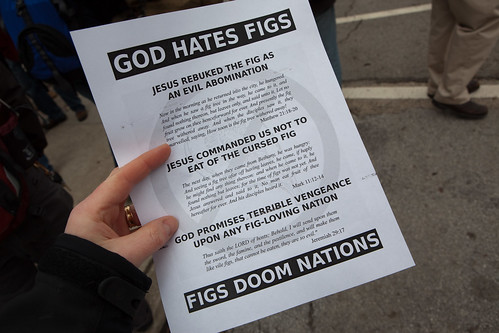
Or for those who prefer levity, how about a God Hates Figs protest?

(photo from Avi Schwab via Flickr)

similar to the one at the University of Chicago, which included the brothers of Alpha Delta Phi, as pictured by Salata at the top of the page? According to Nathalie Gorman's account the frat members:
lined their porch in bathrobes, awaiting the arrival of the protesters. When they appeared, the brothers stripped off their robes and began dancing to Diana Ross & The Supremes’ “I’m Coming Out,” Elton John’s “Tiny Dancer,” and the Weather Girls’ “It’s Raining Men.” The “Tiny Dancer” lyrics “Jesus freaks/out in the streets” elicited a loud cheer from the crowd on the other side of the street.
Of course, that protest, although fun, didn't faze the Phelps clan according to Gorman. She quotes Fred's daughter Shirley Phelps-Roper, the family's spokesperson as saying,
It is so awesome when you juxtapose this little group of servants of God with this restless mob of humanity...These people think that they have the power, this arrogant nation, to change God. The little girly boys up there with their clothes half off gyrating around—they might as well flip off their god.

3/22/10

NewsTrust: looking for how the recession is affecting New Yorkers

Illustration by Jonathan Keegan (website, email) from "Helicopter Parents Make Boomerang Kids" by an anonymous blogger with the nom de internet of "makeitadouble", an upstate NY "Dad, Writer, Poet, Sarcastic Malcontent" who also blogs here.
*
At the bottom of this post you'll find one of my reviews for today about how the recession is contributing to the phenonenom of boomerang kids. Thanks, in part to funding from the Omydar Network, NewsTrust will be spending the last two weeks in March rating local news coverage on how the recession is affecting New Yorkers. Some of you remember I served as community developer for NewsTrust back in 2008 and I've been hired to help w. this project. If you'd like to join us or have suggestions for sources or will be publishing on the topic, drop me a line.
*

During the New Hunt, we will review news and opinions on local economic issues ranging from unemployment to government cutbacks in New York City. Newstrust will be collaborating with the Huffington Post’s NYC portal and its Eyes and Ears team, as well as City Limits. Based on our collective ratings, we will feature the best (and worst) local news coverage and post them on the NewsTrust and HuffPo blogs on Wed. April 7th, 2010.

Starting this week, I'll be finding coverage and next week I'll be coordinating the coverage on goverment cutbacks. My assigned sources are:
Heading up the effort is NewsTrust associate editor Kaizar Campwala.

The other members of the team are freelance writer and editor Kristin Gorski (blog, email, bio--assigned to real estate and to Manhattan. ) and writer and musician Jon Mitchell (blog, email, twitter, bio--assigned to jobs and to Brooklyn, Staten Island).

And of course, NewsTrust founder and Executive Director Fabrice Florin willl be handling the business end of things, as well as adding his reviews.


*

So here's a piece I reviewed today from Sam Roberts (article archive)
"Facing a Financial Pinch, and Moving In With Mom and Dad" by Sam Roberts, NYT.

Roberts, who has written other pieces on the recession's effects in NYC, cites examples of several young people living at home, a census analysis by the NYT (no link) and links to a survey from last fall by Pew and the census's current population survey. He quotes Andrew Beverage of CUNY. In all, a thorough piece which also provides the reader with resources to dig deeper.

BTW in 1985, Roberts was the the second recipient of the Fund for the City of New York's annual Peter Kihss Award for excellence in reporting about New York City government (now seemingly defunct--Kihss has won the first award in 1994, shortly before his death at the age of 72 Nicholas Pileggi (IMDB listing), contributing editor of New York magazine got the award in 1986. Pileggi, Nora Ephon's husband, is the author of Wiseguy: Life in a Mafia Family, which he adapted into the film Goodfellas. ):

3/5/10

Hollins Literary Festival


Photo of Molly Peacock by Marc Royce (email, bio)


Photo of David Payne (uncredited)


Photo of Valerie Martin by Murdo Macleod (website) in September 20, 2009 Guardian interview.

Novelist David Payne and 2010 Louis D. Rubin, Jr., Writer-in-Residence (Back to Wando Passo), poet/memoirist Molly Peacock (The Second Blush) and novelist Valerie Martin (Property) will be the featured writers at tomorrow's Hollins literary festival with readings and a panel in the auditorium of the Richard Wetherill Visual Arts Center (next to the Dana Science Building and across from Moody Center.)

10:30 a.m.--David Payne (bio, email)
11:30 a.m--Molly Peacock (bio, email)
2:00 p.m--Valerie Martin (bio, email)
3:15 p.m.--Poetry panel discussing student-submitted work

There will also be a 12:45 p.m. luncheon in the Moody Dining Hall (pay at the door) and a reception in the lobby of the arts center at 4:15 p.m.

Here's a poem by Molly Peacock from her 2002 collection Cornucopia: New & Selected Poems (W.W. Norton)

Don't Think Governments End The World

Don't think governments end the world. The blast
the burnings, and the final famine will
be brought on by mistake. "I'm sorry," the last
anxious man at the control panel will
try to say, his face streaked with panic, red
hives rising on his neck. He'll have been a jerk
all his life, who couldn't get through his head
that his mother couldn't love him. Work
at the panel would give him the control
that she had denied him again and again.

Thus the world will burn through the central hole
of his being. He won't really be sure-again,
having never been assured of her- of what
he is supposed to do. That is, he'll be sure
at every exercise until the shut
blank door of the final moment injures
his gerrybuilt control and BANG, BANG, BANG.

It won't be his fault, his childish mother's fault,
or the fault of what produced her or what
produced what produced her back through the vault
of savage centuries. If he'd just known what,
he'd have done it to please. He might have known himself
through what he'd felt, and thus might be clear.
She might have said, "That's nice, dear,"
and we wouldn't be dead.

Aren't you scared of your life in his hands?
But of all the men whose hands you'd hope to be in,
Name the one you're sure of. The history of nations
is cold; the world burns by generations.

3/2/10

Coal Ash is "Out of Control

Cover image from Out of Control: Mounting Damages from Coal Ash Waste Sites, from the Environmental Integrity Project and Earthjustice February 24, 2010

Coal ash, a by-product of coal combustion of coal at power plants, gained national attention in December 22, 2008 when when TVA spilled 2.66 million pounds of 10 toxic pollutants into the nearby Emory and Clinch rivers -- more than all the surface-water discharges from all U.S. power plants in 2007, according to a December 2009 report by the Environmental Integrity Project, issued in time for a congressional hearing December 9, The One Year Anniversary of the Tennessee Valley Authority's Kingston Ash Slide: Evaluating Current Cleanup Progress and Assessing Future Environmental Goals.

The EPA had committed to issuing new requirements for coal combustion waste by the end of 2009--something that had been in the works since at least May 2000, partly as a result of inconsistencies in state requirements. In a press release issued December 17, however, EPA announced it would miss the 2009 deadline because
the agency is still actively clarifying and refining parts of the proposal.
Evidently, the rule is stalled at the Office of Management and Budget and a slew of lobbyists would like it to stay stalled. For instance, November 2, 2009, the Associated General Contractors of America asked EPA Administrator Lisa Jackson to slow down regarding regulation or at the least, to designate coal ash as non-hazardous because
even a conditional designation of coal combustion waste as hazardous would strongly discourage the construction industry from making the [sic] any beneficial use of such material in the future. At a minimum it would stigmatize all such material. It could also trigger a host of other regulatory requirements for the transportation of such material, and both requirements for the storage and handling of even small quantities. It could also frighten the surety and insurance industries, making bonds or insurance coverage for any beneficial use of such material either difficult or impossible to purchase. It could even trigger a wave of frivolous but still expensive litigation.
Interesting that the group writes about "small quantities" in the same letter that it boasts that the industry uses over 20 million metric tons of fly ash annually. Of course,
U.S. coal-fired power plants generate nearly 140 million tons of fly ash, scrubber sludge, and other combustion wastes every year.

One of WV's patron saints of coal, Governor Joe Manchin has chimed in to say the combustion waste should go unregulated:
Coal ash recycling is a multibillion dollar industry that provides thousands of truly green jobs across our country...Hastily raising its status to "hazardous" could actually cause more environmental harm and place undue financial burden on countless thousands of Americans.
And, while industry and its friends sees fly ash as "non-hazardous, " EPA indicated that coal ash dumps significantly increase risks to both people and wildlife: the EPA's 2007 risk assessment estimated that up to one in 50 residents living near certain wet ash ponds could get cancer due to arsenic contamination of drinking water. And a 2009 survey found "high hazard potential" at least 49 impoundments.

Now, the Environmental Integrity Project and Earth justice have released a February 24 report revealing that arsenic and other toxic pollutants have been found in water at coal ash 31 additional coal-ash contamination sites in 14 states (DE, FL, IL, IN, MD, MI, MT, NC, NM, NV, PA, SC, TN and WV) in addition to the 70 sites named in the EPA's justification for the pending rule. And the levels are up to 145 x the federal limits.

Earth Justice is urging folks to write, call (202-456-1414) or fax (202-456-2461) the White House. The link includes sample letters and scripts.

And my source for Congressional Research Service reports, Steven Aftergood of FAS, has promised me he will obtain and post a digital copy of a report on coal ash, probably in about a week. I'll post the link when it's available. Meanwhile, if you want a paper copy, you can write your Senator or Congressperson:

Luther, Linda, Managing Coal Combustion Waste (CCW): Issues with Disposal and Use (January 12, 2010), , Report number R40544.

3/1/10

Virginia General Assembly's Gift to Stealth Development

Illustration from application for rezoning submitted in a sucessful request for passage of Blacksburg's Ordinance 1412.

*

Barely a year has past since Virginia Supreme Court ruled on February 27, 2010 in Hale v. Board of Zoning Appeals in favor of the Town of Blacksburg and Blacksburg United for Responsible Growth (BURG) and against Fairmount Properties. Critics of Fairmount said it had used a bait and switch to secure rezoning of a rugby field next to the elementary school. The promise: upscale mixed use development including apartments. The plan submitted following rezoning: a shopping center "anchored" by a big-box Wal-Mart.

Richmond attorney Philip Strother (email), whose firm represented BURG in the case summed up the switch in the article he wrote for the University of Richmond Law Review. Peter Vieth also wrote about the decision March 16, 2009 for Virginia Lawyers Weekly.


Today, the Virginia State Senate with a Dem majority (of 22 - 18) unanimously passed the Republican-held House of Delegates' gift to developers, HB 1250, which lowers the threshold for vested rights to include cases in which
the zoning administrator or other administrative officer has issued a written order, requirement, decision or determination regarding the permissibility of a specific use or density of the landowner's property that is no longer subject to appeal and no longer subject to change, modification or reversal under subsection C of § 15.2-2311.
Writing about HB 1250 in "A letter isn't enough Lawmakers would make it easier for developers to sneak projects past public scrutiny," the Roanoke Times contended today that
It is the sort of rule only developers could love -- developers who prefer to sneak projects past elected officials without genuine public oversight.

*

The Roanoke Times also opined that
if this law had been in place a couple of years ago, Blacksburg almost certainly would have never been able to block a big-box store in town.
I'm not sure. After all, the Blacksburg case involved the failure of the developer to adequately specify use. Justice Lawrence L. Koontz Jr. ruled,
There is simply no language in the proffers and nothing in the attendant materials that were submitted with the rezoning application that would ‘specify use’ so that it could be found the developers clearly intended to reserve … a vested right for an unrestricted retail sales use of the property.
I checked w. Daniel Breslau of BURG and asked what exactly HB 1250 gives the developers and whether the provision would have applied to Fairmount. Daniel replied,
It's not clear if it would have changed the outcome in our case. But it could have. There were a series of letters between the developers and the Blacksburg zoning administrator in early 2007. The letters did not exactly give an order that a big box was permissible. But there was a big box in the plans and the zoning administrator did not list the big box among the things that were not OK in the plans. They tried to claim this was vesting under the existing law, but the courts did not buy it (although the BZA [Board of Zoning Appeals], which accepted every one of the developers' arguments and even invented some of their own, did). The issue is not as clear cut with the change. If the new bill becomes law, zoning administrators in Virginia will have to include a disclaimer in all of their correspondence with developers, saying that their letters are a courtesy and do not represent an "order, requirement, decision or determination," etc., unless their intention is to confer vested rights.
He added,
In some ways the law may backfire on developers. The more they try to ease the conditions for getting vested rights, the less any jurisdiction will want to approve a project without a very detailed and binding plan.
I agree.

*

But, here's what I really don't get about the paper editorial--its warning that
Virginians who care about their communities should take notice before it is too late.
WTF? Why wait to warn us when it is within hours of being "too late." Where was a heads up when the measure was submitted by recently elected Virginia Beach hog farmer Barry Night on January 18 or when it passed the House on February 12? Daniel and otherswrote their Senators today and for what? We all would have appreciated at least the appearance of the ability to affect public policy if indeed the measure only benefits developers.

Oh, and by the way, the bill patron's website says he had a "strong dedication" "protecting citizens' rights." Here's my question for the good delegate:

Since when are developers, whom you count among your financial backers, the only citizens with rights, Mr. Night?

*

Update: former Goochland Andrew McRoberts , who served as Goochland's County Attorney through May 19, 2009, and now is part of the County and is now part of the Local Government practice at the law firm of Sands Anderson Marks & Miller, P.C. in Richmond (email, bio) posted on HB 1250 on March 2 at his informative blog, Virginia Local Government Law (and linked to me. Thanks!) His post looks at vested rights and the ramifications of the new bill and concludes:
whether HB 1250 benefits many or just a few, this step is a big change by its very nature. It is a step toward government in the dark to the detriment of the public will as expressed by its elected officials. A major shift, indeed.

2/28/10

Moving Day (again)

Photo from a blog on low-carb diets.

Since my second cataract surgery was cancelled (twice now) and Rhoda hadn't signed on for a permanent roommate, I spent today loading up what remains out of storage and moving in with Mary Holliman publisher at Pocahontas Press and former Blacksburg Town Council member.

She was entertaining her grandson for dinner, so Mike and I went out to Souvlakis for gyros with tzatziki sauce. If you want to make your own at home, here's Alton Brown's recipe from the Food Network (a channel I became addicted to while living with Rhoda. I've been making yogurt, so maybe I'll pick up a cuke and some mint on Tuesday at Kroger's. Not sure about the lamb. But maybe...

* 1 medium onion, finely chopped or shredded
* 2 pounds ground lamb
* 1 tablespoon finely minced garlic
* 1 tablespoon dried marjoram
* 1 tablespoon dried ground rosemary
* 2 teaspoons kosher salt
* 1/2 teaspoon freshly ground black pepper
* Tzatziki Sauce, recipe follows

Directions

Process the onion in a food processor for 10 to 15 seconds and turn out into the center of a tea towel. Gather up the ends of the towel and squeeze until almost all of the juice is removed. Discard juice.

Return the onion to the food processor and add the lamb, garlic, marjoram, rosemary, salt, and pepper and process until it is a fine paste, approximately 1 minute. Stop the processor as needed to scrape down sides of bowl.

To cook in the oven as a meatloaf, proceed as follows:

Preheat the oven to 325 degrees F.

Place the mixture into a loaf pan, making sure to press into the sides of the pan. Place the loaf pan into a water bath and bake for 60 to 75 minutes or until the mixture reaches 165 to 170 degrees F. Remove from the oven and drain off any fat. Place the loaf pan on a cooling rack and place a brick wrapped in aluminum foil directly on the surface of the meat and allow to sit for 15 to 20 minutes, until the internal temperature reaches 175 degrees F. Slice and serve on pita bread with tzatziki sauce, chopped onion, tomatoes and feta cheese.

To cook on a rotisserie, proceed as follows:

Form the meat mixture into a loaf shape and place on top of 2 overlapping pieces of plastic wrap that are at least 18 inches long. Roll the mixture in the plastic wrap tightly, making sure to remove any air pockets. Once the meat is completely rolled in the wrap, twist the ends of the plastic wrap until the surface of the wrap is tight. Store in the refrigerator for at least 2 hours or up to overnight, to allow the mixture to firm up.

Preheat the grill to high.

Place the meat onto the rotisserie skewer. Place a double-thick piece of aluminum foil folded into a tray directly under the meat to catch any drippings. Cook on high for 15 minutes. Decrease the heat to medium and continue to cook for another 20 to 30 minutes or until the internal temperature of the meat reaches 165 degrees F. Turn off the heat and allow to continue to spin for another 10 to 15 minutes or until the internal temperature reaches 175 degrees. Slice and serve on pita bread with tzatziki sauce, chopped onion, tomatoes, and feta cheese.

Tzatziki Sauce:

16 ounces plain yogurt

1 medium cucumber, peeled, seeded, and finely chopped

Pinch kosher salt

4 cloves garlic, finely minced

1 tablespoon olive oil

2 teaspoons red wine vinegar

5 to 6 mint leaves, finely minced

Place the yogurt in a tea towel, gather up the edges, suspend over a bowl, and drain for 2 hours in the refrigerator.

Place the chopped cucumber in a tea towel and squeeze to remove the liquid; discard liquid. In a medium mixing bowl, combine the drained yogurt, cucumber, salt, garlic, olive oil, vinegar, and mint. Serve as a sauce for gyros. Store in the refrigerator in an airtight container for up to a week.

Yield: 1 1/2 cups

2/26/10

The Imaginarium of Dr. Parnassus

I'm old enough to remember Christopher Plummer from 1965 in his turn as Captain Von Trapp in The Sound of Music. Over a half century later, I got to see him tonight as Dr. Parnassus in Terry Gilliam's 2009 fantasy,The Imaginarium of Dr. Parnassus, in which he plays thousand year-old monk.

The devil, Mr. Nick (played by Tom Waits), you see, had come to the monastery where Parnassus believed he was keeping the world intact with his fellow monks by reading a story. Mr. Nick "proves" Parnassus wrong by stopping the monks' mouths; the world still continues. Parnassus counters that someone elsewhere has continued to tell the story, thus preserving the world. Mr. Nick wagers he can win more souls through desire than can Parnassus through stories and imagination. Parnassus wins and thus gains immortality, but his body continues to age and Mr. Nick offers him youth in order to win the heart of a woman he loves. In exchange, any child he fathers will become Mr. Nick's property when the child turned 16. At the age of 60, in a miracle reminiscent of Sarah's, the Mrs. gives birth to a daughter, Valentina(Lily Cole).

Parnassus has been reduced to performing a sort of medicine show from a decrepit wagon with Valentina and two other troupe members--barker/sleight of hand expert Anton (Andrew Garfield) and dwarf Percy (Verne Troyer)--outside the pubs of London. Mid-act, a drunkard barges onstage, crashes through the stage mirror without paying the price of admission and is thrown into a journey of the imagination that culminates in his being offered a choice between enlightenment and a pub. After he enters the pub, it explodes. Parnassus has lost another soul to Mr. Nick.

It is three days before Valentina's 16th birthday and Parnassus is depressed and drinking, having drawn the tarot card for the hanging man and is about to confess to Valentina when Mr. Nick (who, like a cat, seems to want to play with his prey) offers another wager: Parnassus can save his daughter by winning five souls before Mr. Nick can do so. On the troupe's way to the next venue, Anton spots a man dancing beneath the bridge. On closer inspection, it is a hanging man, (Heath Ledger playing Tony) whom he rescues with the help of Valentina.

Heath Ledger had previously worked with Gilliam in The Brothers Grimm. He asked to play Tony, according to Gilliam's On 12/18/2009 interview with CNN's Andrea Mineo:
he was in London working on the Joker, and at the same time he was working on a music video that he had written. They were designing animation and they needed a place to work, so I put him to work in my effects company. We had a space there and they were happily working. One day, I was showing my special effect boys and talking through the scenes, and Heath slips me this little note saying, "Can I play Tony?" And I said, "Are you serious?" He said, "Yes, I want to see this movie."
Almost anyone conversant with popular culture knows that Ledger didn't live to see the movie. He died in January 2008 of an accidental overdose of prescription medicines while on hiatus before the filming, started in London, resumed in Vancouver.

Gilliam, with a history of plagued productions, was ready to give up the project, according to David Morgan's story, "Resurrecting Heath Legder's Final Film," when his daughter Amy and cinematographer Nicola Pecorini persuaded him to finish. (See also, and an interview with Gilliam on the UK site, The Last Broadcast.)

Gilliam also talked to CNN's Mineo about Johnny Depp's role in rescuing the film:
So one of the people I called was Johnny Depp, because I introduced him to Heath and they had become very close. I was commiserating with Johnny and said, "I think the film's over. I'm going home." And he said "Whatever you decide to do, I'll be there." And that's a heartening statement. That is the beginning of the process of re-imagining the film. It was quite easy to rewrite it. All the premises were there. The ideas were all there. The first scene when Johnny goes through the mirror and his face changes.That establishes the principle very clearly and the rest fell well into place.
And since there were three trips behind the mirror (and perhaps because Depp was only available for a day or two, as he was filming Michael Mann's Pubic Enemies ) Jude Law and Colin Farrell play Tony, on trips two and three respectively. The rationale for the shapeshifting was elegantly accomplished by adding a scene where the initial drunk's face changes while he is within the imaginarium.

I'm amazed by Gilliam's imagination. The imaginarium is gorgeous: see the 12/18/09 photo essay "Designing the Imaginarium," from CBS News. And, despite the opinion of some other critics, I'd say the story is well told and compelling revisioning of Dr. Faustus.

1/1/10

Happy New Years 2010!


Reuters photo of fireworks above the Sydney Opera House published in the Daily Mail.

Looks a bit like Roanoke's Taubman Museum of Art (but less shoehorned in):


The "noughties" are gone. To celebrate the New Year Barry and I tried out Zeppoli's Italian restaurant across from University Mall in Blacksburg. Mussels in garlic butter (the poor woman's snails until they rename slugs--a la Patagonian tooth fish, which is so successful at luring diners as Chilean sea bass that it is seriously overfished )

And Barry brought gifts. Books: The Appalachians (the companion to the pbs film by Mari-Lynn Evans, who also brought us Coal Country); The Complete Novels of Flann O'Brien, Chief of Station, Congo, The Given Day (Dennis Lehane), and Just Enough Liebling.

Plus a tin of brownies from the recipe in Moosewood Cookbook. Until Barry disabused me of the notion, I believed my mother's dictum that no one could make brownies like Duncan Hines. Actually brownies are easy. Unfortunately, neither Moosewood nor Mollie Katzen has the recipe up online, although there are lots of other good ones archived, as well as links to other sites. But, Heidi Swanson has the recipe posted with permission here at her site, 101cookbooks.

And if you want a recipe for a fudgier brownie, here's one by Annemarie Huste, who once said on a cable tv cooking show that she used to make these ones for John John Kennedy:

9 ounces unsweetened chocolate

2 sticks of butter

9 eggs

3 1/2 cups suga

1 1/2 tablespoons salt

2 1/4 cups flour

1 1/2 cups pecan nuts

1 tablespoon vanilla extract

Preheat oven to 325 degrees F.

In a heavy saucepan melt the chocolate with the butter over low heat stirring constantly. When the chocolate is melted put aside to cool. In a mixer combine eggs, sugar, salt and the vanilla extract and mix until light and fluffy. Then add the melted and cooled chocolate. Combine well and fold in the flour and pecan nuts. Line a jelly roll pan with parchment paper, rubbing both the pan as well as the paper with a little vegetable oil. Pour the brownie batter into the preheated pan and bake in your preheated 325 degree F oven for 25 minutes.

Note: The brownies will be very fudgy inside and not dry. When cooled, cut them into 1″ squares.

10/21/09

"After years of doing our part to undermine Wall Street, the darned thing fell on us!"

Graphic design used on a t-shirt used in many union actions...

Northland Poster Collective dedicated itself to placing art and humor at the center of organizing strategy. I just learned that it is no more, as of June, after 30 years and three months.
We don't have to tell you that maintaining a small, insurgent political art organization, without institutional backing or grant funding for thirty years in a capitalist economy is a struggle. That we did it for so long is an achievement we can celebrate. A couple of years ago we engaged in a major fundraising effort that retired a mountain of old debt and set us -- or so we hoped -- on a course toward long-term stability. Given a few more years of steady growth without any global financial meltdowns we may well have gotten there. We didn't get an opportunity to find out. After years of doing our part to undermine Wall Street, the darned thing fell on us!
One of the original members, Ricardo Levin Morales, has a gallery of work here. He will be selling his work online sometime in the future. If you're on facebook, you can view many of the posters here. And some of the website was saved by the the Internet Archive. (If you reach a dead end, you can sometimes do a google search on the name of the poster and artist to find it elsewhere on the internet. You can buy buttons (and soon bumper stickers) from River City Buttons. You can buy t-shirts (minimum order of six) from Aztech Graphix. Email edup1972@hotmail.com.

For other political art distributors, still in business, see:

10/12/09

No Impact Man at the Lyric


Tonight, for the 7:00 show of No Impact Man, the President of Virginia Tech, in honor of sustainability week, bought any student a ticket and a drink. 200 took him up on in. The 9:15 show was slower, but Matt, Shawn and Mark were among the folks I sold popcorn and drinks.

Forget the snarky review in the NYT. The movie is worth seeing, even if you have to pay to get in. It's a candid look at the experiment one writer and his family make to lower their environmental impact, all while living in NYC. It includes a look at the need for political action beyond individual action and the health ramification of our consumerism on, for instance, low income neighborhoods which are often the sites for landfills and the worst traffic.

The filmmaker's blog is here.

10/8/09

EPA Protest goes to Texas, thanks to Charlee


What I've been doing today. Charlee is handing this out tomorrow at the Mountain Justice Road show in TX. With my thanks to Scott Parkin at Rainforest Action Network for the map.

10/7/09

Mark-up for Local Community Radio Act of 2009

Graphic from the Future of Music Coalition.

~

My friends at Prometheus Radio are leading a campaign to get the Local Community Radio Act of 2009 (H. R. 1147) passed to local communities to set up low-cost radio stations.

Boucher's Subcommittee on Communications, Technology, and the Internet issued a media advisory Wednesday, 07 October 2009 09:42 a.m. that it would be meeting at 10 am October 2009 to consider H.R. 1147, the Local Community Radio Act of 2009 in room 2123 of the Rayburn House Office Building.

Sure doesn't give folks much time to weigh in, if they hadn't already. I had written Boucher April 7, but he's still not a co-sponsor. So, dear readers, weigh in if you will. Especially if you are represented by someone on this subcommittee.

I didn't think that Rick, given his stances, would favor new media outlets for those who want single payer health care or a stop to the destruction of mountains by MTR. So, instead I decided to advocate for old time music:

Dear Congressman Boucher,

As a fan of old-time music and your constituent I'd ask that you co-sponsor the Local Community Radio Act of 2009 (H. R. 1147), introduced by Congressman Doyle on February 24. This bill will implement the recommendations of the Federal Communications Commission report to the Congress regarding low-power FM service (LPFM.) LPFM has enriched this country's cities and towns- and has yet to reach its full potential. This bill has bi-partisan support and backing from the FCC, and responds to the conclusive results of the 2003 MITRE study which found that concerns of interference are not an issue.

As you noted in your address in Wytheville in 2007 at the "Putting Southwest Virginia's Unique Heritage and Culture to Work Conference," communities along The Crooked Road including Fries, Floyd and Galax "share a common musical heritage, each of them possesses a unique and interesting identity and heritage." Access to a locally-owned and locally-controlled radio station will enhance culture and public engagement in our community. More LPFMs in Southwest Virginia will mean more opportunities to introduce citizens to a wide range of Virginian artists, musicians, religious groups, cultural and business leaders, and government officials. Local broadcasting can also provide on-the ground content in the case of local emergencies, when on-the-ground content is essential for a rapid response.


The FCC established LPFM radio in 2000, when schools, arts organizations, churches, municipalities, and thousands of other organizations advocated for new radio licenses. The FCC began licensing 100-watt, noncommercial, local radio stations to churches, schools, local governments and community organizations across the nation.

WKJV-LP, licensed to Belle Meadows Baptist Church, and WRKE-LP, licensed to your alma mater, Roanoke College, are examples of community radio stations providing opportunities to learn the art of broadcasting, and an important forum for news, sports, culture and community. Unfortunately, two-thirds of the applications for LPFM licenses in Southwest Virginia remain unapproved, leaving out many such as one requested by Southwest Virginia Community College in Richlands, which hoped to include a student and community radio station in its new Learning Resources Center. Your support of The Local Community Radio Act, could drastically impact the community media landscape in our district, and beyond.

April 2, The Daily Yonder published Kate Blofson in an article, "Low Power Radio Turns Up Local Pride." Blofson quoted Shawn Dakin, a community member involved in a LPFM station in Newcomerston, Ohio: "As far as local news and sports coverage, we’re a forgotten step-child in this part of the county. Too often we only get coverage only if something bad happens, and then that's the only impression that people get."

As Chairman of the Subcommittee on Communications, Technology, and the Internet, you are in a unique position to advance Local Community Radio Act of 2009, moving towards a mark-up, hearing, and vote. I hope that this letter helps you consider the value of the LPFM radio service for communities throughout Southwest Virginia and across the nation and that you will co-sponsor this measure to utilize and enrich the radio airwaves.

Sincerely yours,

Beth Wellington
(address)

10/3/09

Wondering how to raise $50k for Energy Justice Network

Illustration by Linda Zacks from Orion Magazine for Ted Nace's article on Energy Justice Network, "Stopping Coal in It's Tracks."

~
Can you spare $10? (Or more, if you have it...)

I'm trying to figure out how to provide financial support to Energy Justice Network. Thjs shoe-string operation hosts the No New Coal Plants list which is so helpful to us here in Appalachia (plus lists and fact sheets on biomass, natural gas, ethanol, nuclear energy, incinerators and more). It also provides organizing help to a myriad of local activists fighting polluting energy industries.

The goal is $50,000. All deduction are tax deductible. Online, you can charge a donation Action Center, Inc., Energy Justice Network's 501 (c)(3) umbrella. The link is: https://www.justgive.org/nonprofits/donate.jsp?ein=30-0246999 There, you'll be able to donate once or sign up for a recurring monthly donation. Willing to tweet about donating or post a request to your facebook or myspace feed? The short link is: http://tr.im/give_Energy_Justice.

It's a good investment. I'll quote from the funding request Mike I sent out earlier this year:

Since 2001, Energy Justice Network has provided activists with web pages and fact sheets on the hazards posed by a variety of energy and waste technologies. We've linked the most-threatened communities with the resources and energy of students and with the wisdom of hundreds of hard-to-find grassroots leaders with whom we furiously network. Rather than take the NIMBY approach (Not In My Backyard), we always fight for NIABY: Not In Anybody's Backyard. We've done more with less money, and based our assessments on the grassroots realities so many of us face, not a compromised sense of what will make it easy to get foundation funding or earn us the admiration of industry collaborators.

If you'd rather write a check, make it out to Action Center Inc.and mail it to:

1434 Elbridge St
Philadelphia PA 19149

I've already chipped in and hope you'll join me. If all of us donate and ask our friends to join us, we can continue to build this resource for our fight against polluters and their suporters. Remember, "Not in ANYbody's backyard!"