Showing posts with label political art. Show all posts

6/22/16

Roger May: Laid Bare

EDITOR's NOTE:  Photo and text copyright photographer Roger May for his current project, "Laid Bare," used by permission.  All rights reserved to the author.

Last night Roger posted on Facebook this photo and interview with the woman portrayed.  When I saw it this morning,  I found it eloquent and heart breaking: the last of the subject's  words evoke the Old Testament of Job-ian dimensions, the first echoes Esau being conned by Jacob: “I am about to die; of what use is a birthright to me?" 

With Roger's permission I've combined part of his explanation of the project from his website with post from last night. 
If you’ve been "impacted by mountaintop removal mining or worked in the fight to end it," he'd love hear your story and photograph you (nude) in your ravaged landscape.  And, by the way, before he asked ask anyone else to pose nude for him, he went first in this short video.)

*


My point of entry as a photographer was an attempt to photograph the large-scale destruction of mountaintop removal mining in the coalfields of Central Appalachia. Overwhelmed and frustrated by the magnitude of what I was up against, the enormity of strip mining and the perceived threat of anyone speaking out against it, I stopped trying to make those pictures and moved on, but the issue was something I’ve never been able to move on from.

Now, I’m returning to the visual conversation of mountaintop removal mining with the series I’m tentatively calling Laid Bare, which introduces the nude form into the decimated landscapes left behind from this kind of mining. Framing form and land together to explore loss and vulnerability, I hope to collaborate in creating moments of beauty in the midst of vast destruction as a form of protest.

*

This past Saturday, in Mingo County, West Virginia...[a woman] told me part of her story. I trust you'll find it as powerful as I do.

The lawyer for Hobet Mine Company called me to say that, by the time the home place was divided amongst all the living heirs, there’d barely be enough land for each of us to have space for our own graves. I was a newly-separated mother of three living far away in Texas, trying to scrape up enough money for daycare and my kids’ school lunches. I sold my share to Hobet for $178.

Twelve of my childhood summers unfolded in that holler, in the house of my dead daddy’s parents—the closest thing to home I knew. The last time I’d been there before the lawyer called, both my granny, grandpa and great-granny were already dead, and kudzu was snaking up the outside walls of their houses, threatening attic windows. That day, as I drove out of there, carrying photographs, old land deeds and one of my grandpa’s mine pay envelopes with a forgotten dime pressed into its corner, a gigantic construction crane loomed over the mountain like a creature in a Japanese sci-fi film.

That was twenty-odd years ago.

Now, on the King Coal Highway, time has been carved away from these mountains until there is too much space, too much sky. I find myself in another country, thinking that we are not meant to be navigating these mountaintops so effortlessly. We were never meant to be up here at all, so near the sun in restless, rarified air that has become a constant wind. It’s as if the churned up ground has surrendered it stories into an eternal sigh that worries the leaves of trees we cannot name.
Let me lie down in these trembling grasses. Let the scouring wind find my skin. I will let the harsh sun burn me. I will listen for the pulse in the wound and answer it with my own.

5/30/14

Poem: Coal Strike


May 30, I'll be seeing the Participant Media film Cesar Chavez at the Lyric, which reminded me of this poem after I drove down to St. Paul in Wise County, Virginia on July 4, 1989 with other staff members of the New River Free Press.  Both Chavez and Jessie Jackson spoke that day.  The next day, U.S. District Judge Glen Williams in Abingdon would  fine the United Mine Workers and two union officers an additional $720,000 for violating his ban on forming convoys to slow down trucks delivering coal.  

I compiled the illustration from a photograph in the article on the strike which appeared in the March-April 2009 issue of the United Mine Worker's Journal and a photo from the archives of the United Farm Workers.  I first published this post 5/30/14 at 6:13 pm and updated it on 8/13/14, to incorporate the photo at the end of the poem and the following explaination, which I had first drafted earlier, but never posted.

*


Before striking April 5, 1989, the United Mine Workers
toiled sixteen months without a contract
after Pittston Corporation cut medical
benefits to families and pensioners. 
Pittston faults the union for blocking
prosperity in the region.


COAL STRIKE

Independence Day 1989
drizzles its way into
St. Paul, Virginia.
Miners, wives, kids,
supporters
in this mucked field
all decked out in camo
savor watermelon
handed off the back of pick-ups.
Beneath a banner by
New Jersey painters,
Caesar Chavez
farmworker organizer
come all the way from California
bolsters the Pittston strikers:

Non-violence will draw
others to your cause...
The judge cannot
put the whole world in jail.

                    *

West Virginia.
It was Pittston
who dumped slag in Buffalo Creek,
clogged the Middle Fork
starting back in '57.
Five underground mines,
two augers, one strip,
yielded up a thousand
tons of gob a day
black as the coal it came from
crisp as cinders till the rain
slushed it to an oily batter.
Wet or dry, gob steamed,
along with mine posts,
crib blocks, roof bolts
dumped sixty feet high
and behind it, the black lake.

February 1972.
Those days were wet days,
rain and flurries of snow.
And on the 26th
when the dam of uncompacted slag
began to seep
and the sheriff
sent two deputies around
to get the people up the hillsides
the company sent the lawmen home
and issued no warnings.

One minute before eight
black water roared through,
scraping a million tons of refuse,
fusing it to rolling lava,
hurling mushroom clouds of mud
hundreds of feet high
to land on Saunders
destroying the power line.

The one surviving clock
served by that line
abruptly stopped.
8:01 a.m..

                    *

This strike's
gone on a hundred days.
Miners, wives,
pensioners black-lunged
and crush-legged,
preachers from Roanoke
lie down in the roads,
slow their cars
to block the coal trucks.
The judge jails folks for lying down,
for driving slow.

Pittston prints full-page ads
boasting its generous spirit
its love of these mountains.

                    *

Think of that black lake
beginning to seep through the slag.
It is the voices that haunt you.

Someone near Saunders:
I was about 150 foot above
where the water come out.
It was burning there.
Water hit fire,
it shot right through the air
200 foot high, right through the air.
There was dust and black smoke
and when we looked again
the water was down
the smoke cleared
and we couldn't see nary a thing
not a living thing
nothing standing.

Or at Kistler
all the way down
by the mouth of the creek:
Have you ever pushed
a rubber ball
down in the water
and turned it loose?
The house jumped plumb up like that.
I cannot explain that water
as being water.
It looked like a black ocean
black as coal dust
where the ground had opened up.
If you had thrown a milk carton
out in the river that's the way
the homes skimmed along.
The water was a thing alive
coming after us to get us all.
I still think of it as a live thing.

Or at Amherst:
The whole town just raised
started moving down the hollow,
just like it was sitting.
I seen the first house hit the bridge
and then the second
then the third and fourth
and then a mobile home
just vanished underneath.
There was three women in it
they was standing
in a big picture window
and their mouths was moving.
I gathered they was hollering.

                    *

No warning issued.
Miles of track
coiled to barbed wire.
125 corpses
flood-lynched from tree limbs,
buried in silt piles,
washed up limp on the creek banks.
To this day
seven have not been found.
And three children's bodies
of identical size
too battered to tell apart
lie in anonymous graves.
The story is
that they were headless.

                    *

And when a tire is flatted,
a windshield broken out,
the judge calls this violence.


The above photograph is uncredited, but maybe Dave Peyton, who reported on the flood for the Herald Dispatch, along with the legendary Jack Hardin, could tell me who the photographer was.

Peyton is now with the Charleston Daily Mail, but he talks about going down to Man,  at the mouth of Buffalo Creek in Logan County, with Hardin here, in Bob Weaver's Hur Herald.  (h/t to Rachel) Weaver's account published his own account there last year, when he accompanied Peyton to the 4oth anniversary of  of the flood, having himself been on the scene in 1972, having left his funeral home in Spencer, WV to join his National Guard unit in Man.

In 1989, I started writing the poem you'll find above, juxtaposes the accounts recorded by Kai Erickson from survivors of Pittston's disastrous flood  with my observations of the coal strike against the company seventeen years later, when it canceled health insurance to benefits for approximately 1,500 retirees, widows, and disabled miners and refused to contribute to the benefit trust for miners who retired before 1974. The infamous Massey Energy latter bought out Pittston.

I had traveled down to the strike on July 4 that year with friends who worked on the late, great New River Free Press. (You can read about the end of the the Free Press here, but there are factual errors because the reporter took the word of those he interviewed.

As an all-volunteer advocacy journalism project, we believed that we were not constrained from activism, so long as our writing was fact-based and we disclosed our bias, which we did in a mission statement (which I don't have handy and have asked our one-time archivist if he can help me out.)  John Enangonio wrote about the strike for the paper, but it's not available online.


Erik Loomis who teaches history at the University of Rhode Island (emailwebsitewrote about the strike for the Lawyers, Guns and Money blog.

9/29/10

Green Beans

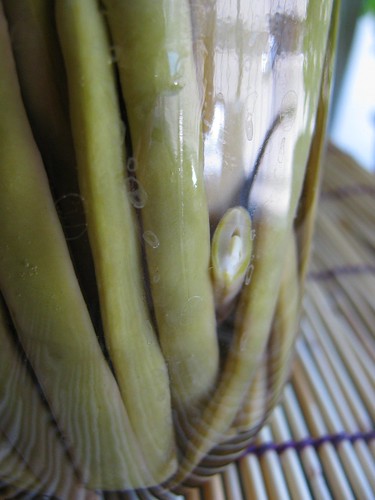
Photo from Flickr--no photographer identified--used by a cooking blog.


The original story in the Roanoke Times included a picture of white-haired Elizabeth holding a can of beans with a title something like, "Women Hasn't Opened Can of Beans for 57 years."  I wrote this to imagine why....

*

GREEN BEANS

"And as the years passed
the beans became a reminder
of her long-departed youth."

--Roanoke Times and World News, 10/26/78

*

Last week Elizabeth turned eighty.
She touches her hand to jar
blue against the velvet green of her beans
canned 1921, last year they had the farm.
The beans curve, green fingers
tip to tip
long, slender
as hers were that July
everyone said she'd the prettiest hands.

She feels cool weight of quart
thinks of pots steaming
so hot that July
Jonathan drug the woodstove out in the yard.
She is telling her daughter
a teaspoon of sugar
a teaspoon of salt
now wipe that rim.

Beans were scarce that year.
She paid her little ones
to pick beetles off
not before the vines all wilted.
Only one row in the new ground thrived
an odd row planted when she ran out of corn.
She sowed and picked beans by the moon
not enough to can
she canned them anyway
stacking beans upright
in concentric circles.

Nights she lay at Jonathan's side
stared at beans in the moon patterned ceiling.
At midnight
she finally slipped from the bed
counted stripe on stripe
tomatoes, peaches, corn
a hundred quarts

and that can of beans

cool fingers
soothing her to sleep.

*

Wish I  had a copy of the article in the Roanoke Times with me, so I could scan the picture of  Elizabeth.

This poem was originally published by Artemis, as I recall.  Although I started it in 1978, when I first joined a writers' workshop, I didn't finish it until several years later at the Hindman Settlement School's Writers' Workshop.  It turned out to be the first of a series about Elizabeth, called Weatherings, which take place over the course of a year in which the weather evokes earlier memories.  Fred Chappell used to sign notes to me Old Fred and tease me that I was writing about myself.  (He didn't know that my birth name is Beth, not Elizabeth, but maybe he was on to something.)


I read it for an audience most recently on September 25 at Voices from the Mountains (the lead-up to the march and sit-in on September 27) and got compliments from our emcee Reverend Billy, novelist Silas House, poet Bob Henry Baber, activists Roland Micklem and Sue Rosenberg and musician Carry Kline, among others, which was heartening.

 To tell the truth, following barn burners like Larry Gibson and Micky McCoy, I was glad that there was a musical interlude before I read  : ).  After this I finished out with Looking Out Over An Abyss in Boone County, one of my own barn burners.  The latter is about Larry Gibson's 50 acres at the edge of an mtr site and I don't think I had ever read to an audience when he was present.

UPDATE:  I also read the poem on the Floyd Radio Show January 7, 2012, where it was recorded and you can now listen on an archived podcast, which I've included at the link.

10/21/09

"After years of doing our part to undermine Wall Street, the darned thing fell on us!"

Graphic design used on a t-shirt used in many union actions...

Northland Poster Collective dedicated itself to placing art and humor at the center of organizing strategy. I just learned that it is no more, as of June, after 30 years and three months.
We don't have to tell you that maintaining a small, insurgent political art organization, without institutional backing or grant funding for thirty years in a capitalist economy is a struggle. That we did it for so long is an achievement we can celebrate. A couple of years ago we engaged in a major fundraising effort that retired a mountain of old debt and set us -- or so we hoped -- on a course toward long-term stability. Given a few more years of steady growth without any global financial meltdowns we may well have gotten there. We didn't get an opportunity to find out. After years of doing our part to undermine Wall Street, the darned thing fell on us!
One of the original members, Ricardo Levin Morales, has a gallery of work here. He will be selling his work online sometime in the future. If you're on facebook, you can view many of the posters here. And some of the website was saved by the the Internet Archive. (If you reach a dead end, you can sometimes do a google search on the name of the poster and artist to find it elsewhere on the internet. You can buy buttons (and soon bumper stickers) from River City Buttons. You can buy t-shirts (minimum order of six) from Aztech Graphix. Email edup1972@hotmail.com.

For other political art distributors, still in business, see:

1/2/00

Poem: Olga Korbut on Chernobyl, 1991


Collage from photos by Heinz Kluetmeier (l), Kimberly Butler (c) and Taro Yamasaki (r)


OLGA KORBUT ON CHERNOBYL, 1991 (after reading "Olga Korbut's Deadly Foe," People, 3/4/91)

The radiation does this.
These pictures in the magazine
could be two different women.

At 17, smiling,
in pigtails
at the Munich Olympics,
I look, what, maybe 12.

At 35, these lined, swollen eyes
this brittle hair
this thin, thin mouth
remind me of my grandmother.

Only the shot
with my student
at the Minsk Sports School
balanced on the beam--
feet perfectly arched,
one hand flourished--
reveals some connection.

Funny, yes?
I didn't know I was smiling.
It's as if
a long-practiced gesture
creates the earlier time.

At our regional hospital
7,000 have come in for leukemia--
if you could see their pictures:
adorable children, each of equal desperation.

I stayed there myself last spring
for my liver
and even with my connections
could get no disposable syringes.
We found a needle
and we boiled it and boiled it.
It was so dull
I could not finish the treatment.
One learns to accept people dying.
(stanza break)

You in the West knew first.
They didn't tell us for four days.
And then only about the accident.
The papers called the radiation levels safe.

In Minsk, 180 miles away,
we were all outdoors.
It was close to May Day
and we were planting gardens,
enjoying the spring weather.
If we had been told
we could have stayed inside.

When people began to hear
our authorities might be
hiding the truth
we were afraid.
Of the water.
Of air.
At first, people were very ill.
Now all the time
we have headaches.
We always feel weary.
It has been five years
and we are still afraid.
When it rains we
cover our heads.

On the streets of Minsk
there used to be
so many pregnant women.
Now you see fewer and fewer.
We are scared and cautious.
We could go away
and maybe give birth to
healthy children.
But it is our home.
Our families are here.
It makes us torn.

Byelorussia used to be
the feeding ground.
Now it is poisoned.
In the past
when I would come to your country
I would buy blue jeans and shoes.
Now I buy chicken bouillon,
dried fruit.

Byelorussia used to be
the republic of mushroom gathering,
berry hunting,
flower picking--
now people don't go into the woods.
In some schools
when the children want to see
what nature used to be like
they go into a little courtyard
inside the building.
The teacher says,
"This is a bird"
and it is a plastic bird.
"This is a tree."
And it is also plastic.

11/17/91

11/30/85

POEM: OYAKO SHINJU


Photo of Fukimo Kimura, h/t Tom Schnabel (bio, radio program) who used it in his post about Kimura, in response to Jarissa MacFarquhar's article, "A Buddhist monk confront's Japan's suicide culture" about Ittetsu Nemoto in the 6/24/13 issue of The New Yorker.

*

OYAKO SHINJU*


"I am sitting in a room different from the one you are in now." 
        

      --Alvin Lucier
Oyako Shunju translates as "parent-child suicide, a practice traditional in Japan. 

"Like most traditional Japanese women, Fumiko Kimura considered 6-month-old Yuki and 4-year-old Kazutaka to be extensions of herself. She loved them passionately, almost obsessively.

"She took them everywhere with her--even to die."
       
      --Leslie Pound, "Mother's Tragic Crime Exposes a Culture Gap," reprinted from the 6/9/85 Dallas Morning News.

After reading Leslie Pound's account,  I decided to write a poem in her persona, as if Kimura was writing me back from jail.

1.  YOU ASK WHY I'D WALK INTO THE PACIFIC WITH TWO BABIES

Childless in your room
other coast of a wide country
you steam rice for supper
write me this question.
I sit in a cell
fill legal pads with pencil:
The ocean cleansed my heart and my body.
The ocean breeze blows the past away.

                               
                               *

My first love was always the ocean.
I was born on a small island.
Old ones called the year of my birth
firehorse--
poor chance to find a husband;
I would burn him, cause his death.

The ocean breeze played a scale,
waves washed my ankles.
I was standing in music.

                                *

Girls take up flower arranging
or tea ceremony
waiting for their husbands.
My aunts advised:
"Polish harder.  Become a piece of jade."

Since they found Western arts
desirable, I practiced piano for ten years.
The ocean breeze taught its scales to my fingers.
All the time I kept one secret.

                                *

All the time I kept this secret:
with no hope for a husband
I was strangely free.
Windy nights at low tide
moon scrubbed waves ivory
against ebony of ocean.
Such a friendly omen
sent me to the keyboard, avid.
One evening, grandmother,
listening to the fifteenth hours'
practice, suspected me
possessed,
gravely counseled magic.

                                *

For her sake I frequented the shrines
lowering eyes
to demonstrate some small despair;
questioned my husband-less
fate, picturing instead
(to get the gesture right)
a hesitation on the keys,
the ruined examination.

The time came; it came to pass.
National Music University not my future
you'd say I brought failure on myself.
The truth:  I misread the ocean's omen.

2.  TIDES TRAVEL OUT

I hoped this
was what ocean counseled.
Maps showed your country of long coastlines.
I had the ear for language,
liked the sound of California,
hummed it as I bought my ticket.

All night I dreamed
a long but easy boat ride, something
I cannot remember--night tides,
a bell, the pier.

                                *

In your country I sold hot dogs, nights,
three blocks from the pier.
Grease frying, coins clinking,
the bell on the cash register:
I was listening for the ocean.

Cars honked at the drive-in window;
teenagers back from the game
yelled across the lot.
The day-cook, Japanese,
was born in your country.
One evening in the back
room he proposed marriage.

                                *

Suppose
the old ones had told you
you would never marry.
Would you notice
he lacked ambition,
a desire for children?
He promised a piano,
an apartment by the ocean.

For eight years
we lived downtown
in a noisy walk-up.
I had to keep my job.
each night I dreamed
I hadn't failed the examination.
In a quiet room
the audience waited.
My hands stretched above the keys.


                                *

I started to walk down to the Santa Monica sea:
I like the sea.  I like the Santa Monica sea
when I lose my way it comes to meet me.
And when I have something sad, it comes to meet me.
Although this was not acceptable
I ask for a divorce.

                                *

I found an auspicious job.
At the Japanese restaurant
I could save up for my lessons.
The cook, Mr. Kimura, was a painter.
He'd graduated in Tokyo
from Musashi Arts University.
He spoke of pink curl of shrimp,
translucent winter melon.

If you could have
heard him in the kitchen--the drawing cut
the thrusting cut,
the clack of lacquer soup bowls.
He spoke of sea bass in August,
sea trout in May.
Shiny eyes,
bright scales,
clean taste of ocean.

3.  HOW TRADITION COMES INTO YOUR ROOMS

Six years ago we married.
He bought me a piano.
Soon owned his restaurant.

Home, evenings, I always
cooked our simple meal:
miso soup, bowls of rice,
cups of scalding tea.
I washed white porcelain, black
lacquer, humming to myself.
The piano waited for my practice.

My hands stretched above the keys,
belly rounding like the sea bass.

                                *

Our son Kazutaka came,
his gurgles the uneven ocean currents.

I spent days at home now,
wished to teach tradition.
I bathed his father's feet each night.
We removed the bed and slept on mats,
left our shoes outside the doorway.

Soon Kazutaka crawled.  We took
all furniture from the living room,
all sharp edges,
the piano.

                                *

I named my daughter Yuri.
Neighbors exclaimed over my tiny porcelain doll.
To hide any sign of pride
I lowered my eyes, spent
whole days dressing her and Kazutaka.
Combing their hair, walking by the ocean.

Kazutaka ran ahead
scooping fists of sand, watched
them pouring through his fingers.
I took his hand,
pointed to the ocean; we watched
tides wash in from Japan.

I told him of my life on the island
of walks on that shore,
of practicing the piano.

                                *

You can imagine my dishonor.
Mr. Kimura's mistress called,
implied to support us
he had abandoned his dreams to paint.
He'd seen her several times each week
and since he hadn't wanted another child
she'd undergone the shame of an abortion.
Now she had found out about Yuri.

4.  THE SECRET OF FIRE AND OF WATER

She sat down with us.
In our home.  Offered me
his love letters,
returned his gifts.
One week later, she sent a boy
with a note to the door.
Offered to sacrifice her own life,
if the problem could be settled.

Mr. Kimura
came home 2, 3, 4,
even 6 o'clock in the morning.
Still I washed his feet, only asking
that he paint my picture.

He never noticed I couldn't
eat, lost my concept of
memory, of sleep.  Left toys
strewn across the apartment floor.
I was not qualified as a mother:
the ocean's omen beckoned.

                                *

A quiet moon, washing waves.
A piano started playing first quietly,
then louder, out of tune.
I heard again grease frying,
the bell on the cash register.
My eyes squeezed shut.
Street lights dazzled, then
again the quiet moon, the washing wave
and the old ones whispering firehorse,
firehorse.

                                *

On the appointed afternoon
my dress was the pink of seashells.
Santa Monica beach nearly deserted,
a teen-age couple mocked the shrieking gulls.
Along the windy shore, an old man
stooped to gather seashells.

You ask how I could walk into the Pacific with two babies?
You must understand
my children were me--
I couldn't leave them behind.

Kazutaka fought; my nails
dug crescents in his wrist as we walked into the sea.
I lay face down in the cold water waiting for our death.

                                *

Living is hard and dying is hard.

Mr. Kimura visits me daily in jail.
I put away the legal pads.
Agree to his plans--we will
start over, have other children.
I lower my eyes to demonstrate
regret, picturing instead
the hesitation of the ocean's waves.

And all the time I keep my secret:
the children were me.
The sea will hold me tight
and it helps me forget my sorrows.