7/29/06

Chamber of Commerce and the Mimimum Wage


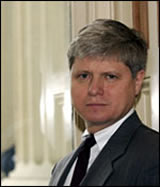
The dapper dude in the photo is U.S. Chamber vice president for labor, immigration and employee benefits, a highlighted speaker at the anti-liberal Federalist Society 's 2005 National Lawyers Convention. The next convention is in November--place as yet unannounced.

*

Randel K. Johnson joined the U.S. Chamber of Commerce in 1997 and he's the go-to man on legislation and government programs regarding the minimum wage. According to a bio I found at the publications page of the Chicago Council on Foreign Relations,
Prior to joining the chamber, he was the Republican labor coordinator for the House Committee on Education and the Workforce.
The House of Representatives closed shop for its recess today after after passing two measures I've been writing about for the past several days. The first measure chained an increase in the minimum wage to a huge reduction in the estate tax. Looks to me like the Republicans are getting ready for the election and want to rebut the Democrats criticism that they are responsible for no increase in the minimum wage during the last 10 years. With the Senate opposition to the estate tax reductions at this level, I've got to wonder if they are making that issue a poison pill for the increase.

 After all, many of their constituents--including Chambers of Commerce--have opposed increases in the minimum wage for years. The Chamber ran a feature, "U.S. Chamber Opposes Raising Minimum Wage" in its magazine as recently as May 2006, although, interestingly, this is one of the few articles on its website available only to members. Publicly available are the news releases the Chamber sent out. June 18 2004 its railing against Senator Kerry featured comments by Johnson:
While the political appeal of this proposal is obvious, the fact remains businesses and workers will be losers under this proposal....The majority of economists agree that raising the minimum wage kills job creation. Placing this burden on small businesses will stifle our economic growth....Small businesses cannot simply wave a magic wand to create more revenue when lawmakers pass these types of bills. It is these businesses, the backbone of our economy, which will be hurt the most by this proposal. Some politicians may view initiatives such as these as a painless way to appeal to voters. But in reality, there is no such thing as a free lunch.

Johnson pointed to a study by the Employment Policies Institute, "Job Loss in a Booming Economy, 2nd Edition" saying that it suggested the 1996 minimum wage increase of only 50 cents per hour destroyed approximately 645,000 entry-level jobs.
According to Sourcewatch.org,
The Employment Policies Institute is one of several front groups created by Berman & Co., a Washington, DC public affairs firm owned by Rick Berman, who lobbies for the restaurant, hotel, alcoholic beverage and tobacco industries. EPI, registered as a 501(c)(3) tax-exempt organization, has has been widely quoted in news stories regarding minimum wage issues, and although a few of those stories have correctly described it as a "think tank financed by business," most stories fail to provide any identification that would enable readers to identify the vested interests behind its pronouncements. Instead, it is usually described exactly the way it describes itself, as a "non-profit research organization dedicated to studying public policy issues surrounding employment growth" that "focuses on issues that affect entry-level employment." In reality, EPI's mission is to keep the minimum wage low so Berman's clients can continue to pay their workers as little as possible.

EPI also owns the internet domain names to MinimumWage.com (http://www.minimumwage.com) and LivingWage.com (http://www.livingwage.com), a website that attempts to portray the idea of a living wage for workers as some kind of insidious conspiracy. "Living wage activists want nothing less than a national living wage," it warns (as though there is something wrong with paying employees enough that they can afford to eat and pay rent).
I'm presuming minimum-wage/estate tax bill is the still-unavailable-as-of 3:34 p.m. H.R. 4.  At that time, Associated Press tax writer Mary Dalrymple had posted her story on the bill which would:
  • increase the minimum wage from $5.15 to $7.25 an hour, phased in over three years.
  • lower estate taxes by exempting $5 million of an individual's estate, and $10 million of a couple's, from estate taxes by 2015.
  • tax estates worth up to $25 million at capital gains rates, currently 15 percent and scheduled to rise to 20 percent.
  • trim rates on the remainder of larger estates to 30 percent by 2015.
The other bill passed was the pension measure. More to come.

UPDATE: The minimum wage measure is H.R. 5970: See: "Stealthy Poison: Minimum Wage Raise Linked Estate Tax Cut, Backdoor CUT for Tipped Workers." The pension measure is HR. 4. which Democrats complain the measure favors some industries and doesn't do enough to prevent employers from eliminating defined-benefit plans, according to the AP's Jim Abrams.

7/3/06

Lieberman: Another Democrat Independent?


Could not find the original image online, but it's attributed to fark.com, so my guess is that it was a photoshop contest.

Makes me wonder whether Joe Lieberman has taken a hint from the playbook of the recent Roanoke City Council winners. Not assured of a win at the Democratic Party mass meeting, the "We are Democrat" independents went straight to the ballot. In a close election against conventional Democrats and Republicans, they won.

Now, the Hartford Courant's Mark Pazniokas, in his article today, "Lieberman Will Petition" quotes Lieberman at today's press conference about his decision to run as an "independent Democrat" even if he loses the August 8 primary:

I've been a proud, loyal and progressive Democrat since John F. Kennedy inspired my generation of Americans into public service and I will stay a Democrat, whether I am the Democraitic party's nominee or a petitioning Democratic candidate on the November ballot.

Almost eerily, even before the announcement, the Courant published a commentary yesterday, "No Conservative: Lieberman's A JFK Democrat" by by Marshall Wittmann, a senior fellow at the centrist Democratic Leadership Council and Steven J. Nider, director of foreign and security studies at the the DLC's think tank, the Progressive Policy Institute.

Joe Lieberman, more than any other national Democrat, represents the JFK tradition in the national Democratic Party

Call me cynical, but it smacks of Tass and the days of the politburo, this softening up pof the public, publishing Lieberman's sound bites before he even utters them. They continue,

Driven by a motley coalition of left-wing bloggers and the MoveOn.org crowd, a serious primary challenge has been launched against Lieberman. However, if Lieberman is defeated, a disastrous message would be sent to the nation that centrist hawks are unwelcome in the Democratic Party.

The Connecticut Senate primary is nothing short of a battle for the soul of the Democratic Party. That is why outside left-wing groups have converged on this state.


Who needs Republican critics, when the Democrats can so shrilly talk about other members of their party this way?

The Nation's Joe Nichols counters today with "Joe Lieberman's Connecticut Problem."

Were Lieberman merely a predictable centrist Democrat, willing to mumble mild criticisms of the Bush administration's foreign policies but unwilling to make a serious break with the administration, he would not be worrying about the increasingly-viable Democratic primary challenge he faces from anti-war progressive Ned Lamont.

But Lieberman is not a predictable centrist. He is an in-the-pocket Bush man -- at least as far as the war in Iraq goes.

6/6/06

Bob Reich, OMB Watch and the Estate Tax

The poster is from Bob Reich's 2002 run for the Democratic nomination for Massachusettes governor by David Caputo of Positronic Design.

Reich is a true progressive. The primary results split the votes 185,315 for Reich to 243,039 for Shannon O'Brien. But those were not the only candidates. Warren Tolman, also running as a progressive got 132,157 votes. Tom Birmingham, who had the teacher's endorsement, got 139,703 votes. Steve Grossman got 5,971. O'Brien went on to lose to Mitt Romney and now we have his health care reform. (I'll write about that later but, for starters, see these Boston University scholar's analysis).

Today TomPaine.com published Reich's "Estate Tax Pyramid Scheme" on Tom Frith's promise to bring repeal to a vote. Here's what he has to say:

Those who argue for repeal say the estate tax discourages entrepreneurs. What? Passing on $4 million tax free to your kids is not enough incentive?

Talk about discouraging entrepreneurship. Repeal the estate tax and within a few decades control over America’s productive assets will be in the hands of non-productive Americans who never lifted a finger in their lives except to speed-dial their financial advisors.

People who inherit great wealth just because they’re lucky enough to have super-rich parents don’t have any particular incentive to be entrepreneurial. They don’t have any particular incentive to do anything. Giving them control over the American economy is like giving control over a Boeing 777 to teenagers with joysticks.

In response to an action alert from OMB watch, I wrote Senators Warner and Allen the following email. I hope you'll consider sending your own.

Dear Senators Warner and Allen

Please vote "no" on estate tax repeal, if it arises this year. We cannot afford to lose a trillion dollars over the first ten years to provide a tax cut that benefits the wealthiest--only one percent of estates pay any estate tax at all.

Warren Buffet has said, "All these people who think that food stamps are debilitating and lead to a cycle of poverty, they're the same ones who go out and want to leave a ton of money to their kids" (Janet Lowe, "Warren Buffett Speaks: Wit and Wisdom from the World's Greatest Investor," John Wiley & Sons, Inc., 1997).

According to a new report from United for a Fair Economy, such people from 18 families worth a total of $185 billion have financed and coordinated the repeal campaign. They posed as small businesses and family farmers, saying their livelihoods would be threatened unless the tax were repealed. In fact it’s hard to find a small business or family farm with an estate valued at more than $4 million.

Most of these 18 families have been wealthy for decades. Only five of them include any of the people who first earned the family fortune. If they succeed in their repeal campaign, they’ll save a total of $71 billion on their tax bills. Should such public relatiions budgets drive domestic policy?

Repeal will increase the disparity in income and further tear apart our national morale. Today’s workers are 24 percent more productive than they were five years ago but their median real earnings have barely budged. Most of the increased productivity has gone to people earning over a million dollars a year--mostly CEOs, investment bankers and hedge fund managers. Average CEO pay back in 1966 was 60 times that of the typical American worker. Now it’s 400 times.

Repeal will squelch entrepeneurism. Thirty years ago, the richest 1 percent owned less than a fifth of America’s wealth. Now, according to a recent report by the Fed Reserve Board, they own more than a third. Repeal the estate tax and within a few decades control over America’s productive assets will be in the hands people who inherit great wealth just because they’re lucky enough to have super-rich parents, but don’t have any particular incentive to be entrepreneurial. As Warren Buffet has also said, "“parents should leave children enough so they can do anything, but not so much that they could do nothing. "Giving heirs a lifetime supply of food stamps just because they came out the right womb" is an "antisocial act."

Repeal removes an important incentive in the the tax code for charitable giving. Charities stand to lose roughly $10 billion a year if the federal estate tax is repealed permanently, according to a study conducted by the Brookings Institution office. The Congressional Budget Office estimated in 2004 that charitable giving would decline by 6 to 12 %.

Repeal reduces revenues to address rising health care costs, unmet education needs, a growth in an aging population on social security and lax homeland security.


Repeal exacerbates record deficits.

Please do not repeal this tax and shift its burden to to middle class, working Americans and our children to come.

Repeal of the "death tax" is, in fact, a "birth tax."

I ask you to keep fiscal discipline, fairness and compassion in mind.

Thank you for your attention to this important matter.

5/15/06

More about Nuclear Astroturf


The above diagram of nuclear fusion is from Energy Quest, the California Commission on Energy's educational website.

*

May 17-19, 2006, the Nuclear Energy Institute (NEI) holds its annual conference, The Nuclear Energy Assembly in San Francisco. It’s theme? Buzz2Build: Turning Promise into Power. The promotional information on the website says, “The outlook for nuclear energy in the United States has never been brighter. Nine consortia or companies are preparing licenses for as many as 20 reactors. The number of reactors with renewed licenses continues to rise, and existing nuclear plants are sustaining record levels of safety and performance.

At one time, in its background paper, "Nuclear Energy: No Solution to Climate Change,” Greenpeace was predicting the demise of nuclear energy.

The nuclear industry is in near-terminal decline world-wide, following its failure to establish itself as a clean, cheap, safe or reliable energy source. The on-going crisis in nuclear waste management, in safety and in economic costs have severely undermined the industry’s credibility.

The paper is undated, but the sources cited date back to the late 1990’s. So, what happened in less than ten year’s time? Could it be the nuclear energy industry's persuation of the federal government to establish Nuclear Power 2010 (NP 2010), unveiled in 2002 as a private industry-government “cost-shared effort," mentioned in my May 10 entry, Nuclear Energy Is Now Clean and Safe?

*

The NEI's Clean and Safe Energy Coalition, which I wrote about that date, is headed by former Environmental Protection Agency (EPA), director Christine Todd Whitman and Greenpeace co-founder Patrick Moore. Not only are these two ex-environmental leaders. Some have argued that they are ex-environmentalists trading their credentials for money to improve the images of known polluters.

After Whitman left the EPA on May 21, 2003, she founded a public relations firm, Whitman Strategy Group. On December 16, 2004, the Washington Post reported,

Whitman actually found herself last month lobbying her former Cabinet colleague Interior Secretary Gale A. Norton on behalf of Citgo Petroleum Corp., which wants federal protection to preserve Petty's Island, N.J., which it owns.

But, according to Sourcewatch.org's article on the Whitman Strategy group

the firm's first ongoing client was FMC Corporation, ‘a chemical company negotiating with the EPA over the cleanup of arsenic-contaminated soil at a factory near Buffalo, N.Y.’ In a May 2005 interview, Whitman said she had not worked directly with FMC, but would likely advise them on ‘how to improve their image’ and gain ‘access to the people they need to speak to.’ FMC ‘"is responsible for 136 Superfund sites across the country ... and has been subject to 47 EPA enforcement actions.’

But Whitman had always been a market forces sort of “environmentalist.” Perhaps that is why his former colleagues are more dismayed with Patrick Moore. After leaving Greenpeace in 1986, Moore founded the public relations firm, Greenspirit Strategies, Ltd.. According to its website, Moore has spoken out in favor of pesticides, salmon farming, poly-vinyl chloride (PVC) and genetic egineering. Oh and of course, nuclear energy.

Usually he trots out his role with Greenpeace without mentioning his current status as a paid spokeman for the industries involved. For some of the details, look at his website and at Eco-Traitor, Drake Bennett’s March 2004 article in Wired. . Also take a look Sourcewatch.org's article.

Even those who support nuclear power argue that Moore has done the industry no favor by overstating the case. On April 16, in his work for the Clean and Safe Energy Coalition, I'd assume, Moore wrote a piece published by the Washington Post, "Going Nuclear: A Green Makes the Case."

In an op-ed, "Wasted Energy," published in the April 18, 2006 New Republic Online, Michael A. Levi responded that Moore had undercut his arguments

with a series of false assertions and slippery arguments. These credibility-damaging tendencies hurt the real case for nuclear power.

A fellow for science and technology at the Council on Foreign Relations, his bio there state that Levi's

interests center on the intersection of science, technology, and foreign policy; he is an expert on arms control and nonproliferation, nuclear and radiological weapons, and science and technology in the Islamic world.

Before joining the Council, Dr. Levi was a nonresident science fellow (2004-2006) and a science and technology fellow (2003-2004) in foreign policy studies at the Brookings Institution. Prior to that, he was director (2002-2003) and deputy director (2001) of the Federation of American Scientists’ flagship Strategic Security Project.

In other words, Levi knows a whole lot more about nuclear energy than I do and he's not necessarily against it. I think that makes a look at his critique especially instructive with regard to the claims made by the coaltion and the Nuclear Energy Institute. For instance, Moore claims that nuclear power is inexpensive. Levi responds,

While literally true, that’s a specious claim. The marginal cost of producing an additional kilowatt-hour of nuclear power using existing plants is indeed less than two pennies. But that ignores the capital costs involved in building nuclear power plants, which exceed the costs of building coal-fired facilities. Including those expenses, an MIT report (which made an honest argument for nuclear power) prices nuclear at 6.7 cents per kilowatt-hour, in contrast with only 4.2 cents for coal, nearly 40 percent lower. To be logically consistent, Moore would also have to believe that buying a house is always cheaper than renting (because property taxes and maintenance cost less than rent) and that owning a car is always cheaper than riding a bus (because gas costs less than bus fare).

Regarding Moore's implications that nuclear waste becomes safe, Levi writes,

even that reduced radioactivity still makes waste disposal difficult and costly.

Levi maintains that Moore's claim that recycling nuclear waste will reduce the amount that needs treatment and disposal is "misleading."

First, it is cheaper to simply mine and use new uranium than to extract the remaining “95 percent of the potential energy” Moore refers to. More importantly, recycling used fuel does little to cut down the volume of nuclear waste. When the remaining “potential energy”—locked up in uranium and plutonium—is extracted from used nuclear fuel, the bulk of the radioactivity in that nuclear fuel remains. As a result, that material must still be protected in large, radiation-shielding casks—and disposed of, meaning that the waste problem does not disappear.

Levi also responds to Moore's minimizing the threats of nuclear terrorism. Moore

weakens his case by completely ignoring the main claim made by serious skeptics: The pools containing spent nuclear fuel, which sit outside the concrete containment domes, may be vulnerable to attack.

Levi argues that Moore fails to treat seriously the question of whether nuclear power can be diverted to make weapons. Moore

notes that “If we banned everything that can be used to kill people, we would never have harnessed fire.” That’s true, but the question here isn’t whether nuclear power is dangerous; it’s whether the dangers associated with it outweigh the benefits it entails. Simply because fire had greater potential for good than harm does not mean that the same is true for nuclear power.

Levi concludes,

the greatest political barrier to nuclear energy is public skepticism. And so, as the pro-nuclear crowd attempts to build credibility, exaggeration is the last thing it needs.

*

Greenpeace goes further that Levi. In that background paper I linked to at the top of this entry, the group says that in

even the most perfunctory examination of the issue shows that nuclear power has no role whatever in tackling global climate change. In fact quite the opposite is true; any resources expended on attempting to advance nuclear power as a viable solution would inevitably detract from genuine measures to reduce the threat of global warming.

*

Special thanks to a Radford friend, Barry, who kindly sent me the citation I'd used to Michael A. Levi's op-ed. Barry had downloaded my blog entry on the Clean and Safe Energy Coalition before the original version of this post got eaten by Yahoo when I tried to incorporate a link to the Sourcewatch.org article on Patrick Moore.

5/10/06

Nuclear Energy Is Now Clean and Safe?

Illustration of Pinocchio by John Walker (email, website) at Picture-Book.com


May 9, the Nuclear Energy Insitute agreed to voluntarily monitor radiation leaks into groundwater. David Lochbaum, director of the Nuclear Safety Project for the Union of Concerned Scientists and leaders of 32 other environmental groups had on January 25, 2006 filed a petition accepted by the Nuclear Regulatory Commission (NRC) to require nuclear reactor operators to provide information on their programs to detect the potential release of water contaminated with radioactive materials. The NRC had formed a task force which resulted in the NEI's reaction.

NEI is the same organization behind the Clean and Safe Energy Coaltion launched April 24. In the April 25 New York Times article, "Ex-Environmentalists Tout Nuclear Power," Matthew L. Wald had wrote that while the Clean and Safe Energy Coaltion depicted itself as a grass-roots advocacy group, a spokesman for

the Nuclear Energy Institute, the trade association of reactor operators, acknowledged that it was providing all of the financing, but would not say what the budget was.

I discovered the new astroturf group when I was in Charlottesville last weekend and read John Borgmeyer's article "The greening of nuclear power" in the May 2-9 C'ville.

The naming of the coalition mirrors language used in 1989 by the International Solar Energy Society, as well as that in Bush's 2006 State of the Union message in announcing the Advanced Energy Initiative

a 22-percent increase in clean-energy research -- at the Department of Energy, to push for breakthroughs in two vital areas. To change how we power our homes and offices, we will invest more in zero-emission coal-fired plants, revolutionary solar and wind technologies, and clean, safe nuclear energy.

Actually, according to an preliminary analysis by the American Association for the Advancement of Science, the nuclear research portion of that initiative would reflect a 40% increase.

The Department of Energy's section in the 2007 budget includes $54 million in 2007 for the Nuclear Power 2010 (NP 2010) unveiled in 2002 as a private industry-government

cost-shared effort to identify sites for new nuclear power plants, develop and bring to market advanced nuclear plant technologies, evaluate the business case for building new nuclear power plants, and demonstrate untested regulatory processes leading to an industry decision in the next few years to seek Nuclear Regulatory Commission (NRC) approval to build and operate at least one new advanced nuclear power plant in the United States.

In February 2004, the Department of Energy teamed up with the electric power industry to issue its Strategic Plan for Light Water Reactor Research and Development .

Ironically, the launch came as an international conference, Chernobyl + 20 convened April 22-25 in Kyiv, Ukraine. The April 26, 1986 Chernobyl disaster reminded people of the dangers of nuclear power, as had the Three Mile Island melt down about 100 miles west of Philadelphia on March 28, 1979. And there have been lesser known problems which led to the aforementioned petition.

In his C'ville article, Borgmeyer writes,

The public relations blitz comes as the Bush Administration plans to jump-start America’s nuclear industry. In August 2005, Bush signed an energy bill that kicks the nuclear power industry a reported $12 million to add to the 103 nuclear plants currently operating in the United States. Around the same time, the Nuclear Regulatory Commission changed its rules to streamline the approval process for new nuclear plants.

Richmond-based Dominion Energy, Inc. is the first company to take advantage of these recent federal incentives. As Dominion seeks approval for two new nuclear reactors on Lake Anna in Louisa County—just 30 miles east of Char-lottesville—the company is trying to recast nukes as the healthy choice for an eco-conscious America.

Ironically, to place it in its best light, the federal government's official information site reports that while the Bush administration has supported nuclear expansion, as of

October 31, 2005, however, no U.S. nuclear company has yet applied for a new construction permit.

To the contrary, the Blue Ridge Environmental Defense League, in its February 27, 2004 fact sheet, "New Nuclear Power Plants in Virginia? Dominioin Power Plans Expansion at North Anna," reports that Dominion filed an early site permit to construct two or more new nuclear reactors on its site on September 25, 2003.

The Nuclear Regulatory Commission's licensing review confirms the September 25, 2003 by Dominion Nuclear North Anna, LLC' and adds

Subsequently, Dominion decided to change the cooling system for postulated Unit 3 and increase the power level for both postulated Units 3 and 4. Revision 6 of the application was submitted on April 13, 2006 to address the change to the cooling system and the increase in power level.

Meanwhile the twentieth anniversary of Chernobyl has returned attention to the disaster. The BBC has posted a haunting remembrance, Chernobyl: 20 Years On. The UK's Observer Magazine published an article of the same name by Adam Higginbotham on March 26, recounting eye witness accounts. The National Geographic posted "Photo Gallery: Chernobyl 20 Years After the Disaster. The International Atomic Energy Agency has posted a feature, "In Focus: Chernobyl." On April 26, Democracy Now aired "Chernobyl 20 Years Later: New Report Finds Death Toll From Nuclear Disaster Close to 100,000."

Clearly, the nuclear power industry has to come up with some strategy to convince the public of the need for new reactors. In an interview with Borgmeyer, David Lochbaum, director of the Nuclear Safety Project for the Union of Concerned Scientists, posits that the coalition is
a reflection of the fact that global warming and climate change is a top message of most environmental groups.This is an attempt to co-opt that message.

*
Take Action

The Union of Concerned Scientists has launched a campaign to write Congress in opposition of a

controversial new program...[to] “reprocess,” or separate, weapons-usable plutonium from the spent nuclear fuel generated by U.S. power reactors.
This proposal would make it easier for terrorists to acquire the material for making a nuclear bomb. It would require the construction and operation of an array of nuclear facilities that would handle enough plutonium annually to make thousands of nuclear weapons. It would also make disposing of nuclear waste more difficult, encourage other countries to reprocess, and cost a tremendous amount of money.

5/5/06

Of Contras and Killer (Ginger) Cookies


Photo from the website of Beeswax Sheepskin, the hot band playing at the Charlottesville Contra Dance tonight at MAC, which I'll get to attend thanks to Sue arranging for a place to stay with Will Morrison and Mary Prendergast of Catharthis.

Sue and Rob volunteered their front porch to be the drop-off point for the community-assisted agriculture producer from Scottsville, The Best of What's Around. Today was the first delivery--all kinds of greens including spinach, kale and mustard, plus asparagus, camomille flowers, pea tops and I don't know what all else.

To welcome those coming to get their shares, I baked Sue's favorite cookie. Here's the recipe:


Joanie's Triple Ginger Snaps


Mix together and set aside:

2 cups flour

1/2 tsp. baking soda

1/2 tsp salt

1 tsp cinnamon

1/2 tsp ground ginger


Cream together:

1/2 cups sugar

1/2 cup unsalted butter, softened


Add in:

1/2 cup molasses

1 large egg, lightly beaten

1 TBS grated fresh ginger

1/2 cup coarsly chopped candied ginger

Gradually add dry ingredients, stirring until well blended. Cover and set in refrigerator to chill for an hour or overnight.

Preheat oven to 350 degrees F.


Form dough into 3/4 inch balls. Pour 1/4 cup sugar into bowl and roll cookies to lightly coat. Place on greased cookie sheets . spaced two inches apart.

Bake in center of oven for 12 to 14 minutes until cookies are just beginning to color and tops are crinkled.

Cool on racks or board. Store in tighly covered container.

4/18/06

Claudia Emerson Wins Pulitzer


The photograph of Claudia Emerson by her husband, technical designer and musician Kent Ippolito, appeared in Blackbird, VCU's online magazine of literature and art.

Congratulations to the Virginia from Chatham, an assistant professor of English at the University of Mary Washington (UMW) who won the 2006 Pulitizer Prize for Poetry for her third collection, The Late Wife: Poems, published last year by LSU Press.

You can hear her read from the poems at UMW in September of 2005 and at at the Library of Congress, where she was awarded the Witter Bynner fellowship in 2005 by Poet Laureate Ted Kooser (also on the committee selecting the Pulitzer.) Emerson also spoke on the May 22 edition of the Virginia Foundation for the Humanities radio progam, With Good Reason , about how she infuses her poems with childhood memories of growing up in Chatham. I set up an article on Emerson at Wikipedia.

Emerson received her MFA from UNC-G in 1991. Her mentor there, poet and fiction writer Fred Chappell, had this to say to Sean Olson who wrote an article for April 18 University News.

Claudia has always had a clarity about her work,not only in her work, but also in the way she goes about her work. I've always admired that clarity. She had a determination -not to win prizes- but to do the very best work she could, to achieve excellence.

Fred, with whom I studied at the Atlantic Center for the Arts ( the same place that I studied with Bill Stafford) reviewed The Late Wife for the Raleigh, NC. News and Observer on December 25, "Same Mine Yields Different Gems," which also includes a review of One Good Hand, by my SAWC cohort, Dana Wildsmith.

*

Here are three of Emerson's her poems, used with her gracious permission, which were featured on Poems.com.


Aftermath


I think by now it is time for the second cutting.
I imagine the field, the one above the last

house we rented, has lain in convalescence
long enough. The hawk has taken back the air

above new grass, and the doe again can hide
her young. I can tell you now I crossed

that field, weeks before the first pass of the blade,
through grass and briars, fog — the night itself

to my thighs, my skirt pulled up that high.
I came to what had been our house and stood outside.

I saw her in it. She reminded me of me —
with her hair black and long as mine had been —

as she moved in and then away from the sharp
frame the window made of the darkness.

I confess that last house was the coldest
I kept. In it, I became formless as fog, crossing

the walls, formless as your breath as it rose
from your mouth to disappear in the air above you.

You see, aftermath is easier, opening
again the wound along its numb scar; it is the sentence

spoken the second time — truer, perhaps,
with the blunt edge of a practiced tongue.


The Spanish Lover

There were warnings: he had, at forty, never
married; he was too close to his mother,
calling her by her given name, Manuela,
ah, Manuela — like a lover; even her face

had bled, even the walls, giving birth to him;
she still had saved all of his baby teeth
except the one he had yet to lose, a small
eyetooth embedded, stubborn in the gum.

I would eat an artichoke down to its heart,
then feed the heart to him. It was enough
that he was not you — and utterly foreign,
related to no one. So it was not love.

So it ended badly, but to some relief.
I was again alone in my bed, but not
invisible as I had been to you —
and I had learned that when I drank sherry

I was drinking a chalk-white landscape, a distant
poor soil; that such vines have to suffer; and that
champagne can be kept effervescent by putting
a knife in the open mouth of the bottle.

Homecoming

The camera is trained on the door, no one
in the frame, only the dog sleeping. And then
finally, I see this was to surprise you,
filming your arrival, the dog's delight. Only now,
six years distant, can this seem scripted, meant:
the long, blank minutes she waited, absent
but there — behind the lens — as though she directs
me to notice the motion of her chest
in the rise and fall of the frame, and hear

to understand the one cough, nothing, the clearing
of her throat. Then, at last, you come home
to look into the camera she holds,
and past her into me — invisible, unimagined
other who joins her in seeing through our
transience the lasting of desire.

*

Here are some links to other Emerson Poems online:

*
Susan Settlemyre William has "An Interview with Claudia Emerson in Blackbird: An Online Journal of Literature and the Arts, Volume 1, No 2 published on December 16, 2002 Pinion, An Elegy. There's a link to the audio file at the bottom of the page.
She reviewed the book in the same issue.

Note: Here's a nice article that came out April 20 in the Richmond Times Dispatch by Michael Martz: "Pulitzer-winning poet from Chatham Virginia: Professor latest with ties to town to bask in literary glory."

3/5/06

Diane Gilliam Fisher


The picture above is of Diane Gilliam Fisher, whose Kettle Bottom (Perugia Press, Florence Mass, 2004, 88 pp.) is an extraordinary evocation of the West Virginia mine wars of 1920-1921. The book starts with an epigram from the poem "Gauley Bridge" in Muriel Rukeyser's 1938 US 1: The Book of the Dead , which recounts the Hawk's Nest incident, the deaths of over a thousand workers, mostly black, from black lung after tunneling under Gauley Mountain in order to divert the New River for a Union Carbide hydro-electric plant.

What do you want--a cliff over the city?
A foreland, sloped to sea and overgrown with roses?
These people live here.

There's still a transcript of the 1936 House Subcommittee on Labor's "Investigation Relating to Health Conditions of Workers Employed in the Construction and Maintenance of Public Utilities," along with explication of poems at Modern American Poetry, the "Online Journal and Multimedia Companion to Anthology of Modern American Poetry

(Oxford University Press, 2000) edited by Cary Nelson. Fisher, of course, published too late to make the cut, but I can't help thinking these poems are so good she should have, if the book had been published earlier.

Kettle bottom, as Fisher explains, is a “petrified tree trunk / buried in the mountain, two, three hundred / pounds” that “Drops through the mine roof” and “kills a man / just like that.” Her book is divided into three sections.


This poem leads off the first section, "Summer~Fall."

Explosion at Winco No 9

Delsey Slayer knowed Tom Junior by his toes,which his steel-toed boots had kept the fire off of.
Betty Rose seen a piece of Willie's ear, the little
notched part where a hound had bit him
when he was a young'un, playing at eating its food. It is true that the men that goes in, but it is us
that carries the mine inside. It is us that listens
to what all they are scared of and takes
the weight of it from them, like handing off
a sack of meal. Us that learns by heart
birthmarks, scars, bends of fingers,
how the teeth set crooked or straight.
Us that picks up the pieces.

I didn't have
nothing to patch with but my old blue dress,
and Ted didn't want floweredy goods
on his shirt. I told him, It's just under your arm,
Ted, it ain't going to show.
They brung out bodies,
you couldn't tell. I seen a piece of my old blue dress
one one of them bodies, blacked with smoke,
but I could tell it was my patch, up under the arm.
When the man writing in the big black book
come around asking about identifying marks
I said, blue dress. I told him Maude Stanley, 23.
*

Here is part of a ten-page long poem that comprises the second section.

Raven Light

I must have slept for I dreamed the fire boss
torching the gas up under the roof
as he come towards me down the hall.
Then I seen he had wings
and that torch was the flaming sword
turning every way at the gate
of the Garden, and then I looked again
and I see his face all black
and grinning--I think it was a dream.
I think I'm awake. Oh Christ.
Christ, don't let me be in hell
Oh, Jesus. Jesus, Jesus.
....
So I guess I'll die. I'm dying right now
and I ain't laughing neither. Twenty
years old and crying into my shirt.
I'm glad Gertie can't see me.
But when he seen God
was really going to make him die, even Jesus cried
and tried to change his mind....
Out of the dark of the drift mouth
they'll be men still coming out. In twos
and threes, holding each other up, dragging
brothers and fathers between them. Only
the carbide lamps show, no faces. I am part
of the dark the lights bob through in little clusters,
wavery constellations that fade into ordinary
men in the daylight. I am far under
the roots of the old chestnut, hid in the
raven light, where the rock
of ages has cleft.

*

This poem is from the third and final section Summer~Winter.


Samson
Pillars is the walls of clay you leave
between rooms while you working
the rooms--Boss had me explain it
to the Big Boss come down from Boston
on the train to lay eyes on things.
Boss didn't call me by my name,
Bragged how big I is, how strong
a colored boy get when he shovel and haul.
Didn't ask me how my eye got gone--
coal shot out when I was pillar drawing.
Didn't ask my name, neither one.


just holler, Come on over here, son.
I played along, Yessir, I told them,
them pillars is coal, they can get sold.
We come back in when the room is all mined
and pull them down, we don't leave nothing
behind, I've knowed three men died that way,
nothing left of them but their names--

roof don't hold too long without no walls.
Bosses begin to edge back towards the hall.
I stood in their way. With my right hand
I pressed one pillar, the other with my left.
I explained--to the mountains we all the same.
I pressed harder, and told them my name.

*


Fisher lives in Brimfield, Ohio with her husband and two daughters. She was born and grew up in Columbus Ohio. Her parents were part of the Appalachian outmigration from West Virginia's Mingo County and Kentucky's Johnson County. She has a PhD in Romance Languages and Literature from Ohio State University and an MFA from Warren Wilson.

*

Last night 's New River Old Time's square dance in Blacksburg featured caller Beth Molaro and the Wild Turkeys (Cindy Cook on fiddle0 Greg Galbreath on banjo/guitar, Jim Barnhill on guitar, and Frances West on bass and autoharp). Stayed with nathan and went over to the Free Press and on to lunch at Nerv (that IS the spelling) with my sister Carol, her friend Diana, both of whom teach at Auburn Elementary and their former student teacher T-Ryan (his really, truly given name.)

2/26/06

Check out Don Asmussen's Bad Reporter strip


Cartoon from Bad Reporter for February 24, 2006 by Don Asmussen (email).

Just discovered "Bad Reporter" by the San Francisco Chronicle's Don Asmussen. Uclick describes Asmussen as having the

uncanny ability to mix multiple news stories... [which reads] like some bizarrre cross of Saturday Night Live and THE ONION.

Bad Reporter appeared first on September 25, 2003 with the slogan, “The lies behind the truth, and the truth behind those lies that are behind that truth." The first topic was the recall of Governor Gray Davis. The column had grown out of an earlier effort for the paper entitled “The San Francisco Comic Strip.”

There's also an archive of all his work for the paper here and he has his own website of animation here , which started with 1999 collaboration with Mondo Media CEO , John Evershed. His 1997 comic at Salon, "The Hero Santon" is archived here .

Asmussen also produced a regular strip for Time magazine from 1996-2001. His work has appeared in The New Yorker, U.S. News and World Report, Mother Jones, and various other publications. He has been profiled in the New York Times, Communication Arts Magazine, and Step By Step Graphics.

Updates:

2/27/06--Asmussen had no article at Wikipedia so I added one .

2/28/06--Don's reply when I wrote him for permission to use the above cartoon and to let him know about the wiki article:

Thanks Beth, that's really sweet of you! Any help is much appreciated in this more and more crowded cartoon universe. I appreciated the Wikipedia article. I almost feel famous in a way... don a

2/9/06

Village Voice's New Owners


The above illustration, "Doom and Dimmer" is from "Fill 'er Up with Fear" , (current link without image) Ward Harkavy's article on Bush's State of the Union address that (doh), we are "addicted to oil. Just found out that effective February 7, his Bush Beat has been cancelled by the new management at the Villiage Voice.

The venerable independent celebrated its fiftieth anniversary by announcing October 24 that it was merging with the Phoenix-based New Times Media in early 2006, pending federal regulatory approval. That approval came November 28.

While adopting the name of the Village Voice media, the organization kept the management of New Times CEO Jim Larkin and executive editor Michael Lacey, as well as New Times-owned national advertising sales agency Ruxton Media Group.

New Times claimed in the news release to have been born of the same
desire to create a venue for high-spirited, innovative public debate...[and to] challenge mainstream sensibilities... irreverent humor, spirited criticism, [and] magazine-style feature writing
It is telling that Lacey founded his chain with others in 1970 from Arizona State University and has catered to local coverage and the youth market. The Village Voice, on the other hand started to introduce
free-form, high-spirited and passionate journalism into the public discourse.
In announcing the end of his column, Harkavy says he will now be,
writing stories for the paper itself. I'll be focusing on New York City angles.
On its website, New Times Media says of the merger:
It'll take a while before we work out all the kinks, and we're pretty sure we'll screw up at least a few things along the way.
Harkavy was the first national journalist to break the story of Wilbur Ross and his connection to the Sago Mining disaster. He graciously granted permission to run his illustration from that article on this blog, just asking for a link and named credit.
Well, Ward, I'll miss your column, and as far as I'm concerned this is a major "screw up."

*

The Voice last changed hands in 2000, after then publisher Leonard N. Stern announced in September 28, 1999 that by the end of the year hoped to sell the paper and the six others he owned: LA Weekly, OC Weekly, City Pages, Seattle Weekly, Long Island Voice, and the Cleveland Free Times. He had purchased the Voice from Rupert Murdoch in 1985.

In addition to publishing, Stern's business ventures include real estate and Hartz Mountain pet products. of which he was the heir of the founder.
The buyers included New York-based financial firm Weiss, Peck & Greer and a private equity fund associated with the Canadian Imperial Bank of Commerce.


In an article January 5, 2006 article in the Athens News, "State attorney general not much interested in fighting alt-newspaper merger,"  The News noted, they had received a response from Alan C. Witten, an attorney with Ohio Attorney General Jim Petro, to the News' editor's e-mail opposing the merger.


In the settlement, the two chains agreed to pay a “substantial” sum of money (Witten’s word) to cover the impact their deal had on the Cleveland market, and to refrain for five years from any business agreements that would impact the media market in Ohio.
Witten has written,

Be assured that this office has taken, and will take, actions against any transaction between these two publishers that violates either our existing judgment against them or Ohio’s antitrust laws in other markets within our jurisdiction.” 

The Bay Guardian seized on the letter as evidence that the merger had run afoul of Ohio regulators. A Dec. 14 editorial in the San Francisco paper cited the letter and characterized it as  “another potential roadblock” to the merger. It claimed Witten had indicated in the letter that the merger “could possibly violate” the consent decree that settled the 2003 lawsuit, and cited unnamed sources who told the paper that California Attorney General Bill Lockyer had contacted Ohio AG Petro about the issue.

*

The editorial urged Lockyer and Petro to join forces and "take on an important case that the federal government is ducking."
The issue even got some coverage in our state's mainstream press, when the Cleveland Plain Dealer ran a story Dec. 17, reporting that Petro's office was "studying a planned merger of alternative-weekly newspaper chains for potential antitrust violations."

By that time, however, the merger was no longer "planned," but an accomplished fact. The U.S. Department of Justice approved it on Nov. 28, essentially finalizing the arrangement, according to Village Voice Media spokesperson Winnie Lerner. "It's a done deal," Lerner said on Wednesday.

Presumably, the state attorney generals in Ohio, California or both could still take their own actions under state law. Ohio AG spokesperson Kim Norris, however, said Wednesday that Petro's office sees no basis for any such action against the merger.

Norris noted that in Witten's letter, the attorney did not say that any business agreement between New Times and Village Voice would trigger a legal response from the state.

The state will act against the chains only if their business deal "violates either our existing judgment against them or Ohio's antitrust laws in other markets within our jurisdiction," the letter stated. And, according to Norris, the AG at this point doesn't see any Ohio media market that would be affected by the merger.

Norris said in 2003, the market swap by New Times and Village Voice clearly violated Ohio's anti-trust laws. In 2006, by contrast, she said, "we do not believe that there's any market in Ohio where these two publishers operate competing newspapers, for which there would be any impact (from the merger)." And as long as that's the case, she said, the Ohio AG has no jurisdiction to act against the merger.

so, evidently collaboration is illegal, merger is okay. Opponents cite the merger's impact on ad sales, noting due to the merger, Ruxton will take newspapers in five markets -- New York, Los Angeles, Seattle, Minneapolis, and Nashville -- away from the Alternative Weekly Network, which serves many independent papers in the Association of Alternative Newsweeklies. (New Times and Village Voice Media papers also belong to the trade group.)

Though this might conceivably hurt alternatives in Ohio in the long run, it's apparently not enough immediate reason for the state's attorney general to get involved in the case.

An Ohio University emeritus journalism professor who has studied media law said Tuesday that federal regulators are less likely than in the past to call foul on media mergers, and state agencies tend to be less aggressive than the feds.

"I don't think they're looking at (media consolidation) issues very much at all right now," said professor Guido Stempel. "And the states have never been that active."

Athens News Editor Smith said his main concern involves what will happen if down the line


They've got some excellent alt-weeklies now...but who's to say that couldn't change under a corporate takeover? If that happened, it could cripple our trade group and the industry as a whole, adversely impacting all the papers in it.

*

So, who is this spokesperson Winnie Lerner? A managing director at the Abernathy MacGregor Group (AbMac). According to her bio on its site, she
provides investor relations, financial public relations and transactions counsel to clients , [especially] in the telecommunications and technology industries...[and] has been involved in every telecommunications transaction the firm has managed over the past six years, including Bell Atlantic’s merger with NYNEX (now Verizon), Bell Atlantic’s bid for AirTouch, WorldCom’s merger with MCI, and, more recently, Vodafone and Verizon’s joint wireless partnership and Vodafone’s acquisition of Mannesmann and Illuminet’s acquisition of NTC.
Lerner holds a B.A. in international relations from Connecticut College. In an example of the revolving door, she joined AbMac in 1996
from the House of Representatives Subcommittee on Telecommunications and Finance where she served as a Legislative Assistant on telecommunications and broadcast issues.

2/5/06

Jack Spadaro's Fight Against Bush's MSHA


The above photo from OHVEC taken in March of 2001, shows the pumps on Wolf Creek, five months after the Martin County sludge spill. Here's that draft of my June 2004 article I promised on Jack Spadaro, who lost his job trying to hold Massey accountable.

Whistleblower Jack Spadaro Fights Bush Administration Retaliation

“I’m hoping that this problem I’ve had will show people how utterly corrupt the Bush administration is. I’m a perfectly law abiding citizen who was doing his job well for thirty years and they storm troop my office and lock me out of my office,” Jack Spadaro, former superintendent of the Department of Labor Mine Safety and Health Administration’s (MSHA) National Mine Health and Safety Academy, told the NRFP in an interview June 16.

On June 4, 2003, government agents entered Spadaro's office in Beckley West Virginia, went through his files, locked him out and placed him on administrative leave. Spadaro had accused the Bush administration of whitewashing the investigation into the October 2000 Martin County, KY sludge spill. Twenty-five times the size of the Exxon Valdez disaster, the Massey Energy sludge spill included hazardous chemicals, including arsenic and mercury. The failed impoundment polluted 100 miles of stream all the way to the Ohio River.

Spadaro had also complained that the new administration doled out lucrative contracts for work at the academy to friends. One contract, for a training program, was worth nearly $200,000. MSHA denied violating the law, but Spadaro told the NRFP they divided the program into 186 smaller contracts.

During their initial investigation, Spadaro and his colleagues discovered records of a 1994 spill at the same impoundment. Massey claimed it had taken corrective measures, but a company engineer said the problem had not been fixed, and that both he and Massey knew another spill was inevitable. It turned out that there was less than 20 feet of rock between the mine workings and an old flooded mine serving to hold mine, but the company had told the government there was a solid coal barrier, at least 70 to 80 feet wide.

Originally, the team wanted to cite the company for ten violations. Spadaro told the NRFP that once Bush took office “the change was dramatic.” The team members had been conducting a “clean, objective, forward-moving investigation.” After the inauguration, they received “instructions to limit the scope.” Spadaro complained on April 11 and 16. Then in October 2001, his new boss, Bush appointee Dave Lauriski called twice and and insisted he sign a watered down version of the report. “He said , ‘I'm in a hard spot and we need your name on the report.” Spadaro told Lauriski that since they weren’t allowed to complete the investigation that “your best bet is to strike my name and go on and publish it without me.”

The final report cited Massey Energy for only two violations, and the company had to pay approximately $110,000 in fines. Massey had been a generous contributor to the Republican Party. According to Public Campaign, a non-profit, non-partisan organization, "Buck" Harless, a board member of Massey Energy, was a Bush "pioneer", who pledged to raise at least $100,000 for the Bush campaign. He and his family alone have given nearly $70,000 to Bush and the Republican National Committee since 1999.

Lauriski was a former executive with Energy West Mining Company and Interwest Mining Company. Davitt McAteer, who had headed MSHA under Clinton when the disaster happened, had come from an entirely different background. He had served as executive director of the Occupational Safety and Health Law Center, a public interest law firm. He had also worked as an attorney with the Center for the Study of Responsive Law and as Solicitor of Safety for the United Mine Workers of America.

In October 2003, the government took steps to fire Spadaro, sayng he had abused his authority, failed to follow procedures, and used his government credit card without authorization. Spadaro denies all the charges.In November, investigative journalist Phillip Babich wrote an extensive article for the on-line magazine, Salon, and Spadaro received coverage on the National Public Radio program Living on Earth. Then on November 18, Representatives George Miller, D-CA, Robert Andrews, D-NJ and Major Owens, D-NY, all members of the House Committee on Education and the Workforce requested that Secretary of Labor Elaine Chao provide them with information to assess whether Spadaro is being wrongly terminated.

In their letter to Chao, they wrote: “Obviously Mr. Spadaro’s status as a whistleblower—questioning the conduct of the Martin County Coal investigation and the Department’s use of no-bid contracts with friends and associates of Department officials—raisers a very serious concern about the nature of the current disciplinary investigation against him.”

On a cold Tuesday this January, 60 people rallied outside the downtown Charleston, W.Va. post office to help the Friends of the Mountains (a coalition of mountaintop removal opponents) kick off its “ Bring Back Jack Campaign,” which is still in progress. According to the Ohio Valley Environmental Coalition (OHVEC), Spadaro is “a rare person--a coal industry regulator who actually regulates the industry and works to protect miners and coalfield residents from the industry's excesses. Over his 30-year career, which began with investigating the causes of the 1972 Buffalo Creek tragedy, Jack has earned the trust and admiration of many Appalachians.”
OHVEC wrote, “It appears to us that Jack was placed on administrative leave…because he dared to delve into the truth about the coal sludge disaster and the Mine Safety and Health Administration’s (MSHA) role in that disaster.”

On February 17, the West Virginia Environmental Council presented Spadaro with its public service award. After talking about the threats to the environment faced in Appalachia, Spadaro acknowledged the public support he has received. “Finally, I want to tell you that your letters, public demonstrations, e-mails, and words of support have sustained me through the past eight months as I have fought to keep my job and continue my life's work. When I was at my lowest, you took up my fight. You helped to restore my energy and determination. I am forever indebted to you for your kindness and concern.”

MSHA officials told Spadaro in late February that he's not being fired. Instead, they want to demote him, cut his pay by $35,000 and transfer him to the agency's Pittsburgh office. That transfer has been stayed while the Office of Special Counsel for Whistleblower Protection investigates at Spadaro’s request.. He told the NRFP that he is concerned that the office has let attorneys from the Department of Labor sit in on the interviews and that there is “an intimidation factor—you can’t get unfettered interviews.” No representative for Spadaro has been allowed to attend. The spokesperson for the office would provide no information to the NRFP, citing its policy to neither comment on an open case nor to confirm whether a case is open.

The Labor Department's inspector general is looking into whether or not MSHA officials broke the law in awarding government contracts. Spadaro says that the report confirms all the charges but has not been released. He speculates that Chao wants to hold up release of the report until Congress’ August recess.

If he doesn't receive satisfaction from the Department of Labor or the Office of the Special Counsel, he plans to appeal to the U. S. Merit Systems Protection Board.
Spadaro’s plight has attracted the attention of Robert F. Kennedy, Jr., writing in The Nation, of the National Audubon Society’s Magazine and of Sixty Minutes, which aired a Bob Simon interview on April 6. Spadaro told Simon he has no plans to go anywhere. “I think that they thought they could simply roll over me, and I would be gone and out of their way,” he said. “But I'm gonna fight them forever if it takes it.”

”I had never seen anything so corrupt and lawless in my entire ….I've been in government since Richard Nixon. I've been through the Reagan administration, Carter and Clinton. I've never seen anything like this.”

To help with the “Bring Back Jack” campaign, readers can call or fax the Office of the Special Counsel on Spadaro’s behalf. They can write Representative Miller, West Virginia Senator Byrd and their senators and congressmen. For details and links to media coverage, see OHVEC's page on Spadaro.

MTR Film series at Virginia Tech includes Sludge featuring Jack Spadaro


The above picture is of whistleblower Jack Spadaro from Sludge, Appalshop's 2005 documentary by Robert Salyer.

*

If you come at 7:00 p.m. to Virginia Tech's 3100 Torgersen Theater on some upcoming Wednesdays, you will be able to attend a free, public showing of a series of documentaries sponsored the the student group, Mountain Justice, in conjunction with the Appalachian Studies Program. For more information email Joan Kark or call her at 540-921-4055.

Salyer will be on hand February 15. Filmed over four years, Sludge chronicles the aftermath of the October 11, 2000 Martin County Kentucky coal waste spill, Spadaro demotion for refusing to sign on to a whitewashing of the spill by MSHA and the threat of the over 235 coal sludge impoundments throughout the region.

But first, this Wednesday, February 8, see excerpts from three earlier Appalshop films and listen to a discussion by Associate Professor Sam Cook from Tech's Center for Interdisciplinary Studies:

  • Buffallo Creek Flood: An Act of Man (Mimi Pickering, 1975)
  • Buffalo Creek Revisited (Pickering, 1984)
  • To Save the Land and the People (Anne Lewis, 1999)
  • The first two films examine the 1972 Buffalo Creek flood which killed 125 people and left 4,000 homeless in in Logan County, West Virginia. The last film is a history of early efforts in Eastern Kentucky to stop stop stripmining.

    Then on February 22, filmmaker Jeff Barrie will lead a discussion after a showing of his 2004 documentary, Killowatt Ours, which explores the consequences of a coal-based economy and demonstrates practical solutions that individuals can take to create a "net zero nation". And on April 12, there will be a showing of Catherine Pancake's 2005Black Diamonds, which charts the increase in large mountaintop coal mines and their environmental and social consequences.

    By the way, Vivian Stockman of the Ohio Valley Environmental Coalition, has her report on the effects of mountaintop removal available at the group's site. The group also has an archive on Jack Spadaro's case.

    Delayed media coverage of the Martin County sludge spill

    On October 11, 2000, the date of the Martin County spill at Inez, Kentucky, officials at Martin County Coal, a subsidiary of Richmond-based Massey energy, convinced the local sheriff to block the roads and keep the press out. In contrast to its quick coverage the Sago disaster, the New York Times' first story, Peter T. Kilborn's "A Torrent of Sludge Muddies a Town's Future" appeared on December 25. Mother Jones didn't write about it until its March/April 2002 issue. But I was at the Highlander Center for the annual Southern Appalachian Writer's Cooperative meeting and so heard about it right away. And I knew about Inez, because my friend John had left to work there and I had been online trying to find him accomodations.

    Suits fail because of cover-up

    Five years later, as the statute of limitations was running out, Attorney John Kirk filed one last lawsuit on behalf of 20 people against Martin County Coal, a subsidiary of Richmond-based Massey Energy, saying that sludge remains in the soil despite a 46 million-dollar cleanup. Another lawsuit Kirk has pending is on behalf of another 25 individuals. More than 400 people who took part in similar lawsuits have reached out-of-court settlements, in which they promised not to release the terms. The Lexington Herald-Leader editorialized on the last of those settlements in September:

    Sparks relied heavily on a whitewashed federal report in reaching his decision to disallow punitive damages for owners of property that was buried under sludge....

    U.S. attorneys were on hand at the Martin County Courthouse last week -- not to be sure all the facts came out, but to try to block testimony by Spadaro and a government-hired private engineer who discovered that only 5 feet of earth, not the 70 feet claimed by the company, buffered the impoundment in places.


    With the judge and federal lawyers against them, the property owners decided to take the confidential settlement offered by the company rather than let a jury hear their case.
    While I don't have copies of the stories I filed on Martin County on hand, there's my draft of the story I wrote on Spadaro whistleblowing on the sludge spill for the New River Free Press in June of 2004 reprinted as my next entry.

    1/26/06

    Of Pharisees and Plotto


    I was pretty amused that the pop-up ads at NewAdvent.com (dedicated to the Holy Heart of Mary) were all directed at those of us of the Jewish faith--a Jewish dating service, a Jewish High School, a Jewish t-shirt company. Yes, a Jewish t-shirt company, Mazeltough.com--their slogan, "Jews Kick Ass!" (see above)

    I was on NewAdvent to check out the Catholic Encylopedia and its definition of "Pharisees".

    A politico-religious sect or faction....[when the] monarchial form of government had become a thing of the past; in its place [was created] a community which was half State, half Church. A growing sense of superiority to the heathen and idolatrous nations among whom their lot was cast came to be one of their main characteristics.

    Sound familiar? Writer John Dufresne in an email today, asked me about Alito. I will be surprised if isn't a done deal. The problem lies with who's in the White House. Many in this country seem to cave to the right. Take the example of even that mildly amusing television program, the Book of Daniel. The American Family Association crows about its power of the pocketbook quoting its chairman Donald E. Wildmon:

    NBC didn’t want to eat their economic losses...Had NBC not had to eat millions of dollars each time it aired, NBC would have kept ‘Daniel’ alive. But when the sponsors dropped the program, NBC decided it didn’t want to continue the fight.

    AFA claims 2 million supporters online. Does that mean they count me, since I registered for the newsletter, just to keep an eye on them? These are the same folks who are reminding their followers to call for an up or down vote on Alito. Someone should remind these Pharisees that it's too soon to use that slogan after their treatment of that "closet liberal" Harriet Meyers.

    It seems Mazeltough posts a lot of ads. One blogger, Vampirical, (Jeff Marion) actually questioned the addition to his site by Google ads on November 30. Through his site I learned about GNOD.com (Global Network of Dreams), the cool site artificial intelligence experiment of Marek Gibney of Hamburg, Germany. In his subsite, Gnooks, type in any three names of authors you like and it will recommend a fourth.

    John Dufresne

    Ed Falco

    Bobbie Ann Mason

    yields John Yount. I haven't read him, but I just may. Am on my way over to the library for the writer's practice group. By the way, substitue Marc Estrin for Bobbie Ann and you get Richard Russo. William Stafford for Bobbie Ann and you get May Sarton.


    By the way, did you know that for folks who can't type, there's actually a site, http://dictioinary.com/ That's a good thing, because I can't. In fact, I just went back to this entry and corrected Bobbie Ann's name. (Yes, I know her from the Hindman Settlement School, where I walked her back to the Quiltmaker's Inn, but maybe I should still call her Ms. Mason.)

    When I originally typed it Mason's name, Gnook suggested "Bobby". Since John Yount seemed on target and I lack confidence in both my spelling and my memory, I acceded. (Which I had to look up to get the spelling--did you know it also means to take the throne? That threw me (pun intended.) Then John Dufresne wrote me back, that Gnook mispelled Alice Munro's name. Maybe because the creator's German?


    John's blog has a new feature, excerpts from Plotto: the Master Book of All Plots. He cites this one on January 25:

    Involved in a Hopeless Love Affair, and Seeking to make the best of a Disheartening Situation: "A, and his friend A-2, traveling together, meet with a tragic accident in which A-2 is killed. Before he dies, A-2 requests A to carry the news of his death to his sweetheart, B. A proceeds with his mission."

    Evidently, screenwriter/director Don Roos has a copy of Plotto. Consider his minor movie, Bounce: A man switches plane tickets with another man who dies in that plane in a crash. The man, feeling guilty, goes to check up on the widow and falls in love.

    Is anything starring Ben Affleck except Good Will Hunting and Dogma minor? Roos also wrote The Opposite of Sex, Boys on the Side, and Love Field.

    By the way, I wonder if John knows that the original author of Plotto, Michiganer

    William Wallace Cook, prolific writer of dime novels. Heroes such as Frank Merriwell, Nick Carter, and Buffalo Bill were his specialty. Employed by Street and Smith, serial publishers, Cook's problems in turning out quantities of material on a tight schedule were described in the autobiographical account, The Fiction Factory. He later systematized his writing technique in Plotto, A New Method of Creative Fiction.

    By the way, evidently Plotto is also a board game. Which is seredipitous, because, I was just about to pass on something about games which I got from the Guardian's news alert today.

    I subscribe for its superior news coverage, not games. Yes and you bought Playboy for the interviews? You can now now download authentic Japanese hand drawn "addictive" sudokus, rather than their computer-designed imposters at its site.

    (Sounds like a poem form). Dell used to call them Number.Places until a few months ago. I used to work them first in every issue of their Math and Logic Puzzles. They are addictive.

    1/24/06

    Happy Birthday, Walter Zevon


    Today is the great Warren Zevon's birthday. The illustration is by editorial cartoonist R. J. Matson who, when he's not drawing for The New York Observer, Roll Call, The New Yorker, The Nation, MAD Magazine, City Limits, etc., also illustrated a CD for Zevon and others for the Capitol Steps comedy troupe.

    Zevon was an honorary member of Dave Barry's Rock Bottom Remainders and played with them in 1998. This excerpt is from Barry's remembrance in the Miami Herald from 9/9/03:

    He was also fascinated by writing. One of his closest friends was The Herald's Carl Hiaasen, a fellow twisted mind whom Zevon sought out at a book signing after Hiaasen mentioned him in his book Native Tongue. Through Hiaasen, Zevon became an honorary member of the Rock Bottom Remainders, a band of writers (I'm one) who periodically attempt, without success, to play rock 'n' roll. In 1998, at Hiaasen's urging, we invited Zevon to perform with the band; to our shock, he agreed, and flew to Miami to join us on stage for a performance at the Miami Book Fair.

    We did several of his songs, including Poor, Poor Pitiful Me; the hilarious Hula Hula Boys; and the legendary Lawyers, Guns and Money. We also did Werewolves of London, but Zevon insisted that it had to be sung by Stephen King. King happily agreed, belting out a truly frightening version of the song, much to Zevon's delight.

    Carnacki has a nice remembrance on his site today.