Showing posts with label Bush Administration. Show all posts

1/12/09

How will Roberts Rule on Clean Water?


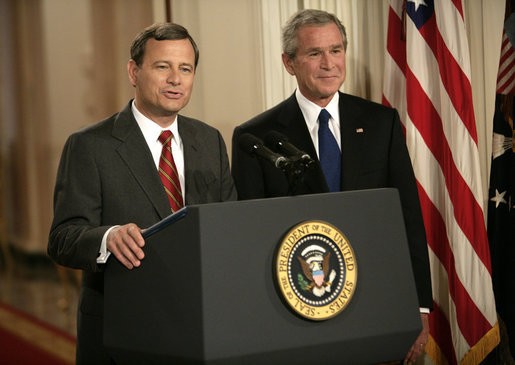
Photo of Chief Justice John Roberts and President Bush via DC Dicta.

I have often said that a major effect of any Presidency is the effect of its Supreme Courts appointments. Even after an administration is long gone, its life-time appointees continue to to make rulings which affect all of our lives.

In "The Chief Justice on the Spot."Greenhouse, the former NYT Supreme Court reporter who is a Knight Distinguished Journalist-in-Residence and Joseph M. Goldstein Senior Fellow at the Yale Law school, wrote January 9,
A case sitting quietly in the Supreme Court’s in-basket promises to tell us more than almost any other about John G. Roberts Jr. and his evolution from spear carrier in the Reagan revolution to chief justice of the United States — and in the process set the direction of the debate over race and politics for years to come.
Greenhouse was writing about a voting rights case, but she just as easily could have been writing about a mining case currently before the Supreme Court. And while that case involves gold mining in Alaska, it has relevance for the continued expansion of mountaintop removal coal mining here in Appalachia. That's because the Alaska case involves dumping mine waste in bodies of water, a practice which makes MTR more feasible.

With this case, we can look at one more piece of the Bush legacy. First, because of regulations promulgated by the administration. Second because of the Bush nomination of John Roberts as the Chief Justice of the Supreme Court. The Clean Water Protection Act proscribed dumping mine waste in bodies of water. But , faced with suits about violations of the Act, Bush's Army Corps of Engineers redefined that waste as "fill." And, although it was not widely discussed at the time of his nomination, Roberts, before he took his seat, acted as "spear carrier" when he advised the National Mining Association pro-bono on how to deny citizens standing in environmental cases/ And then, two years later, he hired on to argue on behalf of the association against citizens trying to stop coal companies from shearing off West Virginia's mountains.

The case before the Supreme Court

In the mining case being argued today, Coeur Alaska, Inc. v. Southeast Alaska Conservation Council, et al. and Alaska v. Southeast Alaska Conservation Council, et al., the Army Corps of Engineers granted a permit for a gold mine north of Juneau, Alaska, to the company Coeur Alaska. The permit allows the company to deposit mine tailings into Lower Slate Lake after raising the level of the lake by building a long earthen dam. Tom Turner (bio, email) , editor at large for the public interest law firm EarthJustice, wrote January 9 on the Coeur case,

All agree that the tailings, fill or otherwise, would kill nearly all life in the lake. Coeur and the Corps insist that once the ore has been exhausted they’ll restore the lake to its former glory and where have we heard that before.

According to another Martin post today, a mining company attorney told the court that an Alaskan lake would be better off in the long run and

Justice David Souter described that logic as "Orwellian."

Tom Waldo, an attorney in Earthjustice's Juneau office argued the case at the Supreme Courttoday on behalf of the Southeast Alaska Conservation Council, Lynn Canal Conservation, and the Sierra Club. Here’s their brief and information on their victories to date.

The troubling implications of the case

Turner explains,

That the high court agreed to review the case is troubling—if it had left the appeals court decision alone all would have been well. Should the Court uphold the Corps’ authority to discharge mine waste in a pristine waterway, all waters everywhere could be at risk and the Clean Water Act would be in a shambles.

That the court agreed to review the case is especially troubling, to my mind, given Benjamin Wittes's observation in the May 2005 issue of The Atlantic that,

the threat to basic environmental protections from conservative jurisprudence is broad-based and severe...By tightening doctrinal requirements that limit citizen access to the courts, judges greatly reduce the legal accountability of polluters.

Roberts and the coal industry

As I wrote for the New River Free Press at the time of Roberts's nomination,

In 1999, as a partner in the Washington, DC law firm of Hogan & Hartson, Roberts’s lecture before the NMA’s conference offered "several pointers" on how the group might get their views heard by judges.

In the 1999 landmark case of Bragg v. Robertson, the now-deceased U.S. District Judge Charles H. Haden II limited mountaintop removal coal mining, finding that a stream buffer zone rule prohibiting mining within 100 feet of waters, barred coal companies from burying larger streams with strip mine waste.

The NMA was not a direct party in the case; instead, it hired Roberts and two other attorneys at his firm of Hogan & Hartson to file a "friend of the court" brief in the 4th U.S. Circuit Court of Appeals, saying the ruling "jeopardize[d] the continued viability of the coal industry in Appalachia and elsewhere."

The brief also argued that Haden had allowed citizens to "circumvent" an administrative process to appeal permit decisions to the state Surface Mine Board. "Such a result eviscerates the very process Congress established to coordinate the various regulatory programs applicable to coal mining, and creates grave uncertainty for the members of the coal industry who rely upon mining permits as the blueprint for compliance with these programs."

In its April 2001 decision, the 4th Circuit overturned Haden, saying the dispute instead belonged in state court [where the coal companies hold more sway.]
The Supreme Court decision in the Alaska case, not expected until June, will fill in another piece of the puzzle of the legacy of George W. Bush. The position Roberts takes will reveal whether he continues pro-mining bent or departs from it in his current role. And if the Roberts Court upholds dumping in streams, it will setting a destructive precedent for mountains and for clean water, unless the Obama Administration and Congress provide relief.

1/8/09

Foreshadowing the Bush Legacy on Coal

Photograph by J. Miles Carey of the Knoxville News Sentinel accompanied December 25's NYT story by Shaila Dewan, "Coal Ash Spill Revives Issue of Its Hazards."

*

leg·a·cy (lg'-s)--The American Heritage Dictionary of the English Language
  1. Money or property bequeathed to another by will.
  2. Something handed down from an ancestor or a predecessor or from the past
In these final weeks leading up to the inauguration of President Barack Obama, the media has turned to writing stories on the legacy of George W. Bush. In the past, I've written on Mr. Bush's record on torture, secrecy, the unitary executive, concentration of wealth, the increasing deficits, the economic downturn (recession, depression?), warrantless domestic spying, reproductive rights, children's health care, organized labor and the erosion of civil liberties under the Patriot Act.

To assess what has been handed down from his eight years in office is doable. To write about what will last long term is harder. One exception, though, comes to mind: here in Appalachia, we face a permanent hole in our vistas (and our lives) in the wake of so-called mountaintop removal mining (MTR). So-called because I prefer to call it Mountain Range Destruction. This type of mining pulverizes whole mountains for their underlying coal and dumps the resulting toxin-laden rubble in headwater streams. I'd love to provide you with the latest figures on the extent of this destruction and how much has occurred during the Bush administration, but I cannot find the data. And while I might consult with Ken Ward, Jr. over at the Charleston Gazette for arcane sources, right now he's covering the coal sludge spill pictured above.

In looking at the Bush legacy on coal, in the past, I've written about:
  • the National Mining and Health Safety Administration including
    • the firing of West Virginia mining engineer Jack Spadaro for refusing to sign on to the final report on the Martin County coal sludge spill
    • the appointment of industry officials in a case of "foxes guarding the henhouse
    • the result on the weakening and stalling of regulations to protect miners
    • resistance to the Supplemental Mine Improvement and New Emergency Response Act of 2007, in which George Miller (D-CA) attempted to address weaknesses in the MINER Act of 2006, passed as a result of West Virginia's Sago mine disaster and subsequent mining deaths in West Virginia and Kentucky.
  • the Army Corps of Engineers and its redefinition of "waste" to "fill" in the Clean Water Act, which reversed court rulings preventing MTR rubble from being dumped into valleys
  • the unsuccessful attempts to pass the Clean Water Protection Act to reverse the rule.
  • the midnight change which canceled the Stream Buffer Zone rule which said that mining companies may not dispose of the rubble within 100 feet of an intermittent or perennial stream, unless the company can prove the mining activity won't hurt water quality or quantity. Environmental lawyers had successfully used this rule in court to stop MTR permits. For examples, see Ohio Valley Environmental Coalition v. the Army Corps of Engineers on October 11, 2007 and before that the Haden decision in favor or Kentuckians for the Commonwealth From May 8, 2002.
  • the ties of Supreme Court Chief Justice John Roberts to the coal industry prior to his nomination and how he fought against citizen standing in environmental suits.
I'll add links to the above, as time allows. Today, though, I thought I'd go back to almost the very start of the administration, to January 29, 2001, and look at how it went on to foreshadow his legacy on coal. That's the day George W. Bush signed the executive order establishing The National Energy Policy Development Group, more commonly known as the Cheney Energy Task Force, whose recommendations served as the basis of Joe Barton's (R-TX) Energy Policy Act of 2005 which included a lot of money for the coal industry including funding for things I questioned before such as coal-to-liquids and "clean coal." The task force revealed, like later events, the administration's penchant for public secrecy and its alignment with the interests of, among others, the coal and the primarily coal-fired electric power industries.

The National Energy Policy Development Group
aligns closely with industry

The task force, working quickly, produced its National Energy Policy report by May 16, 2001. The composition of the task force, according to the report, was confined to government officials. It prominently featured a quote by the president
America must have an energy policy that plans for the future, but meets the needs of today. I believe we can develop our natural resources and protect our environment.
Sounds good, as do so many turns of phrase, starting with "compassionate conservative." The plan's recommendations, however, often looked like a wish list from industry. For instance, the President should:
  • issue an Executive Order to direct all federal agencies to include in any regulatory action that could significantly and adversely affect energy supplies, distribution, or use, a detailed statement on: (1) the energy impact of the proposed action, (2) any adverse energy effects that cannot be avoided should the proposal be implemented, and (3) alternatives to the proposed action.
  • direct the Secretary of Energy to explore potential opportunities to develop educational programs...long-term in nature...funded and managed by the respective energy industries, and should include information on energy’s compatibility with a clean environment.
  • [increase funding for]the Low Income Home Energy Assistance Program [LIHEAP [which is used primarily to pay energy bills for low-income individuals[and]... allow funds dedicated for the Weatherization and State Energy Programs to be transferred to LIHEAP
  • [put] FEMA...[in charge of planning for how to address] power shortages
  • direct the EPA Administrator to work with Congress to propose legislation that would establish a flexible, market-based program to significantly reduce and cap emissions of sulfur dioxide, nitrogen oxides, and mercury from electric power generators...over a reasonable period of time to allow utilities to make modifications to their plants without fear of new litigation [note no carbon dioxide caps]
  • direct the Secretary of the Interior to work with Congress to create the “Royalties Conservation Fund”... [to] earmark potentially billions of dollars in royalties from new oil and gas production in ANWR [the Alaska National Wildlife Refuge.
  • issue an Executive Order...directing federal agencies to expedite permits and other federal actions necessary for energy related project approvals on a national basis.
  • [direct]to propose appropriate funding of those [energy efficiency] research and development programs that are...modeled as public-private partnerships.
  • direct the Department of Energy to continue to develop advanced clean coal technology by...[i]nvesting $2 billion over 10 years to fund research in clean coal technologies [and] Supporting a permanent extension of the existing research and development tax credit.
  • direct federal agencies to provide greater regulatory certainty relating to coal electricity generation through clear policies that are easily applied to business decisions.
You get the idea. You can read other examples here.

The court fight to reveal who met with Cheney and the Task Force regarding the report

In April 2001, Representatives Henry A. Waxman and John D. Dingell asked the Government Accountability Office (GAO) to examine the process and costs associated with the task force. Subsequently, Senators Joseph I. Lieberman, Ernest F. Hollings, Carl M. Levin, and Byron L. Dorgan, chairs of their respective committees or subcommittees, also requested this analysis.

After Cheney refused to cooperate, David Walker, the GAO's comptroller general sued for the information. On December 9, 2002, United States District Judge John D. Bates ruled against Walker. Walker did not pursue an appeal. The GAO, instead, issued an incomplete report on August 22, 2003.

The skewed task force recommendations also led Judicial Watch and the Sierra Club to sue for disclosure of just whom had met with Cheney and the task force and when. But, on June 24, 2004, the Supreme Court ruled, returning the case to the Court of Appeals for the District of Columbia.

At the time John Dean wrote that the election of John Kerry could make the suit moot. If Bush were re-elected, he noted

I remain hopeful that the underlying lawsuits in Cheney v. District Court will open the records of the National Energy Policy Development Group.

That is the right result legally and constitutionally - and the right outcome for our democracy. We deserve to know if private interests are unduly influencing purportedly governmental bodies.

Such was not to be: the court closed the book on disclosure, when it ruled May 10, 2005 that Cheney and the task force were not subject to the federal open meetings law.

An anonymous whistleblower emerges

And then years after all the stonewalling, the WaPo's energy reporter Steven Mufson heard from a whistleblower. On July 18, 2007, in Papers Detail Industry's Role in Cheney's Energy Report (transcript of chat with readers), Mufson wrote that a former White House official provided his paper with a copy of a
confidential list prepared by the Bush administration shows that Cheney and his aides had... held at least 40 meetings with interest groups, most of them from energy-producing industries.
And sure enough that list included the National Mining Association, Entergy (a company with coal-fired electric plants) and others. Mufson writes,
Jack N. Gerard, then with the National Mining Association, had a meeting with Lundquist and other staffers in February. He urged the administration to give the Energy Department responsibility for promoting technology for easing global warming and to keep the issue away from the Environmental Protection Agency, which could issue regulations on greenhouse gas emissions. The administration adopted that position.
All these meetings were held before a meeting with environmental groups on April 4, for which Cheney was not even present. And the official who supplied the list indicates
By the time of the meeting...the initial draft of the task force was substantially complete and President Bush had been briefed on its progress.
Rep. Henry A. Waxman (D-CA), chairman of the House Oversight and Government Reform Committee, who unsuccessfully pushed for details of the meetings, told Mufson
Six years later, we see we lost an opportunity to become less dependent on importing oil, on using fossil fuels, which have been a threat to our national security and the well-being of the planet.
And, I might point you to just how inefficient that dependence is, as I wrote about in the recent research of Stanford's Mark Jacobson, who found that
options [such as clean coal] that are getting the most attention are between 25 to 1,000 times more polluting than the best available options [such as wind].
And all of this dependence on coal continues to take its toll, the most recent example I wrote about being the massive fly ash spill right before Christmas at a coal-burning electric plant in Tennessee.

December 22, 2.6 million cubic yards (the equivalent of 525.2 million gallons, 48 times more than the Exxon Valdez spill by volume) of coal ash sludge ruptured a dike of a 40-acre holding pond at TVA's Kingston coal-fired power plant covering 400 acres up to six feet deep, damaging 12 homes and wrecking a train....

According to the EPA the cleanup will take at least several weeks, but could take years. Officials also said that the magnitude of this spill is such that the entire area could be declared a federal superfund site.

Of course, looks at legacy benefit from 20-20 hindsight. But isn't it interesting to see how even in his earliest days in office, the President was revealing a pattern which would emerge in the years to come, a pattern which will effect us for years in the future?

But to me, there's a larger question. While those who fail to study history are doomed to repeat it, is it really our best use of time right now to be writing about the Bush legacy? I think we've already had a lot of coverage on how Bush operated. The time for researching how Mr. Bush got us to where we are today is long gone and could be spent more wisely. Mother Jones (see, even we centrists in Appalachia quote her) said "Pray for the dead but fight like hell for the living." Translating that as a metaphor for journalism (and activism)--it's time to concentrate on holding Barack Obama accountable.

12/29/08

OSHA Compromised Under Bush


Photo of Peter Infante from Bill Moyer's 2001 program, Trade Secrets (transcript) about the compromise of health by the chemical industry.

One wonders about due diligence of the mainstream press, when we have an example of the Bush Administration pandering to industry in 2001 and 2002 appearing today in the Washington Post. In case you missed the significance of the chronology, that's over two years before Mr. Bush won re-election to his second term. Of course, as Bill Moyers showed in his 2001 program, "Trade Secrets," the dangers posed by the chemical industry was nothing new. What was new was the that political appointees
ordered the withdrawal of dozens of workplace health regulations, slow-rolled others, and altered the reach of its warnings and rules in response to industry pressure.
This according to "Under Bush, OSHA Mired in Inaction" by the WaPo's R. Jeffrey Smith.

In fact, the agency's first director under Bush, John L. Henshaw,
startled career officials by telling them in an early meeting that employers were OSHA's real customers, not the nation's workers. "Everybody was pretty amazed," one of those present recalled. "Our purpose is to ensure employee safety and health. ... He just looked at things differently."

Within two years, Henshaw, an industrial hygienist who had worked for Monsanto and another chemical firm, withdrew 26 draft regulations on OSHA's public calendar, including rules meant to limit workplace exposure to air contaminants, highly hazardous chemicals, and shipyard and scaffolding hazards.

Smith tells of Peter Infante (bio, Moyers interview, email), an epidemiologist at the Occupational Safety and Health Administration (OSHA) (actually, although Smith doesn't mention it, the Director of the Office of Standards Review) who tried to publish a bulletin
warning dental technicians that they could be exposed to dangerous beryllium alloys while grinding fillings. Health studies showed that even a single day's exposure at the agency's permitted level could lead to incurable lung disease.

Political appointees at the agency gave his copy to a lobbying firm for the country's principal beryllium manufacturer. Infante made what he deemed reasonable changes only to have the th elobbyists complain again. Eventually, despite objections from the senion staff, the politicos decided to publish the bulletin with a footnote challenging a key recommendation the firm opposed.

At that point Infante wrote the agency's director of standards in March 2002:
In my 24 years at the Agency, I have never experienced such indecision and delay
Infante ended up resigning in protest. Smith writes that that the result is
a legacy of unregulation common to several health-protection agencies under Bush: From 2001 to the end of 2007, OSHA officials issued 86 percent fewer rules or regulations termed economically significant by the Office of Management and Budget than their counterparts did during a similar period in President Bill Clinton's tenure, according to White House lists.
White House officials say their "objective is quality, not quantity," and that heavy restrictions on corporations harm economic performance.

Robert Harrison, a professor at the University of California at San Francisco and chairman of the occupational health section of the American Public Health Association disputes this:
The legacy of the Bush administration has been one of dismal inaction....like turning a ketchup bottle upside down, banging the bottom of the container, and nothing comes out. You shake and shake and nothing comes out.

12/18/08

Another 11th Hour Gift: Bush EPA guts CO2 emissions for new coal plants

Photo from Repower America's campaign to encourage the public to comment on its CO2 rulemaking encouraging regulation.

November 28 marked the EPA's deadline for public comment on "Regulating Greenhouse Gas Emissions under the Clean Air Act" (EPA-HQ-OAR-2008-0318), notice of which was filed July 11, 2008. NRDF had a similar campaign for regulating greenhouse gasses. Meanwhile, the Citizens Against Government Waste opposed EPA making a finding. While I haven't seen notice of a final rule, we can can probably guess which side won.

First, the Bush Administration gutted MTR rules. Then today, it gave a new parting gift to coal, saying that new power plants will not be required to install technology to reduce carbon dioxide emissions. You can find this latest in "EPA's Interpretation of Regulations that Determine Pollutants Covered By Federal Prevention of Significant Deterioration (PSD) Permit Program", a memo issued December 18 by EPA Chief Stephen L. Johnson.

David A. Fahrenthold and Steven Mufson wrote about the memo in "EPA Eases Emissions Regulations for New Power Plants" which will appear in tomorrow's WaPo. (Since the internet version is available before the print version, I can tell you that the paper will bury the item on the third page of the D section.)

Johnson's memo, according to the reporters
turns on a seemingly arcane regulatory question that could govern the future of new fossil fuel-burning buildings and power plants under the Clean Air Act.
Readers here know that the Bush EPA has flat-out ignored the 2007 Supreme Court ruling that greenhouse gases such as carbon dioxide should be regulated under the Clean Air Act just like other kinds of air pollution such as soot. The current memo is the latest in a Sierra Club legal challenge to the 2007 permit for a new coal-fired power plant in Bonanza, Utah that included no requirements to control carbon dioxide emissions.

The club argued before EPA's Environmental Appeals Board that given the Supreme Court ruling, the EPA must follow its own rule which required plants to use the best available technology to control all "regulated" pollutants. November 13 the Board held that the rule was unclear.

The Board denies review of the Region’s alleged failure to consider alternatives” to the proposed facility, but remands the permit to the Region for it to reconsider whether to impose a CO2 BACT limit and to develop an adequate record for its decision....

The administrative record of the Region’s permitting decision, as defined by
40 C.F.R. section 124.18, does not support the Region’s view that it is bound
by an Agency historical interpretation of “subject to regulation” as meaning
“subject to a statutory or regulatory provision that requires actual control of
emissions of that pollutant.” The Region did not identify in its response to
comments any Agency document expressly stating that “subject to regulation
under this Act” has this meaning.
Robert Meyers, the head of the EPA office of air and radiation, said in an interview with the reporters,
That is our established interpretation....We've been applying it that way for 30 years.
Meyers said he does not know if plants are positioned to receive final approval before President-elect Barack Obama takes office on Jan. 20. Officals "close to the president-elect's team, according to the reporters,
say that the Supreme Court ruling and the EPA's power to regulate carbon dioxide can serve as powerful levers to bring corporations and other parties to a bargaining table about broad framework for controlling greenhouse gases.
That's a little vague for me. I'd much rather hear that permits will not be granted under the new administration without emission controls.

12/12/08

The Senate Torture Report


Cartoon by Simanca Osmani, Brazil.

I've written before about the Survival Evasion Resistance and Escape (SERE) training techniques, originally designed to help captured members of our military withstand torture, which were then used as "agressive" interrogation techniques of detainees in U.S. custody.

Well, yesterday, Senate Armed Services Committee Chairman Carl Levin (D-MI) and Ranking Member John McCain (R-AZ) released a report, "Senate Armed Services Committee Inquiry into the Treatment of Detainees in U.S. Custody (executive summary and conclusions)" which in major part looked at the influence of the SERE techniques.

The Committee concluded that the authorization of such techniques by senior officials was both a direct cause of detainee abuse and conveyed the message that it was okay to mistreat and degrade detainees in U.S. custody.

Levin said,

SERE training techniques were designed to give our troops a taste of what they might be subjected to if captured by a ruthless, lawless enemy so that they would be better prepared to resist. The techniques were never intended to be used against detainees in U.S. custody.

Senator McCain added,

The Committee’s report details the inexcusable link between abusive interrogation techniques used by our enemies who ignored the Geneva Conventions and interrogation policy for detainees in U.S. custody. These policies are wrong and must never be repeated....The abuses at Abu Ghraib, GTMO and elsewhere cannot be chalked up to the actions of a few bad apples. Attempts by senior officials to pass the buck to low ranking soldiers while avoiding any responsibility for abuses are unconscionable. The message from top officials was clear; it was acceptable to use degrading and abusive techniques against detainees. Our investigation is an effort to set the record straight on this chapter in our history that has so damaged both America’s standing and our security. America needs to own up to its mistakes so that we can rebuild some of the good will that we have lost.

Kinda nice to have McCain2K back, now that he's no longer running for prez and needs to kowtow to Mr. Bush in photo-ops where the later says he's "wink" against torture, while issuing signing statements to the contrary.

In "Pack of Liars," Dan Froomkin does a nice job over at the WaPo of summarizing the report, ading some additional background and linking to other coverage. As he writes,

Yesterday's bipartisan Senate report on the abuse of detainees in U.S. custody at Guantanamo, Abu Ghraib and elsewhere doesn't just lay out a clear line of responsibility starting with President Bush, it also exposes the administration's repeated explanation for what happened as a pack of lies.
See also:

12/11/08

Broken Government

Cover Art for Broken Government: An assessment of 128 executive branch failures since 2000, issued December 10 by the Center for Public Integrity.

The Center for Public Integrity blog for December 9 announces its new report, "Broken Government" with a formal publication date of tomorrow. For those of you unfamiliar with the center, it produces "original investigative journalism about significant public issues to make institutional power more transparent and accountable." Its newest report
tell[s] the story of what has gone wrong with our government over the last administration — and what needs to be fixed by the next one.
The Center asks that go to this form and add additional examples of
an important failure in a federal department or agency. Tell us why this is important, how it happened, and how it has directly affected citizens. And please tell us how you learned of the failure. If you can point us to any documentation, public or private, that would help make our coverage even stronger.
Here's a complete list of links to problems already enumerated in the report. You can also look up the failures by agency or by the categories of
Josh Israel (email) the project coordinator, also authored the September 2008 report, "Two-Party Debates: A Corporate-Funded, Party-Created Commission Decides Who Debates — and Who Stays Home," which was part of the Center's protect, The Buying of the President 2008.

In his introduction to Broken Government, Israel writes that
the pendulum appears to be swinging the other way in regard to regulation and the role of government, among Republicans as well as Democrats. It is thus an opportune moment to provide an inventory of just what’s broken — and perhaps a bit of a blueprint for just what needs fixing.
He outlines
examples of government breakdown in areas as diverse as education, energy, the environment, justice and security, the military and veterans affairs, health care, transportation, financial management, consumer and worker safety, and more — failures which adversely affected ordinary people and made the nation a less open or less secure place to live. While some are, by now, depressingly familiar, many are less well known but equally distressing.

He says that while

the list is diverse, it also reflects some recurring — and troubling — themes. Some of these problems were in place well before George W. Bush’s inauguration, but were exacerbated by his policies or worsened by his administration’s actions (or inactions). Many of the failings are tied to Bush appointees who appear to have been selected primarily on the basis of ideology and loyalty, rather than competence.
Some examples of his list, which he terms "stark" are:
  • a National Aeronautics and Space Administration inspector general who blocked multiple investigations — Republican Senator Charles Grassley said of his leadership: “I thought he’d be gone by now. . . . You’d like to have him get the message.”
  • a secretary of Housing and Urban Development who openly encouraged his staff to consider political affiliation when awarding contracts.
  • a team leading the Department of the Interior that was so flagrantly involved in political activity that the department’s own inspector general noted that “short of a crime, anything goes at the highest levels of the Department of the Interior.”
He also criticizes the administration for displaying
what’s at best a lukewarm interest in independent oversight, often siding with business over consumers and special interests over the public.
Hre are examples he highlights:
  • an Environmental Protection Agency that largely ignored and underutilized its own office and task force on children’s health, leaving the governmental entity responsible for air quality and other regulations without any “high level infrastructure or mandate” to protect children.
  • a Food and Drug Administration unable to guarantee food and drug safety — causing conservative Republican Congressman Joe Barton of Texas to repeatedlylast the agency for “stonewalling, slowrolling, and plain incompetency.”
  • a Federal Labor Relations Board that in the past year has been without a general counsel and the required quorum necessary to handle hundreds of complaints regarding unfair labor practices.
He also details how the federal government shifted its functions
from public employees to private contractors, as federal spending on contractors nearly doubled from FY 2001 to FY 2006, jumping from $234.8 billion to $415 billion. These contracts often lacked competitive bidding processes and effective oversight and suffered from cost overruns and poor execution.
Another troubling trend, he contends is how
the White House and its political appointees have frequently inserted themselves into matters of science, overruling experts and suppressing reports that did not coincide with the administration’s philosophy. The nonpartisan Union of Concerned Scientists warned that “political interference in federal government science is weakening our nation’s ability to respond to the complex challenges we face.”
He quotes Thomas E. Mann (email, website), Congressional scholar and senior fellow at the Brookings Institution:
I think we’ll look back on this period as one of the most destructive periods in American public life . . . both in terms of policy and process,” , told the Center. “The broken government is not limited to one end of Pennsylvania Avenue; it involves the executive and legislative branches, which both contributed to embracing policies and actions that have come back to haunt us.
He then traces how we arrived at this state, going back to the presidency of Ronald Reagan when the Republican Party, in large part, started to criticize federal government, saying it
operates inefficiently, and is more often part of the problem than part of the solution. That philosophy has underscored a continuing quest to dismantle pieces of the federal government and to regulate as little as possible. Reagan famously joked that “the nine most terrifying words in the English language are: "I’m from the government and I’m here to help."
Democrats, according to Israel continued the trend:
Bill Clinton and Al Gore were elected in 1992 promising to “reinvent government,” eliminate excessive regulation, and cut the size of government. Clinton’s “Putting People First” plan called for a 25 percent reduction in the White House staff and elimination of 100,000 jobs in the bureaucracy, and the 42nd president largely delivered. Amid outsourcing, government shrinkage, and deregulation, Clinton declared, “The era of big government is over.”
George Bush, of course, did likewise:
In his first address to Congress in 2001, Bush declared: “Government has a role and an important role. Yet too much government crowds out initiative and hard work, private charity, and the private economy. Our new governing vision says government should be active, but limited; engaged, but not overbearing.”
And yet, ironically, Cheney also sought to strengthen the presidency:
Behind the limited government mantra was the gnawing perception — pushed hard by Vice President Dick Cheney — that the reforms of the postWatergate era had dangerously weakened the presidency. Cheney and others in the administration thus began advocating a more “unitary executive” — a vision of the president as a singularly powerful chief executive. Over time, Bush enthusiastically bought in. The concept of the “unitary executive” only further empowered Bush and his allies as they plowed forward with their vision of spending cuts, deregulation, and concentration of power within the confines of White House.
Presidential historian Robert Dallek (email, website), professor emeritus at UCLA, told Israel,
In my judgment, there’s a clear connection between the Bush administration’s governing philosophy and the abuse of power we have seen in the last eight years...The Bush-Cheney assumption has been that the post-Watergate reforms weakened the presidency and a president’s ability to deal with foreign dangers. Much of what they have done has been an attempt to right this so-called imbalance. The result has been a resurgence of the imperial presidency.
Brooking's Mann added,
We saw genuine distortion in the constitutional system, an exaggerated sense of
presidential power and prerogative and acquiescence by a Republican Congress in the face of the first unified Republican government since Dwight Eisenhower...That led to abuses. Certainly, it led to bad policies, because Congress wasn’t challenging
the executive along the way and overseeing it. And I think it encouraged a diminution in the capacity of government to deal with important problems.
Israel then traces the effects of 9-11, Katrina, and the current financial melt-down as a
a series of cataclysmic events has started to change the nation’s view of what the government’s role should be — and has necessarily altered some of the administration’s approach to governing. Those events have also put new strains on federal operations and have brought the consequences of federal failure into sharper relief.
Of 9-11, Israel writes,
The Bush administration determined that in order to keep the nation safe from further acts of terrorism, a major expansion of law enforcement, intelligence, and military operations was required. While no major terrorist acts have occurred on American soil since, the dramatic growth of the nation’s security apparatus has been a messy, expensive process involving missteps, bureaucratic turf battles, and the creation of the Department of Homeland Security — the largest government reorganization since 1947.
With regard to Katrina in 2005, he adds that the hurricane
which killed a reported 1,698 people — and in the process laid bare a response that was chaotic at best, dysfunctional at worst. The breakdown in emergency response at all levels of government also demonstrated that some catastrophes and crises are so large that they truly require federal government organization and management.
He maintains that that the attempted bail-out of the financial sector the administration has
caused many to conclude that deference to the “trust us” mantra of Wall Street and unquestioned faith in the free market’s ability to selfregulate
required rethinking.
Meanwhile, to all this, he adds the effects of globilization:
Increased trade with other countries has resulted in a flood of new imports that must be monitored for both safety and homeland security. A host of scares involving dangerous food, drug, and toy imports have made clear the need for more oversight of products manufactured overseas. Meanwhile, cargo holds carrying potentially dangerous weapons require port security officials to screen more freight than ever before.

12/5/08

National Academy of Sciences: Current EPA reviews hinder useful and timely regulation


December 5 cartoon by David Horsey.

The NYT's Cornelia Dean on December 3: "Panel Seeks Changes in E.P.A. Reviews"
The Environmental Protection Agency must revise its approach to assessing environmental health hazards and other risks, because current practices hinder useful and timely regulation, an expert panel of The National Research Council says. The council, the research arm of the National Academy of Sciences, said the agency should scrap some of the assumptions on which its decisions have been based and reduce its focus on individual chemicals and other hazards to consider how they act in combination. It should also accept that uncertainty was always an issue and seek to provide practical information to policy makers as quickly as possible. The report, which the panel produced at the behest of the E.P.A., was made public Wednesday and is online at www.nas.edu. [Science and Decision: Advancing Risk Assessment] Determining whether something is a hazard and, if so, how great and to whom is a crucial step in devising appropriate environmental regulations, the panel said, and the field is advancing as testing systems and other technology advance. But assessing environmental risks is highly complex and full of uncertainty, it continued, and at the E.P.A., “the regulatory risk-assessment process is bogged down,” with some assessments taking a decade or more. For example, the report cited an assessment of trichloroethylene, a commonly used solvent, that has been under way since the 1980s and is not expected before 2010. The environmental agency’s conclusions about risk are usually crucial in establishing regulatory goals. As a result, they are often subject to intense political or economic pressure. When the Bush administration proposed changes that it said would streamline risk-assessment procedures, critics called the proposal an effort to weaken environmental regulation. In a 2007 report, the academy dismissed the proposal as “fundamentally flawed,” and it was withdrawn.

12/3/08

Scott Horton

In "Justice after Bush: Prosecuting an outlaw administration" Scott Horton in the December Harpers writes,

Americans may wish to avoid what is necessary. We may believe that concerns about presidential lawbreaking are naive. That all presidents commit crimes. We may pretend that George W. Bush and his senior officers could not have committed crimes significantly worse than those of their predecessors. We may fear what it would mean to acknowledge such crimes, much less to punish them. But avoiding this task, simply “moving on,” is not possible.
His article will be the springboard for a December 4 forum at NYU forum, After Torture: Discussing a Plan for Justice in the Post-Bush Era.

12/2/08

Bush's "Right of Conscience"


Cartoon by Eleanor Mill, who I hadn't realized died July 19. 2008 To check out her art by topic, you will have to substitute her initials (em) for those of another artist according to keyword. For instance, http://www.newsart.com/em/em240.htm shows her cartoons on pregnancy and fertility.


The LAT's By David G. Savage for December 2, 2008: "Broader medical refusal rule may go far beyond abortion: The Bush administration plans a new 'right of conscience' rule that would allow more workers to refuse more procedures. Critics say it could apply to artificial insemination and birth control."

The outgoing Bush administration is planning to announce a broad new "right of conscience" rule permitting medical facilities, doctors, nurses, pharmacists and other healthcare workers to refuse to participate in any procedure they find morally objectionable, including abortion and possibly even artificial insemination and birth control. For more than 30 years, federal law has dictated that doctors and nurses may refuse to perform abortions. The new rule would go further by making clear that healthcare workers also may refuse to provide information or advice to patients who might want an abortion. It also seeks to cover more employees. For example, in addition to a surgeon and a nurse in an operating room, the rule would extend to "an employee whose task it is to clean the instruments," the draft rule said. The "conscience" rule could set the stage for an abortion controversy in the early months of Barack Obama's administration.

see: "Right of Conscious as a Parthian Shot" by Leslie Anne Catlett of Poughkeepsie AKA didionsmommy. The definition, BTW, is

a hostile remark or gesture delivered while departing [from the custom of archers from Parthia, an ancient Asian empire, who shot their arrows backwards while retreating]

11/29/08

Eleventh Hour Regs on Toxins

The NYT's Robert Pear today, "Bush Aides Rush to Enact a Rule Obama Opposes,"

The Labor Department is racing to complete a new rule, strenuously opposed by President-elect Barack Obama, that would make it much harder for the government to regulate toxic substances and hazardous chemicals to which workers are exposed on the job. The rule, which has strong support from business groups, says that in assessing the risk from a particular substance, federal agencies should gather and analyze “industry-by-industry evidence” of employees’ exposure to it during their working lives. The proposal would, in many cases, add a step to the lengthy process of developing standards to protect workers’ health. Public health officials and labor unions said the rule would delay needed protections for workers, resulting in additional deaths and illnesses. With the economy tumbling and American troops fighting in Iraq and Afghanistan, President Bush has promised to cooperate with Mr. Obama to make the transition “as smooth as possible.” But that has not stopped his administration from trying, in its final days, to cement in place a diverse array of new regulations. The Labor Department proposal is one of about 20 highly contentious rules the Bush administration is planning to issue in its final weeks. The rules deal with issues as diverse as abortion, auto safety and the environment. One rule would make it easier to build power plants near national parks and wilderness areas. Another would reduce the role of federal wildlife scientists in deciding whether dams, highways and other projects pose a threat to endangered species. Mr. Obama and his advisers have already signaled their wariness of last-minute efforts by the Bush administration to embed its policies into the Code of Federal Regulations, a collection of rules having the force of law. The advisers have also said that Mr. Obama plans to look at a number of executive orders issued by Mr. Bush. A new president can unilaterally reverse executive orders issued by his predecessors, as Mr. Bush and President Bill Clinton did in selected cases. But it is much more difficult for a new president to revoke or alter final regulations put in place by a predecessor. A new administration must solicit public comment and supply “a reasoned analysis” for such changes, as if it were issuing a new rule, the Supreme Court has said.

11/12/08

Congressional Review Act could reverse Bush's lame duck deregulation

It looks like I scooped MSNbc's Rachel Madow by months with" New FBI Guidelines: More COINTELPRO?"Although many of Bush's new regulations have to do with energy and the environment, MSNBC's Rachel Maddow noted (video) on Tuesday that there's also
one that'll kick opponents of the Patriot Act right in the teeth....would allow state and local law enforcement agencies to collect intelligence on individuals and organizations even if the information is unrelated to any criminal matter...Even if they weren't already watching you -- they soon could be.

According to Al Giordano, Obama-Biden Transition Co-Chair John Podesta told a "pad and pen only" press conference call that
Every Executive Order by Bush is Under Review: Those that Obama promised during the campaign to rescind, will be eliminated immediately.
I'm not sure exactly what the promised list included and Giordano doesn't seem to have asked. After all, after making promises to the contrary, our president-elect voted for retroactive telecom immunity.

Interestly, in "Dems eye midnight regulations reversal" by Erika Lovely and Ryan Grim (update by Grim) reports that the Bush administration plan to require that Obama take years to undo climate rules finalized more than 60 days before January 20 failed to take into account the Congressional Review Act of 1996:
Any regulation finalized within 60 legislative days of congressional adjournment is considered to have been legally finalized on the 15th legislative day of the new Congress, likely sometime in February. Congress then has 60 days to review it and reverse it with a joint resolution that can’t be filibustered in the Senate.
In other words, any regulation finalized in the last half-year of the Bush administration could be wiped out with a simple party-line vote in the Democrat-controlled Congress.
An unnamed senior aide on the Senate Environment and Public Works Committee, chaired by Sen. Barbara Boxer (D-CA), acknowledged to Politico that her committee is considering the option. Eben Burnham-Snyder, spokesman for House Global Warming Committee Chairman Ed Markey (D-MA), went on record:
On egregious rule-makings that would have a detrimental effect on energy and environmental policy, [the CRA] speeds up the process for rescinding the bad rule...It’s something Markey is seriously looking into.
According Politico, Congress last used the CRA in 2001 to overturn a Clinton administration rule that set new requirements for ergonomic work spaces. CRA targets may include:
  • a rule to allow federal agencies to determine on their own whether their policies will threaten endangered species, rather than requiring them to go through the U.S. Fish and Wildlife Service for approval
  • regulations opening land in the West to oil shale development

and best of all,
  • elimination of the stream barrier rule that eases mountaintop removal
In case you're wondering where to find the law, it passed as part of H.R.3136, the Contract with America Advancement Act of 1996 passed on March 28, 1996. This act amended Title 5, United States Code, by adding an eighth chapter, "Congressional Review of Agency Rulemaking." Here's the explanation of the bill from the Congressional record of April 16, 1996 from Senators Harry Reid (D-NV), and former Senators Ted Stevens (R-AK) and Don Nickles (R-OK)
In the 104th Congress, four slightly different versions of this legislation passed
the Senate and two different versions passed the House. Yet, no formal legislative history document was prepared to explain the legislation or the reasons for changes in the final language negotiated between the House and
Senate. This joint statement of the authors on the congressional review subtitle is intended to cure this deficiency....

As more and more of Congress’ legislative functions have been delegated to federal regulatory agencies, many have complained that Congress has effectively abdicated its constitutional
role as the national legislature in allowing federal agencies so much latitude in implementing and interpreting congressional enactments. In many cases, this criticism is well founded.
Readers of this blog know about Stevens. Nickles retired in 2005 and now runs a pr firm, The Nickles Group.)

Want more information. Read Disapproval of Regulations by Congress: Procedure Under the Congressional Review Act issued October 10, 2001 by Richard S. Beth, Specialist in the Legislative Process for the Government and Finance Division of the Congressional Research Service. See also the CRS Congressional Oversight Manual Updated May 1, 2007.

In other interesting news, see the AP story: "Obama team expected to broker subpoena deal: President-elect seen as getting at least some information from Bush aides."


UPDATE: November 24, the CRS issued a new report, Midnight Rulemaking: Considerations for Congress and a New Administration by Curtis W. Copeland, Specialist in American National Government of the Government and Finance Division.

10/30/08

Bush's Eleventh Hour Deregulation


Still shot from the film 1984.

R. Jeffrey Smith writes in "A Last Push To Deregulate: White House to Ease Many Rules" for tomorrow's front page of the WaPo:
The White House is working to enact a wide array of federal regulations, many of which would weaken government rules aimed at protecting consumers and the environment, before President Bush leaves office in January.

The new rules would be among the most controversial deregulatory steps of the Bush era and could be difficult for his successor to undo. Some would ease or lift constraints on private industry, including power plants, mines and farms.

Those and other regulations would help clear obstacles to some commercial ocean-fishing activities, ease controls on emissions of pollutants that contribute to global warming, relax drinking-water standards and lift a key restriction on mountaintop coal mining.

Once such rules take effect, they typically can be undone only through a laborious new regulatory proceeding, including lengthy periods of public comment, drafting and mandated reanalysis.
I wish the article had provided an idea of where to find the specifics on the regulations or what I, as a citizen, might do, if anything, if I object to any of these last minute regulations. It did point to the fact that Clinton also issued many last minute regulations, which Bush was able to reverse because they had not yet taken effect and that Bush is trying to avoid such reversals by finishing the regulations earlier.

Diane Rehm had a program on October 28 on last minute regulations (link to the audio files--there's an $18 charge for an emailed transcript.) Her guests were WSJ energy reporter Stephen Power; Executive Director of NYU Law School's Institute for Policy Integrity Michael Livermore (email); and OMB Watch Executive Director Gary Bass.

Power's October 29 WSJ's blog entry, "White House Signals It's Flexible on Deadline for New Rules" emphasizes Livermore's charge that Bush is reversing a previous promise to have regulations in place by November 1, as well as Livermore's October 28 piece in Grist, "Bush administration missed its own memo." Livermore includes links to documents on how the administration has pushed back its promised deadline and to the October 27 post at The Pump Handle ( a blog on public health and the environment), "Bolten’s Memo on Midnight Regs? Ignore it. ? " which broke the story on the deadline reversal and some of them. Livermore is co-author with Richard L. Revesz (email) of Retaking Rationality: How Cost-Benefit Analysis Can Better Protect the Environment and Our Health (Oxford University Press, 2008). See also his report for NYU, The Cost-Benefit Compass, which provides the background to understand how cost benefit analysis can be used to give weight to human as well as business concerns.

The OMB Watch Blog, RegWatch, can help keep you apprised of developments in this area.

January 30, 2007, the NYT's Robert Pear published "Bush Directive Increases Sway on Regulation,"
In an executive order published last week in the Federal Register, Mr. Bush said that each agency must have a regulatory policy office run by a political appointee, to supervise the development of rules and documents providing guidance to regulated industries. The White House will thus have a gatekeeper in each agency to analyze the costs and the benefits of new rules and to make sure the agencies carry out the president’s priorities. This strengthens the hand of the White House in shaping rules that have, in the past, often been generated by civil servants and scientific experts. It suggests that the administration still has ways to exert its power after the takeover of Congress by the Democrats.


More later...

10/29/08

From the Pen of David Levine


"George W. Bush and puppet master Dick Cheney,"2004 by David Levine (website) from a show at the Forum Gallery.

See a slideshow of other portraits at the November Vanity Fair, which also includes an article, Levine in Winter,” by David Margolick, about Levine's work and his disappearance from The New York Review of Books due to macular degeneration. (Hat tip to Elaine Fleck for letting me know about the article.)

An archive of Levine's work at the Review is here.
On Election Day, November 4 Fantagraphics will publish American Presidents, a collection of artist David Levine’s commander-in-chief caricatures with a foreword by Bill Moyers.

9/29/08

President Bush on the Economy: He's no FDR

"Bailout Bonanza" by Nat Beeler in the September 26 Washington Examiner.

Given his behavior after 9-11, I cannot imagine Bush saying, as FDR did in his inaugural address on March4, 1933, that we have nothing to fear but fear itself. But look, too, at FDR's rhetoric of concerning the financial sector in that speech:
Only a foolish optimist can deny the dark realities of the moment....Practices of the unscrupulous money changers stand indicted in the court of public opinion, rejected by the hearts and minds of men....This nation is asking for action, and action now....There must be a strict supervision of all banking and credits and investments. There must be an end to speculation with other people’s money. And there must be provision for an adequate but sound currency.


Then look at President Bush's speech this morning on the bail-out plan for the financial sector, the Emergency Economic Stabilization Act. He sought to assure Americans that there is nothing wrong with business as usual and that
over time, much -- if not all -- of the tax dollars we invest will be paid back.
I have learned to supect such promises from this administration. Remember when Deputy Secretary of Defense Paul Wolfowitz testified before Congress on March 27, 2003 regarding Iraq,
There's a lot of money to pay for this. It doesn't have to be U.S. taxpayer money. We are dealing with a country that can really finance its own reconstruction, and relatively soon....oil revenues of Iraq could bring between $50 and $100 billion over the course of the next two or three years…We're dealing with a country that can really finance its own reconstruction, and relatively soon.

9/24/08

Gore calls for Civil Disobedience while Bush Supends Posse

Al Gore today at the Clinton Global Initiative:
I believe we have reached the stage where it is time for civil disobedience to prevent the construction of new coal plants that do not have carbon capture and

Meanwhile, Radley Balko, a senior editor of the libertarian Reason Magazine alerted readers today in a blog post to an item in the Army Times, "Posse Comiwhatus?" By staff writer Gina Cavallaro, the editors benignly titled it "Brigade homeland tours start Oct. 1: 3rd Infantry’s 1st BCT trains for a new dwell-time mission. Helping ‘people at home’ may become a permanent part of the active Army."

Of course, Army Times was reporting the actual deployment. A previous April 2008 piece in Stars in Stripes provided the outlines of upcoming plans.

It once was the case that Republicans used the term "martial law" metaphorically to refer to the de-democratization of the legislative process. But the Defense Authorization Act of 2006, passed on Sept. 30, gave Bush literal martial law powers, as noted in Congressional Quarterly. The American Conservative questioned such power in April 2007 . And back on August 8, 2005, WaPo staff writer Bradley Graham wrote a front page story, " War Plans Drafted To Counter Terror Attacks in U.S.: Domestic Effort Is Big Shift for Military. The military officials quoted in the article didn't seem to envision the type of deployment we are now reading about.

The war plans represent a historic shift for the Pentagon, which has been reluctant to become involved in domestic operations and is legally constrained from engaging in law enforcement. Indeed, defense officials continue to stress that they intend for the troops to play largely a supporting role in homeland emergencies, bolstering police, firefighters and other civilian response groups.

For background, see the former a FEMA director's opinion that the Posse Comitatus rule allows the President and Congress to order the military to police domestically. Contrast this with an article from llrx on the historic interpretation of the Act. You can find another article at Antiwar.com which questions what's going on.

9/21/08

Pentagon Threatens States over Environmental Cleanup of Bases

The Washington Post's Lyndsey Layton reported on September 19 in "States Accuse Pentagon Of Threats, Retaliation:Allegations Arise in Base Cleanup Hearing" that the previous day, the Environmental Council of States testified that when environmental officials from California, Colorado, Alabama, Ohio and about a dozen other states tried to force to clean up polluted military sites, the Defense Department retaliated by reducing or withholding federal oversight dollars due them.

The disclosures came during a Senate hearing yesterday on the Pentagon's refusal to follow final orders from the Environmental Protection Agency to clean up three military bases: Fort Meade in Maryland, Fort McGuire in New Jersey and Tyndall Air Force Base in Florida.

Congress gives the Pentagon about $30 million annually to dispense to states with contaminated military bases, to help pay the states' costs to oversee cleanup of those sites.

But in 2006, the Pentagon began telling some states they would no longer receive money for various oversight activities and would lose all of the money if they took enforcement action.


9/11/08

Chafee on Palin: A "cocky wacko"


The assessment came, according to CNN today, when former Senator Lincoln Chafee (R-RI) was at the New America Foundation on September 9 to discuss (video) his book, Against the Tide: How a Compliant Congress Empowered a Reckless President.

9/10/08

Charlie Savage: Sex, Drugs and Graft at Interior

The NYT's Charlie Savage writes today three reports delivered to Congress by Interior's Inspector General Earl E. Devaney, which find

wrongdoing by a dozen current and former employees of the Minerals Management Service, which collects about $10 billion in royalties annually and is one of the government’s largest sources of revenue other than taxes.

9/8/08

Balancing Safety and Freedom


Cover of Louis Fisher's booking coming out this month, The Constitution and 9/11 from the University Press of Kansas (ISBN 978-0-7006-1600-8)

He writes,
The announced purpose of U.S. antiterrorist policies after 9/11 was to bring democracy and the rule of law to the Middle East. At home, those values were regularly threatened by illegal, unconstitutional, secret, and unaccountable programs. The Bush administration claimed that terrorists hate America for its freedoms, yet its actions jeopardized those freedoms and brought the reputation of the United States lower in the eyes of the world.
On October 17, 2008, those of you in VT or nearby states might want to be over at the Chase Community Center of the Vermont Law School in South Royalton to attend the Vermont Law Review Symposium: Examining Our Priorities: Balancing National Security With Other Fundamental Values, where Fisher will be the keynote speaker.

He's a constitutional law scholar with the Library of Congress, whom I got to hear speak in DC, along with Charlie Savage. Panel topics will include immigration, environmental law, protecting library records, and the right to dissent. Another speaker will be reporter Will Potter on "The Threat of Unpopular Ideas,” including domestic “eco-terrorism” and “domestic terrorism” laws like the Animal Enterprise Terrorism Act.

8/22/08

Bush moves to shield anti-abortion health care workers

As the Bush Administration counts down its last days, it announced 8/21/08 the beginning of a thirty-day comment period on a new rule that would empower federal health officials to stop funding more than 584,000 hospitals, clinics, health plans, doctors' offices and other entities if they do not accommodate health-care workers who object to abortion. The regulation would cover
participating in any activity with a reasonable connection to the objectionable procedure, including referrals, training, and other arrangements for offending procedures.
The WaPo's Rob Stein reports August 22 in "Protections Set for Antiabortion Health Workers: Opponents Denounce Proposed Regulation Allowing Federal Officials to Pull Funding" that the the regulation would cost more than $44 million to implement and that Health and Human Services Secretary Mike Leavitt justified the rule, saying,
People should not be forced to say or do things they believe are morally wrong...Health-care workers should not be forced to provide services that violate their own conscience.

When asked whhether the regulation would protect health-care workers who consider birth control pills, Plan B and other forms of contraception to be equivalent to abortion, Leavitt said:
This regulation does not seek to resolve any ambiguity in that area. It focuses on abortion and focuses on physicians' conscience in relation to that.
Conservative groups welcomed the rule. David Stevens of the Christian Medical and Dental Association said,

I think this provides broad application not just to abortion and sterilization but any other type of morally objectionable procedure and research activity....We think it's badly needed. Our members are facing discrimination every day, and as we get into human cloning and all sorts of possibilities, it's going to become even more important.
Women's health advocates, family planning advocates, abortion rights activists and others, condemned the regulation, saying it could create sweeping obstacles to a variety of health services, including abortion, family planning, end-of-life care and possibly a wide range of scientific research. Said Robyn S. Shapiro, a bioethicist and lawyer at the Medical College of Wisconsin,
It's breathtaking....The impact could be enormous.