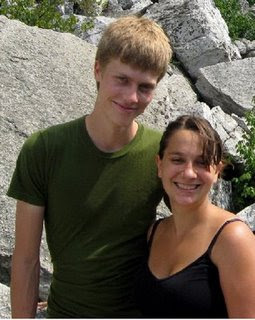
 Photograph
 via Glenn Greenwald of Monica Bicking (r.) and her friend Eryn Trimmer. Both were arrested at the Food Not Bombs communal house in St. Paul prior to the Republican convention's start, perhaps because they were volunteering at the RNC Welcoming Committee which had opened a convergence space for locals and visitors who wanted to protest at the RNC. Their preemptive arrests and others came as part of a joint operation between the Ramsey County Sheriff’s Department, the Minneapolis Police Department, and the FBI. Afterwards, in a news conference, Ramsey County Sheriff Bob Fletcher told Minnesota Public Radio and others, in reference to the the ironically named Welcoming Committee
We had sources working inside this organization.
*
Citizen surveillance: To expose, disrupt and otherwise neutralize?The post-Watergate
Church Committee documented citizen surveillance by the Central Intelligence Agency, National Security Agency, Internal Revenue Service and Federal Bureau of Investigation. COINTELPRO, the FBI's domestic surveillance program, had agents infiltrating protest and civil rights groups, among others,
"to expose, disrupt and otherwise neutralize" them.
On
April 30, 2001 , historian Howard Zinn (
email) wrote attorney
Dennis Cunningham (contact form) that based on his studies,
the FBI tactics, violating constitutional rights, described in the committee report,...[were] not confined to those years, [as] is clear from what...[the FBI] was doing before 1956 and after 1971.
More than seven years later, the FBI may continue to engage in its efforts "to expose, disrupt and otherwise neutralize," abetted by the mindset of the Bush administration's war on terror after the events of September 11, 2001.
While no one wants a repeat of such events, there is a legitimate debate about the balance between safety and civil liberties. As Senator Pat Leahy (D-VT), Chairman of the Senate Judiciary Committee
said on July 9 in introducing Attorney General Michael Mukasey,
On issue after issue...this administration makes the Watergate era look like child’s play.
And yet, Mukasey testified
statement,
webcast in RAM) that he was looking at consolidating the guidelines to grant more leeway in domestic surveillance.
Even before Mukasey's proposed new guidelines, Bobby Scott (D-VA) had introduced H. Res. 1211 on 5/20/2008, express the sense of the House that the current guidelines
should be rescinded and replaced by the former Guidelines ('Levi guidelines') to protect Americans from domestic Federal Bureau of Investigation spying in the absence of suspected criminal activity.
Scott's measure had no co-sponsors and has gone nowhere other than to be referred on to subcommittee. It appears to be facing the same dead end as
H. Res. 1026, Cynthia McKinney's (D-GA) 2006 call to reinstate the Church Committee.
When will they ever learn?
In "
History lessons never learned,"Geoffrey R. Stone (
email,
webpage), Edward H. Levi Distinguished Service Professor at the University of Chicago Law School, wrote in the August 29, 2007
Chicago Tribune that Mukasey's predecessor, Alberto Gonzalez, might have profited from the example of Edward Levi, who, in the wake of the Church Committee revelations issued the first
Attorney General Investigative Guidelines in 1976 which
reiterated and reaffirmed the rights of all Americans by clearly and carefully circumscribing the investigative authority of the FBI...[and] expressly prohibited the FBI from investigating, discrediting or disrupting any group or individual on the basis of protected 1st Amendment activity.
So, look Mukasey's proposed guidelines in context of
- his promotion of retroactive telecom immunity for warrantless surveillance, as enacted in the new FISA law
- the rule revision proposed July 31 to liberalize police intelligence-gathering by state and local police agencies; and
- the potential problems already spotlighted by the Electronic Privacy Information Center regarding state "fusion centers," which share surveillance information between the FBI, state and local agencies and others (for an example, see the Memorandum of Understanding between the FBI and Virginia State Police.)
All these factors, raise the question in my mind of whether Mukasey, too, has failed to learn the lessons of history.
It's not as if the current guidelines constrain citizen surveillance
John Ashcroft's
Attorney General's Guidelines on General Crimes, Racketeering Enterprise and Terrorism Enterprise Investigations, which Scott wants rescinded, specify that
Mere speculation that force or violence might occur during the course of an otherwise peaceable demonstration is not sufficient grounds for initiation of an investigation...but where facts or circumstances reasonably indicate that a group or enterprise has engaged or aims to engage in activities involving force or violence or other criminal conduct...in a demonstration, an investigation may be initiated...(my emphasis added)
That's a lot of wiggle room. The FBI's "October Plan,"
described on September 17, 2004, by CBS Correspondent Jim Stewart used
aggressive - even obvious - surveillance" techniques...people suspected of being terrorist sympathizers, but who have not committed a crime. Other "persons of interest," including their family members, may also be brought in for questioning.
There's also a lot of wiggle room, if you believe the account "
Moles Wanted," in the May 21, 2008
City Paper. Matt Snyders (
contact form) writes that an U. of Minnesota policeman and an FBI agent attempted to recruit a student who had turned himself in for spray painting an elevator
to show up at “vegan potlucks” throughout the Twin Cities and rub shoulders with RNC protesters, schmoozing his way into their inner circles, then reporting back to the FBI’s Joint Terrorism Task Force, a partnership between multiple federal agencies and state and local law enforcement.
You can read about a sweep of several houses prior to the RNC in Glenn Greenwald's accounts or in more detail in a variety of articles, videos and photographs at The Minnesota Independent, a project of the non-profit Center for Independent Media. You can also read Monica Bicking's brother Ian's thoughtful
take on the actual meaning of his sister's use of the term "anarchism." Also of interest is
Pioneer Press reporter Mara H. Gottfried's (
email)
account of journalist Amy Goodman (
email) questioning her arrest and that of other journalists at a news conference with St.Paul police chief John Harrington. And, after this was submitted to NewsTrust, I had a review from Jeanne Roberts, who wrote
this essay. She's a journalist who lives in Minneapolis and emailed me to say that she knows a couple of those arrested through her sons.
It's a terrible thing.... The Twin Cities are... primarily [a] ... community of Scandinavian/German heritage, meaning the people are calm, reasonable and thoughtful. Our diversity, mostly toward the inner cities, is as great as New York's, though on a smaller scale. This kind of thing doesn't happen here. We adults expect that kids will cut up (protest, riot, complain, cut classes and get mixed up with a few unsavory types in the process), and we take it with a grain of salt. The police have overreacted, and we are not pleased...
What sticks out in my mind in reading all of these articles and also the local mainstream media coverage is the possible conflation of crime and dissent and the curtailment of free speech. The police entered private homes with guns drawn with
warrants for items like paint, bottles, and rags--labeling them as "the ingredients for making Molotov cocktails,"-- supposed evidence of planned violence. Violence perhaps diametrically opposed the arrestees' beliefs. For instance, neighbors describe Monica Bicking as a committed, admirable activist, not a terrorist. (I will link, as soon as I can find the source again.)
As Bicking's attorney Bruce Nestor
said,
If they have evidence of a criminal act, then they should charge them...And if they can charge [my client, Monica Bicking] with a complaint, then we will go defend that in court. But right now they are just holding them. You can’t just hold [Bicking] to prevent her from exercising her free speech.
Problems, of course, weren't limited to St. Paul. In Denver, complaints about police spying on the Quakers and other non-violent activists date back to at least
2002. Prior to the Democratic convention this year,
the police asked first responders to report "stockpiling" of materials that could be used for violent protests including bicycles, maps and "FRS devices" (a
type of walkie talkie.) At the convention, police drew
the ACLU's attention for their
August 27 arrest of ABC News producerAsa Eslocker, who was investigating the role of lobbyists and big donors at the convention, as well as for denying legal representation to
protesters and bystanders arrested en masse on August 25. There was report of at least one
pre-emptive arrest at the DNC as well.
And remember the NYT
report from 2007 that teams of undercover New York City police officers traveled to cities across the country, Canada and Europe to conduct covert observations prior to the 2004 RNC?
The proposed Attorney General Investigative GuidelinesLara Jakes Jordan (
email) covers the Justice Department for Associated Press. For a July 2 story, she interviewed
[m]ore than a half-dozen senior FBI, Justice Department and other U.S. intelligence officials familiar with the new policy [who] agreed to discuss it only on condition of anonymity...
and
reported that while
[c]urrently, FBI agents need specific reasons — like evidence or allegations that a law probably has been violated — to investigate U.S. citizens and legal residents
the new guidelines would
let agents open preliminary terrorism investigations after mining public records and intelligence to build a profile of traits that, taken together, were deemed suspicious.
On August 13, Mukasey delivered
remarks in Portland to the Oregon Anti-Terrorism Conference and Training saying he hoped to have his new guidelines for FBI's intelligence activities within the United States
implemented and made public within the next few weeks...to eliminate distinctions in the existing rules that make it, in practice, harder to gather information about threats to the national security than it is to conduct "ordinary" criminal investigations.
He gave examples such as eliminating limits on how agents use information from informants, conduct surveillance based on tips and search databases. But, as
whistleblower Michael German, an FBI agent for 16 years now at the ACLU,
told Marisa Taylor (
email, story
archive) McClatchy's reported covering the Departments of Justice and Homeland Security,
I'm concerned with the way the attorney general frames the problem. He talks about arbitrary or irrelevant differences" between criminal and national security investigations, but these were corrections originally designed to prevent the type of overreach the FBI engaged in for years.
Asked about the guidelines in light of the
FBI seeking personal records of Americans by relying on national security letters, rather than seeking FISA court orders and the FBI secretly
obtaining reporters' phone records through exigent letters without following proper procedures, German said Mukasey needed to strengthen the guidelines, not "water them down."
Nobody's complaining about the FBI collecting domestic intelligence when it's appropriate and authorized under the law....What the attorney general is doing is expanding the bureau's intelligence collection without addressing the mismanagement within the FBI. If you have an agency collecting more with less oversight, it's only going to get worse.
Congress reactsOn August 18, Leahy and Ranking Member Arlen Specter (R-PA)
wrote Mukasey, asking that he postpone approval of his proposed guidelines.
On August 20, Senators Russ Feingold (D-WI), Ted Kennedy (D-MA), Richard Durbin (D-IL), and Sheldon Whitehouse (D-RI) also raised their concerns,
writing the Attorney General, asking that he delay signing the still-secret guidelines until "members of Congress, experts in the relevant fields, and affected communities have had a full opportunity to provide detailed input to the Department of Justice." They note that the guidelines were made available to congressional staff for
only a few hours at a time over the course of a week and a half – during the August congressional recess when many staff and members are out of town – does not constitute the kind of meaningful and robust consultation that we believe is called for, and that might help improve the guidelines. (my emphasis added)
So, why are folks concerned about the guidelines? The Senators wrote that (again, my emphasis added):
- The guidelines permit the FBI to use a variety of intrusive investigative techniques to conduct “assessments” of possible criminal activity, national security threats or foreign intelligence collection – without any initial factual predication. We are concerned about the extent to which such authority might, for example, permit the FBI to conduct long-term physical surveillance of an innocent American citizen; interview such an individual’s neighbors and professional colleagues, including based on a “pretext” or misrepresentation; recruit human sources to provide information on that individual; or conduct commercial database searches on that individual – all without any basis for suspicion. Moreover, the mechanisms that the FBI intends to use for approval and oversight of these new investigative tools have not been shared with Congress and yet are critical to understanding how these tools could be employed....the draft guidelines might permit an innocent American to be subjected to such intrusive surveillance based in part on race, ethnicity, national origin, religion, or on protected First Amendment activities.
- The guidelines permit the collection of foreign intelligence information inside the United States, through both “assessments” and predicated “full investigations,” with little explicit protection for information gathered about United States persons. The definition of “foreign intelligence” is broad, and covers any information relating to the activities of a foreign government, organization or person. We are concerned about the extent to which the FBI may be permitted to gather or use information about Americans under the rubric of foreign intelligence gathering when there is no suspicion of a crime, threat to national security, or any other wrongdoing.
- The draft guidelines include broad information-sharing provisions with few constraints ...[regarding] U.S. persons who are under no suspicion of wrongdoing.
The Land of the Free and the Home of the Brave?
Privacy International's (PI) studies national policies on constitutional protection, privacy enforcement and other factors, then scores countries along a scale from "consistently upholds human right standards" to "endemic surveillance societies." In its
2007 report, PI ranked the
United States with
Russia and
China as being among the worst.
In the absence of the publication of Mukasey's guidelines, it's hard for members of the public to evaluate the concerns raised by our Senators, but I find the further blurring of the lines between criminal actions and the First Amendment right to dissent chilling. As Glenn Greenwald wrote,
Those who are simply assuming that they probably got what they deserved -- and who are, more generally, defending the Police here simply because some actual criminals engaged in destructive behavior -- are no different than those who justify anything and everything the Government does because there are some Terrorists out there and they're really violent.
As Caroline Fredrickson, director of the ACLU’s Washington Legislative Office,
said in 2006 when hiring Michael German, its "a time when it’s hard to tell the difference between the morning paper and a George Orwell novel."
And as Reagan-era Justice Department official Bruce Fein
told Congress that same year,
This is a defining moment in the constitutional history of the United States, and on this issue I think we're all republicans and we're all democrats, to borrow from Thomas Jefferson's inaugural, because the issues that we confront with regard to checks and balances are indispensable to the liberty of those living and those yet to be born.
At 9:30 a.m. on September 17, the Senate Judiciary Committee will be
hearing from Robert S. Mueller, III, Director of the Federal Bureau of Investigation in the wake of complaints. I wait, wondering, what, if anything, will come out of this hearing--how much further will we erode our Constitution and how much further will we descend from our proclamation in our national anthem that we live in the "Land of the Free and the Home of the Brave."


